


You wake up, walk to the bathroom mirror, and pause. Your skin looks puffy. Maybe a little dull. There might be a crease from your pillow running across your cheek, and somehow — despite eight hours of sleep — you look more tired than when you went to bed. Sound familiar? You are not alone, and there is nothing wrong with you.
Morning skin can look and feel different from the skin you see later in the day. Water loss, fluid redistribution, sleep position, your environment, and your evening skincare routine can all play a role. Once you understand what is actually happening, your skincare morning routine starts to make much more sense.
Let’s look at what happens to your skin overnight — and what you can realistically do about it.
What Happens to Your Skin While You Sleep
Your skin follows its own circadian rhythms. Barrier function, blood flow, temperature, sebum production, and transepidermal water loss (TEWL) can vary throughout the day and night rather than simply switching between a daytime and nighttime mode.
During sleep, the skin continues to carry out normal maintenance and repair processes. Research also suggests that sleep quality can influence skin hydration, barrier function, and appearance, although the relationship is more complex than simply saying that the skin “repairs itself” at night.
Transepidermal water loss (TEWL) — the natural movement of water through the skin and into the surrounding air — also varies according to time of day and environmental conditions. Temperature, humidity, sleep environment, and individual skin characteristics can all influence how much moisture the skin loses overnight.
That is one reason your skin may feel drier or tighter in the morning, even if you applied a rich moisturiser the night before.
Why Your Face Can Look Puffy in the Morning
Morning puffiness is usually related to temporary fluid redistribution rather than an increase in facial fat. While you sleep, you remain in one position for several hours and move much less than you do during the day. Gravity, sleep position, fluid balance, and individual anatomy can all influence where fluid sits in the tissues around the eyes and face.
For most people, this gradually changes as they get up, move around, and begin their day.
Why Sleeping Position Matters More Than You Think
If you sleep on your side or stomach, your face remains in contact with the pillow for several hours. This can create temporary compression lines and increase friction compared with sleeping on your back.

Sleeping on your back may reduce prolonged facial compression, although it is not a requirement for healthy skin. Sleep quality and comfort are ultimately more important than forcing yourself into a position you cannot maintain comfortably.
A silk or satin pillowcase may reduce friction compared with some rougher fabrics, but claims that it can prevent wrinkles or dramatically improve skin are stronger than the available evidence supports.
Why Your Skincare Morning Routine Matters
A common question is: should you do skincare morning and night?
For most people, having both a morning and evening routine can be useful — but the emphasis is different.
Night routines often focus on moisturisation, recovery, and treatment ingredients that may be more practical to use at night. Your skincare morning routine is primarily about preparing the skin for the day and protecting it from environmental exposure.
In the morning, your skin may have a mixture of sebum, sweat, and residue from overnight products on its surface. It usually benefits from a gentle refresh rather than aggressive cleansing, followed by moisturisation and appropriate sun protection.
The Order of Skincare Morning — Simplified
The order of skincare morning products is generally guided by texture and formulation: lighter products are usually applied before richer ones. However, there is no universal rule that every skincare product must follow the exact same sequence. Specific formulations and individual skin tolerance can change the ideal order.
- Cleanser: Use a gentle cleanser if your skin needs cleansing in the morning. Some people with dry or sensitive skin may prefer simply rinsing with water.
- Toner or Mist: Optional. A hydrating toner or facial mist can add comfort and surface moisture, but it is not necessary for everyone.
- Serum: This is where targeted ingredients such as vitamin C or niacinamide can be introduced if they suit your skin.
- Moisturiser: Choose a formulation appropriate for your skin type and current needs.
- SPF: Finish your morning skincare routine with broad-spectrum sunscreen when sun protection is needed.
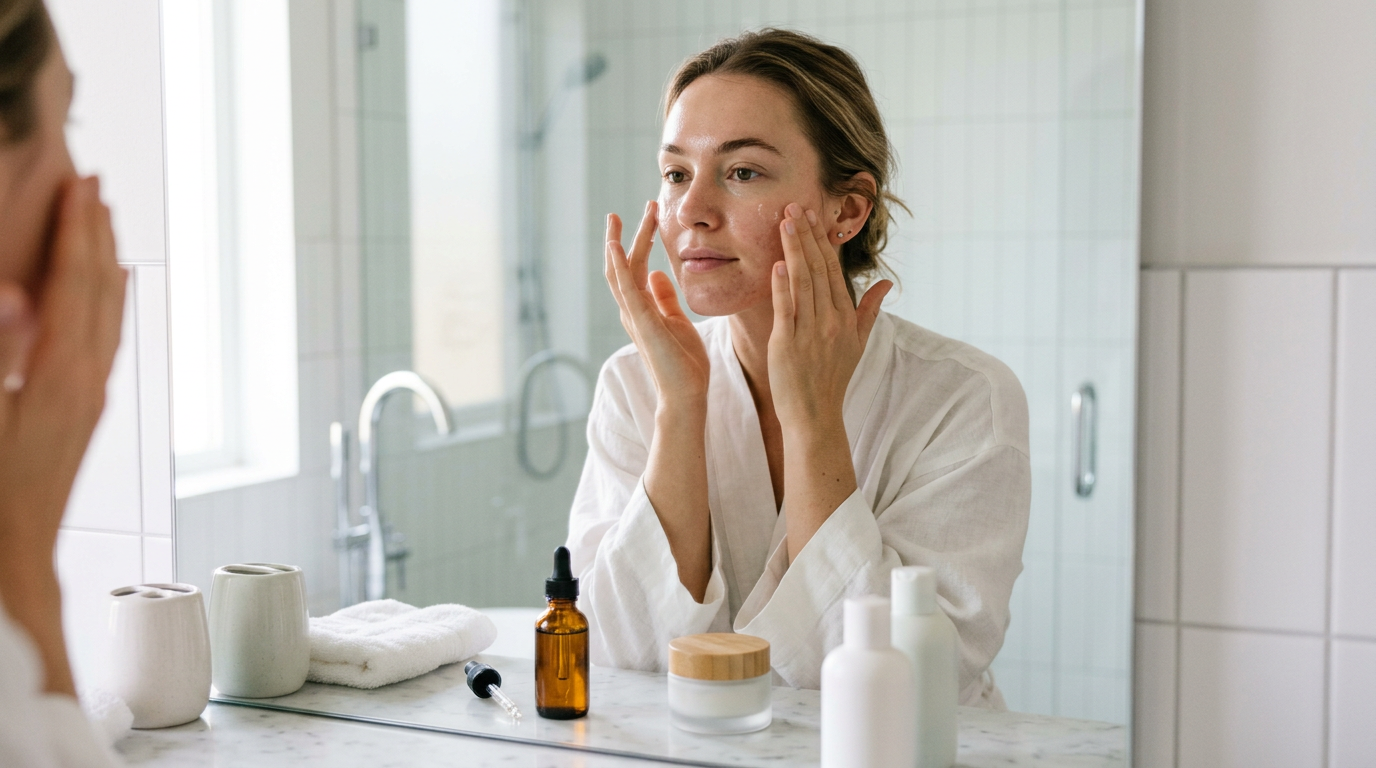
If you also wear makeup, your morning skincare and makeup routine can continue naturally from here: skincare first, sunscreen, then primer and makeup.
Scientifically Backed Ingredients for Morning Skin
Not every skincare ingredient needs to be used in the morning, and not every popular ingredient has the same level of evidence behind it. Here are several ingredients that can make sense in a morning routine, depending on your skin and the formulation.
Hyaluronic Acid
Hyaluronic acid is a humectant that binds water and can help increase skin hydration. Its performance depends on the molecular form, concentration, formulation, and surrounding environment.
You may have seen the claim that hyaluronic acid can hold up to 1,000 times its weight in water. This describes a commonly cited property of the molecule, but it does not mean that every hyaluronic acid serum will produce the same result on skin.
For morning use, applying a hydrating product to slightly damp skin and following with a moisturiser can be a practical approach, particularly if your skin tends to feel dry.
Niacinamide
Niacinamide, also known as vitamin B3, is one of the better-studied cosmetic ingredients used in modern skincare.
Depending on the concentration and formulation, it can support the skin barrier, help regulate sebum production, improve the appearance of uneven skin tone, and reduce the appearance of pores. It is also generally well tolerated by many skin types, although individual reactions are always possible.
Vitamin C
Vitamin C is an antioxidant that can help protect against oxidative stress and may support a more even-looking skin tone. Topical vitamin C formulations have also been studied for their potential role in supporting collagen synthesis and reducing the appearance of hyperpigmentation.
Its effectiveness depends heavily on the specific form, concentration, stability, packaging, and overall formulation. L-ascorbic acid is one of the most studied forms, but it is not automatically the best choice for every person or every formulation.
Peptides
Peptides are a broad group of cosmetic ingredients with different structures and proposed mechanisms of action. Some peptides are designed to interact with skin signalling pathways associated with firmness, texture, or other aspects of skin appearance.
Evidence varies considerably between individual peptides and formulations, so it is more accurate to evaluate a specific peptide product than to assume that all peptides work in the same way.
Important: If you have a diagnosed skin condition, are pregnant, breastfeeding, or are using prescription skincare, speak with an appropriate healthcare professional before introducing new active treatments.
Expert Tip — And a Myth Worth Debunking
💡 Expert Tip
If you use a hyaluronic acid serum in the morning, applying it to slightly damp skin can be a practical way to support hydration. Follow it with a moisturiser when appropriate, particularly in dry or low-humidity environments, because humectants alone do not necessarily prevent water loss from the skin.
🚫 Common Myth: “You Don’t Need SPF on Cloudy Days”
Cloud cover does not eliminate ultraviolet exposure. Depending on weather conditions, location, season, and cloud thickness, significant UV radiation can still reach the skin.
Cumulative UV exposure is a major contributor to photoaging, including wrinkles, uneven pigmentation, and loss of skin elasticity. UV exposure is also an important risk factor for skin cancer, although photoaging and skin cancer are distinct outcomes with different biological mechanisms.
For that reason, regular broad-spectrum sun protection is one of the most evidence-supported habits for protecting skin over the long term.
The Best Skincare Morning Routine for Different Skin Types
The best skincare morning routine is not identical for everyone. The right approach depends on your skin type, sensitivity, climate, lifestyle, and the products you are already using.
For Oily or Acne-Prone Skin
- Gentle foaming or gel cleanser
- Niacinamide serum, if well tolerated
- Lightweight moisturiser
- Broad-spectrum SPF
For Dry or Dehydrated Skin
- Cream or milk cleanser — avoid overly stripping formulas
- Hyaluronic acid or another hydrating serum on slightly damp skin
- Rich, barrier-supporting moisturiser with ingredients such as ceramides
- Broad-spectrum SPF with a hydrating base
If you are looking for a serum specifically built around barrier support, Quiet Dose Barrier Repair Serum is one example worth considering. Its formulation combines five ceramides with cholesterol, panthenol, ectoin, and squalane, making it relevant to routines focused on hydration and supporting the skin barrier, particularly for dry or sensitive skin.
For Sensitive or Reactive Skin
- Micellar water or a very gentle cream cleanser
- Fragrance-free, minimal-ingredient products where possible
- A simple hydrating or soothing serum if well tolerated
- Broad-spectrum SPF — mineral or organic filters can both be suitable depending on the formulation and individual tolerance
For Combination Skin
- Balanced gel-cream cleanser
- Niacinamide serum if appropriate
- Lightweight moisturiser, applied more generously to drier areas
- Broad-spectrum SPF with a texture you can comfortably use every day
A Basic Skincare Morning Routine — For When You Have 5 Minutes
Life is not always slow mornings and elaborate routines. A basic skincare morning routine that you can follow consistently will generally be more useful than a complicated routine you rarely complete.
On a rushed morning, keep it simple:
- Rinse with water or use a gentle cleanser, depending on your skin’s needs.
- Apply a moisturiser if needed.
- Apply broad-spectrum sunscreen generously and evenly.
That is enough for a functional morning routine. Serums and additional treatments can be added when you have the time and when they genuinely address a skin concern.
If you use a moisturiser that contains SPF, remember that the level of protection depends on the product, the amount applied, and whether it provides broad-spectrum protection. A dedicated sunscreen may be easier to apply in an amount sufficient for reliable protection.
Small Habits That Make a Difference
Skincare products are only part of the picture. A few simple habits can also influence how your skin looks and feels.
- Stay hydrated throughout the day. Adequate fluid intake supports normal body function and overall skin health, although drinking a glass of water immediately after waking is unlikely to produce a dramatic visible skincare effect.
- Use cool or lukewarm water to cleanse. Very hot water can be drying and may increase temporary redness or discomfort, particularly in sensitive skin.
- Use gentle facial massage if you enjoy it. Light massage may temporarily improve the appearance of puffiness for some people, although the effect is usually modest and short-lived.
- Keep a facial mist nearby if you enjoy using one. A mist can feel refreshing and temporarily add surface moisture, but it should not be considered a replacement for a moisturiser or other barrier-supporting product.
- Prioritise consistency over perfection. The best skincare morning routine is one you can realistically maintain.
Frequently Asked Questions
Should I do skincare morning and night?
For most people, having both can be useful, but the emphasis is different. Morning routines tend to focus on hydration, protection, antioxidants, and SPF. Night routines often focus on moisturisation, recovery, and treatment ingredients that may be more practical to use after dark.
What is the correct order of skincare morning products?
A useful general guide is cleanser → toner or mist → serum → moisturiser → SPF. However, the ideal order can vary depending on the specific formulations you use. If a product comes with specific application instructions, follow those first.
Why does my skin look worse in the morning even when I follow a routine?
Several factors can contribute — overnight water loss, fluid redistribution from your sleeping position, room humidity, sleep quality, or products that are not well suited to your skin.
Try keeping your evening routine simple, using a moisturiser that supports your skin barrier, and paying attention to your sleeping environment. If morning puffiness or irritation is persistent or unusually pronounced, it may be worth discussing it with a healthcare professional.
Can I use retinol in my morning routine?
Retinoids are generally used at night. Some retinoids are sensitive to light, and retinoid use can also cause irritation or increased skin sensitivity in some people. Using them at night makes the routine easier to manage and avoids unnecessary daytime exposure. Daily sunscreen remains particularly important when using retinoids.
A Simple Morning Routine That Actually Works
You do not need a complicated shelf full of products to take good care of your skin in the morning.
For most beginners, the foundation is simple: cleanse gently if needed, moisturise when appropriate, and protect your skin from UV exposure. Everything else should have a reason for being there.
Once you understand what your skin actually needs, you can add targeted ingredients one at a time — rather than chasing every new skincare trend.
The goal is not the most complicated skincare morning routine. It is a routine that makes sense for your skin and that you can realistically maintain.
This article is for informational purposes only and does not constitute medical advice. If you have a persistent skin concern, diagnosed skin condition, or are unsure which products are appropriate for you, consult a qualified healthcare professional or dermatologist.
Pingback: Niacinamide or Vitamin C? How to Choose the Right Active - Denyva