


She matched her foundation in the store — natural light, three swatches, a deliberate choice. She applied it flawlessly at home, blended it past her jawline, and stepped out feeling certain about her complexion. By 11am, her face was a distinctly warmer, more orange tone than her neck. Not dramatically so. Just enough to be undeniable. She bought a shade lighter the following week. Same shift. She changed brands entirely. Same result. The shade was never the issue. The issue was makeup oxidation — a real, chemically defined reaction between the formula she was wearing and the specific surface chemistry of her skin: its sebum output, its pH, its temperature, and the particular pigment system in every foundation she tried.
Makeup oxidation is not a shade-matching failure. It is not an application technique problem. It is a physicochemical process — the formula responding to its new environment on the skin surface rather than the controlled, stable environment of the bottle. The colour shift involves multiple mechanisms: physical disruption of the pigment-binder system, possible pH-mediated changes in pigment particle interactions, and film destabilisation by sebum — not a single, uniform chemical reaction. Understanding that distinction changes how foundation is selected. Not just how it is applied.
What Is Makeup Oxidation — And Is It Actually Chemistry?
Oxidation, in its simplest form, is what happens when a substance chemically reacts with oxygen — or, more broadly, with the reactive molecules it encounters in a new environment. The most familiar example: iron rusting. Expose iron to air and moisture, and its surface color shifts — it darkens, it reddens, it becomes something visually different from what it was. This is iron oxidizing. It is not metaphor. It involves electrochemical reactions at the metal surface — the loss of electrons from iron in the presence of water and oxygen.
The connection to foundation is more direct than most people realise. Most liquid foundations achieve their skin-tone color through iron oxide pigments — inorganic mineral compounds. Yellow iron oxide, red iron oxide, and black iron oxide are blended in carefully calculated ratios to produce every shade from porcelain to deep espresso. These pigments are chemically stable inside the bottle. But when they contact the skin surface — with its lipids, acids, and warmth — they can undergo physicochemical shifts — including changes in how pigment particles interact with surrounding formula components under different pH conditions — that alter how they appear to the eye. The SCC study on factors affecting foundation color change identifies precisely these interactions as the primary mechanism behind the darkening and warming of liquid foundations on skin.
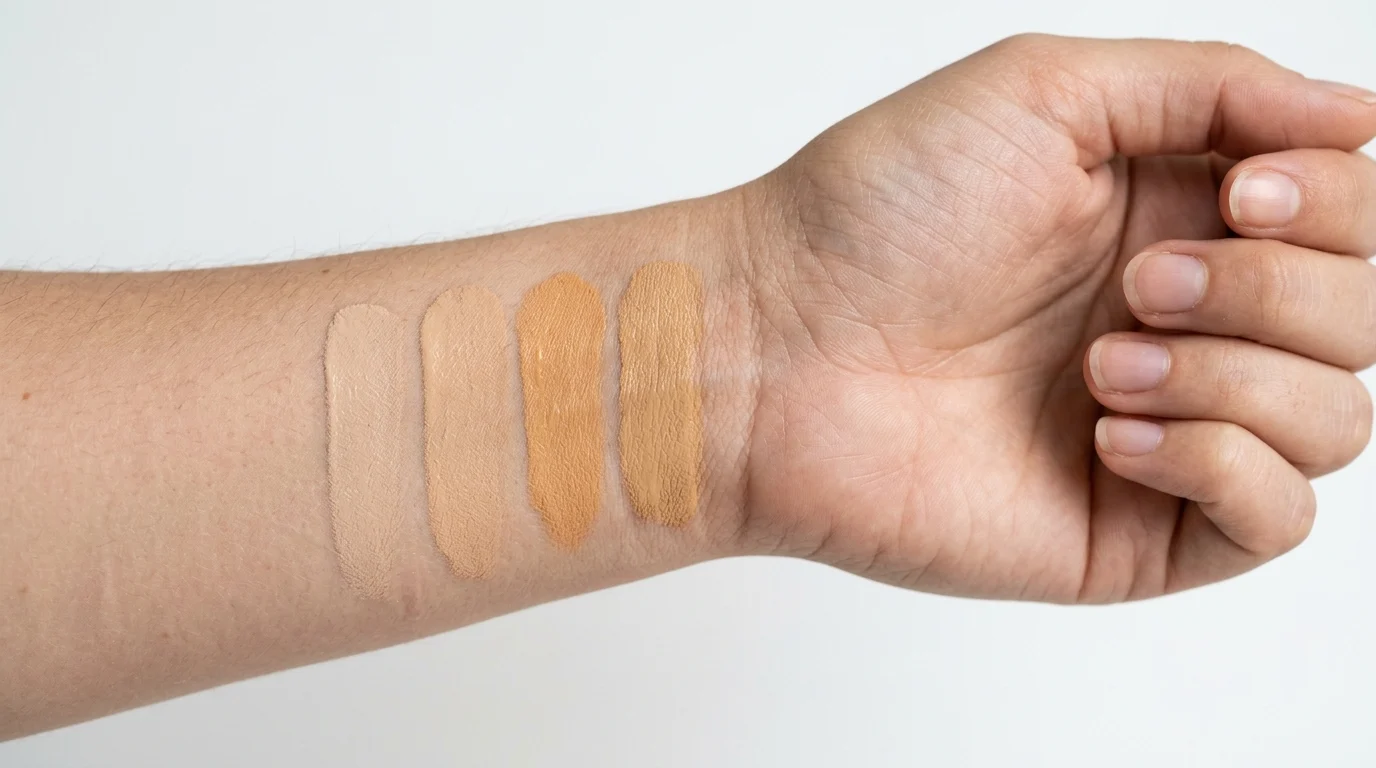
Think of it this way: iron oxide pigments share the same chemical family as the rust on a metal gate. They are already, in a technical sense, oxidized forms of iron. But they can undergo further physicochemical shifts — changes in how pigment particles interact with the surrounding formula matrix — that alter how they appear to the eye. This is not degradation in the dramatic sense. It is a color shift. And for anyone who experiences it, the result is unmistakable. Cosmetic Dermatology: Products and Procedures (Draelos) remains a foundational authority on cosmetic pigment chemistry and confirms that iron oxide-based pigments are inherently reactive to the chemistry of the skin surface environment.
The Sebum Factor: Why Oily Skin Oxidizes Foundation Faster
Of all the variables that drive foundation oxidation causes, sebum is consistently the most significant. Sebum is the skin’s natural oil, produced continuously by sebaceous glands beneath the surface. It is not an impurity. It is a functional biological secretion that lubricates and protects the skin. But when it reaches the skin’s surface and contacts a foundation film, it becomes the primary driver of film destabilisation and pigment-distribution disruption.
Here is the mechanism in plain terms. Foundation is a system: pigment particles suspended in a binder — a network of polymers, emollients, and film-formers that keeps pigment evenly distributed and color-stable. When sebum — a lipid-rich substance — contacts that system, it begins to penetrate and disrupt the binder network. The pigment particles, no longer evenly suspended, shift in concentration and in their interaction with light. Visually, the formula reads darker and warmer. Imagine dropping cooking oil onto a watercolor painting. The oil does not remove the pigment — it changes how it reads. It darkens it, shifts its tone, alters its optical behavior. Sebum does exactly this to the pigment-binder system of a liquid foundation.
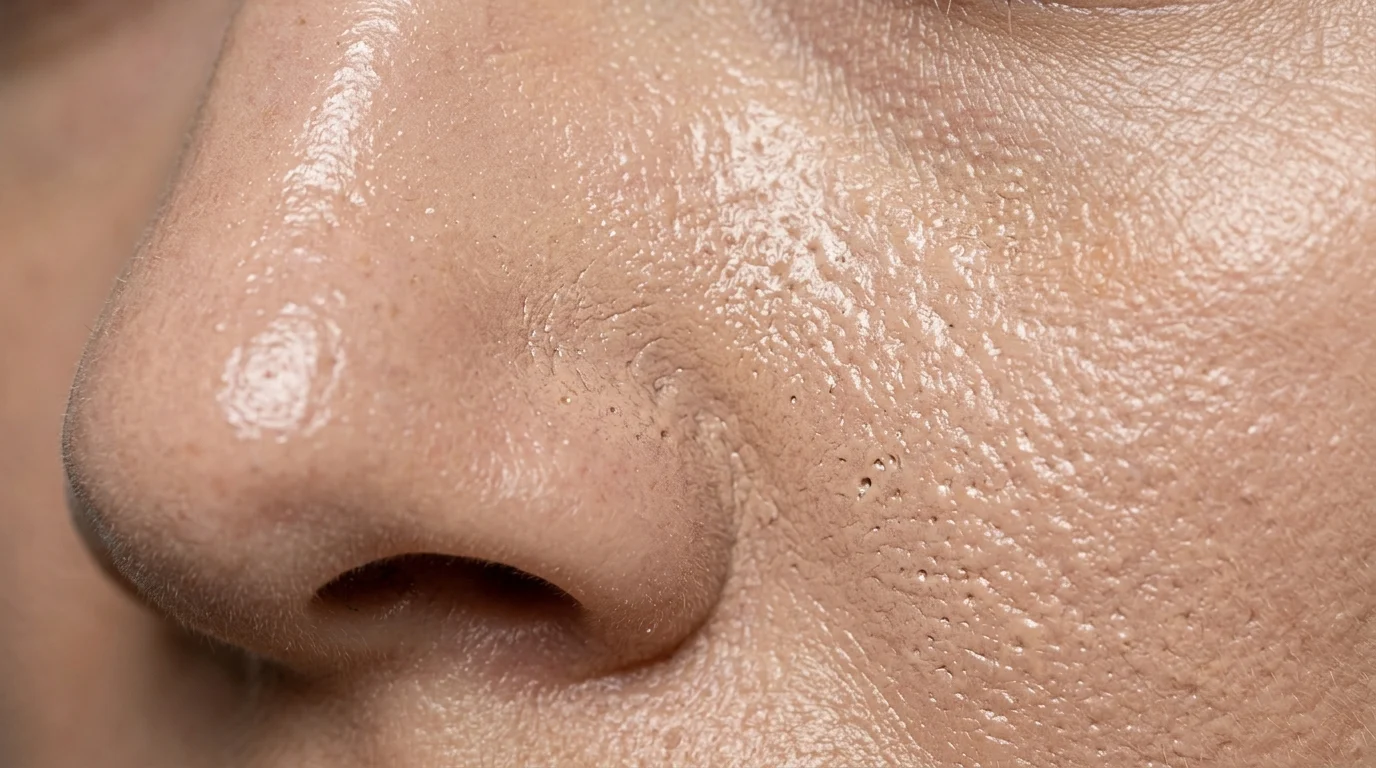
Research on sebum interaction with cosmetic formulations confirms that lipid penetration into the foundation film is a key driver of pigment instability during wear. Higher sebum output creates a more reactive surface — meaning faster, more pronounced color shift. This is why oily skin and makeup oxidation are so consistently linked.
The skin factors that increase oxidation risk include:
- High sebum output or oily skin type — more lipid on the surface means a more reactive interface with the foundation film
- Warm skin temperature — heat accelerates the rate of chemical reactions, including sebum-pigment interaction (more on this below)
- Skin that has not been prepped with a barrier-creating primer — without a semi-occlusive layer between skin and formula, sebum contacts the pigment system more directly; understanding how skin barrier condition affects makeup wear and oxidation rate is a practical starting point for anyone adjusting their routine
- Post-workout or mid-afternoon sebum surge — sebum production is not constant; it peaks in response to heat, physical exertion, and stress, which is why foundation color change during day often worsens after noon
Skin pH and Foundation Color: The Chemistry Nobody Explains
The skin’s surface has a natural pH of approximately 4.5 to 5.5 — mildly acidic. This acidity is not incidental. It is maintained deliberately by the skin’s acid mantle, a thin surface layer composed of sebum, sweat, shed corneocytes, and water-soluble compounds including amino acids and lactate, that acts as a protective barrier against bacteria and environmental stressors. Foundation formulas, by contrast, are typically pH-adjusted to approximately 6 to 7 for stability and shelf-life inside the bottle.
The moment foundation contacts skin, pH equilibration begins. The formula’s pH shifts toward the skin’s more acidic environment. And here is where skin pH and foundation oxidation intersect with pigment chemistry: iron oxide pigments are generally considered pH-stable in the ranges encountered on skin. However, the pH differential between a foundation’s formulation and the skin surface may affect the stability of the binder and emulsion system surrounding the pigment particles — altering how pigments are dispersed and, consequently, how they read visually. Evidence for direct pigment colour change from skin-range pH shifts is limited; the more likely mechanism is pH-mediated disruption of the formula matrix rather than a change in the iron oxide pigment itself. Think of how litmus paper turns red in an acidic solution and blue in an alkaline one — it is the same paper, but the chemistry of the surrounding environment causes the dye to present differently. While iron oxides do not behave as directly as pH indicator dyes, the principle of environment-driven optical change in a colour system is a useful conceptual entry point.
Research on cosmetic formulation chemistry and skin surface interaction supports the relationship between skin surface pH and the stability of pigment systems in cosmetic formulas — particularly those with higher iron oxide concentrations. Foundations with heavier pigment loads are, in general, considered more susceptible to this pH-driven colour shift.
Temperature, Time, and Why Oxidation Gets Worse Through the Day
Chemical reactions happen faster at higher temperatures. This is not a cosmetic-industry observation — it is a foundational principle of thermodynamics. Skin generates heat. Facial skin surface temperature typically ranges between 30–34°C under normal resting conditions — lower than core body temperature due to heat dissipation. During physical activity or warm environmental exposure, skin surface temperature can rise further, meaningfully accelerating reaction rates at the formula-skin interface.
As the foundation film warms on the skin surface, the rate of both sebum penetration and formula-matrix disruption is thought to increase. A process that may be relatively slow in a cool, air-conditioned environment is likely to accelerate significantly during physical exertion or in warm outdoor conditions — though the precise rate varies with individual skin chemistry and formula composition. This also explains something that confuses many people about foundation turns dark after application: the color shift is not visible at the moment of application because the physicochemical process requires both contact time and warmth to develop fully. The foundation looks correct. Then, gradually, it does not.
The International Journal of Cosmetic Science on formulation stability and wear is a primary peer-reviewed resource for cosmetic chemistry research on how temperature and environmental conditions interact with foundation wear over time. Research in this area broadly supports heat as an accelerant of pigment instability and binder disruption during wear.
Formula Architecture: Which Foundation Types Oxidize More
Not all foundations oxidize equally. The formulation itself — its pigment load, its base chemistry, its film-forming system — determines how reactive it will be on the skin surface. The science behind makeup oxidation and formulation factors outlines how these architectural differences translate into real-world color shift differences.
The relationship between formula type and oxidation tendency, in order of general susceptibility:
- High-coverage liquid foundations — higher iron oxide pigment load means more reactive pigment available to shift; these are typically the most oxidation-prone formulas
- Water-based formulas — more permeable to sebum interaction than silicone-based alternatives; the aqueous base offers less resistance to lipid penetration
- Silicone-based foundations — create a more stable, less permeable film that may reduce the rate of sebum penetration and slow pigment-lipid interaction compared to water-based alternatives; they do not eliminate sebum breakthrough, particularly under high-sebum conditions or extended wear; generally more resistant to makeup color shift causes
- Tinted moisturisers and skin tints — lower iron oxide pigment concentration means less reactive pigment available; color shift, when it occurs, is less severe; see foundation vs tinted moisturiser and how formula weight affects oxidation risk for a direct comparison
- Powder-over-liquid systems — surface powder absorbs sebum before it can fully penetrate the liquid foundation film, effectively slowing the oxidation rate
Foundation formula chemistry is rarely discussed in shade-matching conversations, but it is arguably the more important variable for oxidation-prone skin. The formula architecture determines the baseline reactivity of the product before it even contacts the skin.
Skincare Actives That Influence Foundation Oxidation
The skincare routine applied before foundation is not a neutral preparatory step. Certain actives alter the skin’s surface chemistry — its pH, its lipid composition, its barrier integrity — in ways that directly affect how foundation behaves. Understanding how common skincare actives interact with foundation chemistry at the skin surface matters particularly for anyone using a sophisticated actives routine.
Three actives are worth addressing specifically:
- Vitamin C (ascorbic acid) — despite being a well-established antioxidant, ascorbic acid may behave as a pro-oxidant in certain conditions, particularly in the presence of free transition metal ions such as ferrous iron (Fe²⁺). However, the iron in iron oxide pigments is in a stable, insoluble oxidised form (Fe³⁺ within a mineral lattice) rather than the free ionic form that participates in Fenton-type pro-oxidant reactions. Any interaction between residual ascorbic acid and iron oxide pigments on the skin surface is therefore likely to be limited. The primary concern with vitamin C before foundation is pH destabilisation of the formula matrix rather than direct iron-mediated pro-oxidant activity. This does not mean avoiding vitamin C — it means ensuring it is fully absorbed and dry before foundation is applied.
- Exfoliating acids (AHAs and BHAs) — glycolic acid, lactic acid, and salicylic acid, when freshly applied, can transiently lower the skin’s surface pH below its natural resting state. However, the skin’s buffering capacity means this effect is temporary — pH typically begins returning toward baseline within minutes of application. The concern is most relevant in the immediate period between serum application and foundation, rather than as a persistent skin-state change. On active exfoliation days, allowing more absorption time before foundation application is a reasonable precaution.
- Niacinamide — evidence suggests that niacinamide may help moderate sebum production over consistent use, and a meaningful reduction in sebum output would logically reduce the primary driver of film destabilisation at the skin surface. Of all common skincare actives, it is among the most likely to support foundation colour stability over time — though individual response varies.
None of these actives need to be abandoned. The variable is sequencing and absorption time — not the actives themselves.
How to Prevent Foundation Oxidation: What Actually Works
Prevention is not about finding the one foundation that will not oxidize. It is about managing the conditions — on the skin surface and in the formula choice — that make oxidation more or less likely. Understanding how aging skin changes the surface environment that drives foundation oxidation also helps, as sebum patterns and pH regulation shift with age.
Evidence-grounded strategies for minimising foundation oxidation:
- Consider choosing half a shade lighter than the perfectly matched shade — for those who experience noticeable oxidation, the colour shift often reads as a darkening and warming of the formula over several hours of wear; starting slightly lighter can compensate for this, though the degree of shift varies by individual skin chemistry and formula
- Apply a silicone-based primer before foundation — this creates a semi-occlusive layer that reduces direct contact between the skin’s sebum and the foundation’s pigment-binder system, slowing the reactive interface; this is arguably the single most effective tactical intervention for how to prevent foundation oxidation
- Allow skincare to fully absorb before foundation application — residual actives (especially vitamin C or AHAs) on the skin surface may increase formula reactivity; allow sufficient time for each product to absorb fully before applying foundation, as serums and treatments vary in how quickly they settle into the skin
- Choose silicone-based or long-wear formulas if sebum output is high — these resist lipid penetration better than water-based alternatives and are the practical definition of best foundation for oxidation prone skin
- Set with a translucent powder immediately after application — absorbs surface sebum before film disruption begins; early sebum management is generally considered more effective than mid-day correction, since blotting and re-powdering later cannot fully reverse pigment redistribution that has already occurred
- Carry blotting papers rather than a powder compact for touch-ups — blotting physically removes sebum from the skin surface without adding additional product that can compound pigment density and accelerate colour shift
- Store foundation away from heat — elevated storage temperature (a warm bathroom, a car glove compartment, a sunny windowsill) pre-ages the formula and increases its oxidation tendency before it contacts skin
Myth — Oxidation Is a Shade-Matching Error The most persistent misconception about foundation oxidation is that it indicates the wrong shade was chosen. It does not. Oxidation occurs even in perfectly matched shades — because it is a physicochemical process driven by the skin’s surface environment, not a visual mismatch at the moment of application. Two people can apply the same foundation in the same shade: one oxidises significantly, one barely at all. The difference is their individual skin chemistry — sebum output, pH, and temperature. The correct response to oxidation is formula selection and skin surface preparation. Shade adjustment alone addresses the symptom, not the cause.
If your skin produces unusually high sebum output, experiences persistent sensitivity to makeup products, or shows signs of barrier disruption, consulting a dermatologist before changing your foundation routine may help identify whether skin condition rather than product chemistry is the primary variable.
Frequently Asked Questions
Why does my foundation look fine when I apply it but turns orange by noon?
Because makeup oxidation is a time- and temperature-dependent process. At application, the foundation film has not yet been warmed by skin temperature or penetrated by sebum. Both of those conditions develop over hours of wear. By mid-morning, the combination of skin warmth and sebum interaction has disrupted the pigment-binder system enough to produce a visible color shift. The formula was reactive from the start — it simply took time and heat for that reactivity to become visible.
Does oily skin always cause foundation oxidation?
Oily skin significantly increases oxidation risk, but it is not the only variable. Skin pH, formula architecture, pigment load, and skincare actives all contribute. Someone with dry skin but a very acidic skin surface and a high-coverage, water-based foundation can experience colour shift too — though typically less pronounced. Oily skin amplifies oxidation because sebum is the primary driver of film destabilisation, not the only one.
What is the single most effective way to prevent makeup oxidation?
A silicone-based primer applied before foundation. It creates a semi-occlusive layer between sebum and the foundation’s pigment system, reducing the primary reactive interface. Combined with a translucent powder set immediately after application, a silicone primer addresses both the formulation contact point and the surface sebum before oxidation can begin. For those with very high sebum output, switching to a silicone-based foundation formula compounds this effect significantly.