

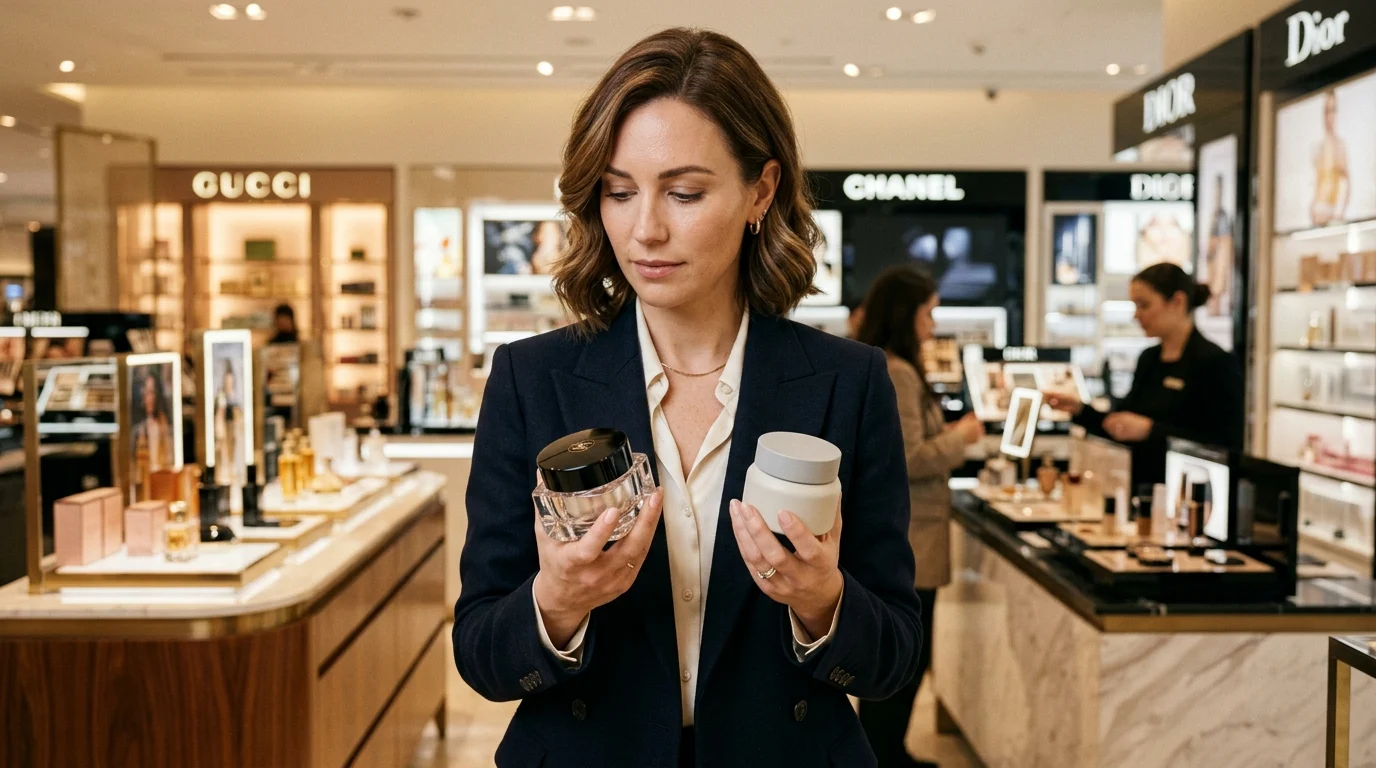
Picture this: a woman standing at a department store counter, holding two moisturisers side by side. The first is £180, from a heritage luxury house — weighty glass, a lacquered box, a counter attendant in a lab coat, and decades of brand history behind it. The second costs £95. She found it through a skincare forum. The packaging is minimal. There is no retail presence, no magazine campaign. Both claim barrier-repair benefits and measurable hydration outcomes. She has no clear framework for deciding which one is more likely to actually deliver the results she’s paying for.
This is the central tension of niche skincare vs luxury skincare — and it is not resolved by looking at price, ingredient lists, or packaging alone. The real question is structural: where does each model invest its resources, who is it actually formulating for, and what kind of trust relationship does it build with the person buying it? Understanding that requires looking at brand architecture, not just bottles.
This is not a case against luxury skincare, nor a promotion of niche brands as automatically superior. The difference between luxury and niche skincare is not a question of one category being right and the other wrong — both contain excellent products and significant marketing noise. What follows is an attempt to give you a genuinely useful framework for evaluating both — analytically, without allegiance.
Defining the Categories: What Niche and Luxury Skincare Actually Mean
What Makes a Brand “Luxury” in Skincare?
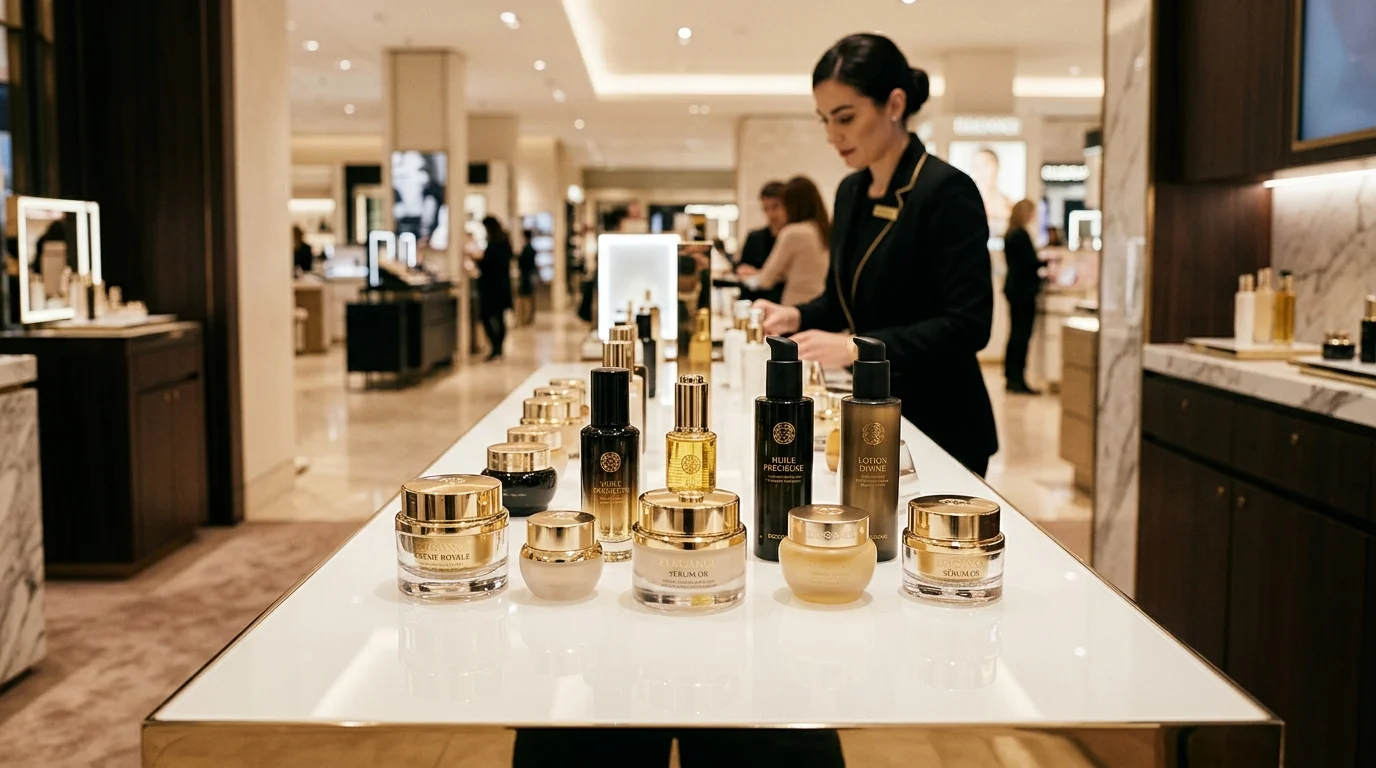
Luxury, in skincare, is primarily a positioning category rather than a formulation one. Brands like La Mer, Dior Beauty, Chanel, and SK-II compete on heritage narrative, aspirational identity, retail theatre, and packaging that signals premium ownership before the formula is ever applied. Their formulations are frequently well-engineered and clinically tested — but the retail price reflects far more than ingredient investment.
Consider the economics of department store distribution: a brand selling through a major retailer typically surrenders 40–60% of the retail price in channel margin before a single ingredient is costed. Add global advertising spend, celebrity campaigns, and the cost of maintaining physical counters with trained staff worldwide, and the formula itself — the actual product in the jar — often represents a relatively modest fraction of what the consumer pays.
This does not make luxury skincare brands dishonest. It makes them structurally optimised for something specific: brand equity. Research on brand equity and consumer purchasing behavior in the beauty industry consistently shows that purchasing decisions in beauty are shaped as much by perceived quality, social signalling, and accumulated brand trust as by functional product performance. Luxury skincare brands are architecturally built to generate and sustain exactly those perceptions.
What Makes a Brand “Niche”?
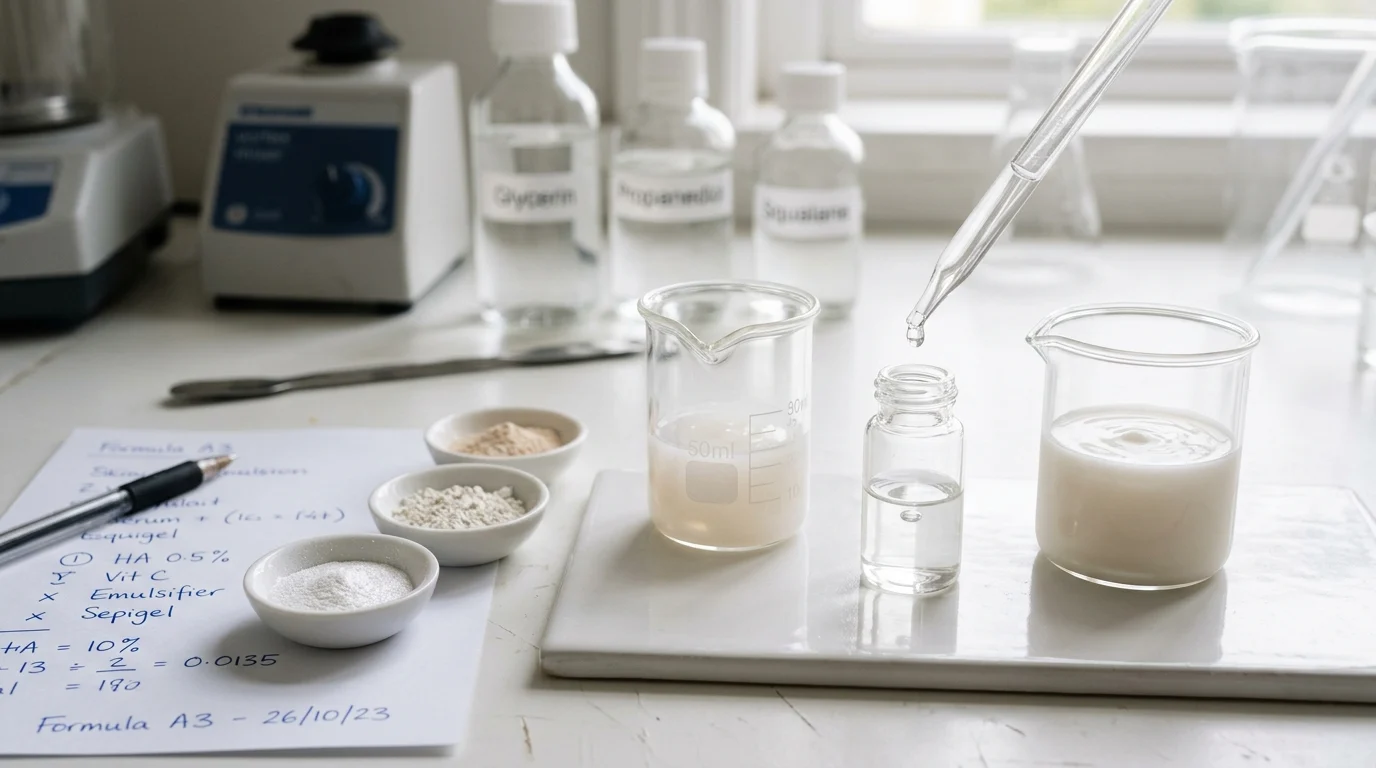
Niche skincare brands — typically founder-led, smaller in scale, and predominantly direct-to-consumer — compete on different signals. Formulation specificity. Ingredient transparency. A science-led or philosophy-led rationale for why the product exists at all. Their cost structure is different: without department store margin or mass advertising budgets, a greater proportion of what the consumer pays can, in principle, be allocated to what is actually in the formula.
Critically, “niche” is not a synonym for cheap or amateur. Many of the best niche skincare brands are priced at or above luxury tier — which is precisely why the question of whether niche skincare brands are better cannot be answered by price alone. The defining characteristic is intent: a niche brand is building for a specific skin concern, formulation philosophy, or consumer profile — not for the broadest possible aspirational appeal. That narrowness of focus, when it is genuine, tends to produce more purposefully formulated products.
That said, “niche” has also become a marketing aesthetic in its own right. Minimal packaging, scientific-sounding copy, and founder storytelling can all function as brand equity signals in exactly the same way that heritage and elegance do for luxury houses. Scepticism is warranted across both categories.
Niche Skincare vs Luxury Skincare: Where the Real Differences Live
Formulation Philosophy
The most meaningful operational difference between these two categories lies in what each model is optimising for at the formula stage. Luxury brands tend to formulate for broad, immediate appeal: textures that feel pleasurable on first application, light fragrances that communicate premium quality, finishes that work across skin tones and types in a department store demo environment. These are not trivial considerations — sensory performance is a legitimate aspect of skincare value — but they reflect a product designed to convert at point of sale as much as to deliver long-term skin outcomes.
Niche brands, when operating from a genuine formulation-first philosophy, tend to build products around a specific outcome: barrier repair, microbiome balance, controlled active delivery, compatibility with post-procedure skin. The sensory experience may be secondary. The packaging may be designed entirely around ingredient stability rather than visual impact.
Luxury skincare formulation signals:
- Elegant, often fragranced textures designed for immediate sensory appeal
- Proprietary complexes with trademarked names — frequently one key active in a largely conventional base
- Broad skin type claims intended to maximise addressable market
- Significant investment in packaging and unboxing experience as part of perceived product value
Niche skincare formulation signals:
- Published ingredient concentrations or formulation rationale available to the consumer
- Fragrance-free or minimal-fragrance positioning, particularly for actives-focused products
- Specific skin concern targeting rather than universal skin type claims
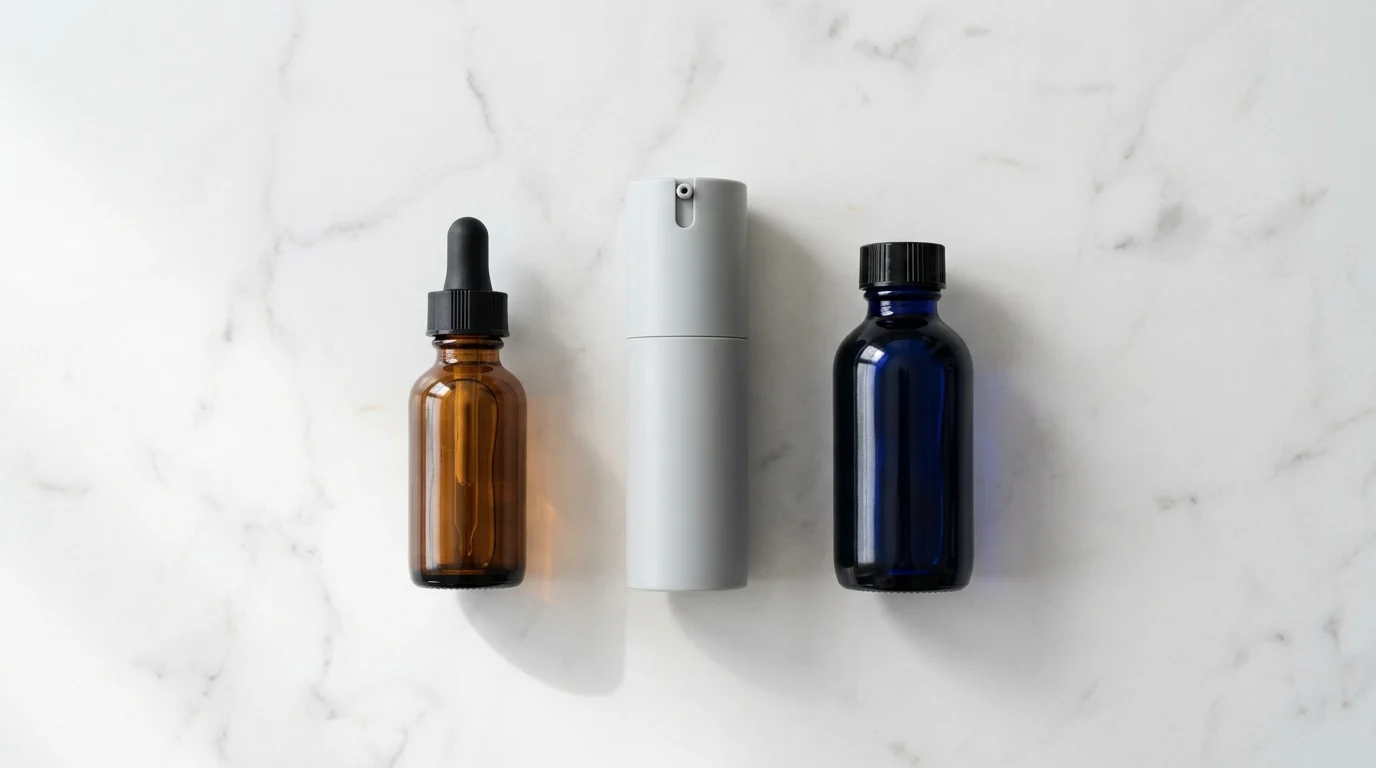
- Packaging decisions driven by active stability — airless pumps, opaque vessels, amber or dark glass
- Direct-to-consumer model that permits shorter shelf life and higher active load
Ingredient Transparency
Ingredient transparency is one of the clearest and most practically useful differentiators between the two models. Many luxury brands list a proprietary “complex” — Miracle Broth, Pitera, Cellular Swiss Ice Crystal — without specifying what the complex contains in isolation, at what concentration, or with what supporting evidence for efficacy at that dose. The trademark is doing significant communicative work, and consumers broadly accept this as part of the luxury brand contract.
Niche brands building their credibility on scientific rigour tend to operate differently. Publishing exact percentages, sourcing origin, formulation reasoning, or clinical study references is a fundamentally different trust claim — one based on formula substance rather than brand heritage. It invites scrutiny rather than deflecting it. For the ingredient-literate consumer, that distinction is significant.
Clinical Testing and Safety
Here is where the niche category does not automatically win. Large luxury brands have substantially more clinical testing infrastructure: longer-running consumer panels, more extensive patch test databases, established dermatologist relationships, and decades of large-scale post-market safety data. For consumers with reactive skin, compromised barrier function, diagnosed skin conditions, or post-procedure recovery needs, that breadth of safety evidence is genuinely relevant — not just a marketing credential.
Smaller niche brands may conduct rigorous testing within their means, but their safety data set is inherently narrower at launch. This is worth factoring into the evaluation, particularly before introducing a new active into a sensitised skin routine.
Brand Equity and Why Consumers Pay for More Than the Formula
Brand equity, in the simplest possible terms, is the additional value a consumer perceives in a brand beyond the functional value of the product itself. It is the gap between what a formula contains and what a consumer believes they are receiving. How brand positioning and perceived value shape luxury beauty purchasing decisions has been well documented: consumers reliably attribute higher quality, greater efficacy, and stronger safety to products from brands they trust — independent of objective formulation data.
Both niche and luxury brands benefit from brand equity. But they build it through structurally different signals. Luxury builds it through sensory aspiration: the weight of a bottle, the smell of a product, the prestige of a counter, the social signal of a recognisable name on a dressing table. Niche builds it through intellectual aspiration: a founder’s credible biochemistry background, published formulation rationale, a visible ethos around ingredient sourcing. One addresses how ownership feels; the other addresses how ownership is rationalised.
Neither trust architecture is more legitimate than the other. They speak to different consumer values. What matters is knowing which one you are responding to when you make a purchasing decision — and whether it maps onto what you actually need from a product.
Four Brands That Blur the Line Between Niche and Luxury
The most useful brands to study are not the ones that sit neatly at either end of the spectrum. They are the ones that complicate the binary — brands where price, formulation intent, and brand positioning do not all point in the same direction. The following four illustrate the range.
Aesop
Aesop is the clearest example of a brand that began as genuinely niche and evolved into something harder to categorise. It launched as a formulation-led, minimalist brand with a strong botanical ingredient philosophy and a deliberate rejection of conventional beauty marketing. That positioning was niche in the truest sense. Over time, Aesop has built one of the most recognisable retail experiences in global beauty — its stores are architectural events — and its brand equity now carries significant aspirational and aesthetic weight alongside the formulation story. When considering luxury vs niche skincare, Aesop sits squarely in the middle: a brand that retains its ingredient ethos while operating, experientially, at luxury tier. Aesop skincare reviewed for formulation philosophy and brand positioning.
Augustinus Bader
Augustinus Bader entered the market at luxury price points — its The Cream retails at over £200 — but brought a formulation foundation with genuine scientific credibility. The TFC8® peptide complex is derived from Professor Bader’s regenerative medicine research in wound healing; it is not a marketing confection. This brand occupies an unusual position: luxury-tier pricing, niche formulation philosophy, and a clinical science narrative that holds up to scrutiny. It demonstrates that price tier and formulation intent are not always opposites. Augustinus Bader reviewed for sensitive skin and clinical formulation depth.
Noble Panacea
Noble Panacea represents niche skincare in its most structurally pure form. Founded by Sir Fraser Stoddart, a Nobel Prize laureate in chemistry, the brand is built entirely around a proprietary time-release delivery system — OSMV™ — that controls the rate and depth at which actives are delivered into skin. There is no department store counter. No celebrity campaign. No retail margin. The entire brand equity is constructed from delivery science and academic credibility. For consumers who want their skincare investment to sit in the formula rather than the experience, this is a useful reference point. Noble Panacea reviewed for delivery technology and niche formulation science.
Vintner’s Daughter
Vintner’s Daughter is built around a single principle: botanical bioavailability. Founder April Gargiulo spent years developing each of the brand’s two products — a serum and an essence — using biofermentation to increase the skin-available fraction of plant actives. The two-product philosophy is a direct challenge to the multi-step routine complexity that drives high revenue in premium skincare. No advertising. No retail margin. All brand investment concentrated in formulation development and ingredient quality. Vintner’s Daughter reviewed for botanical formulation philosophy and ingredient bioavailability.
When Luxury Skincare Is the Better Choice
Intellectual honesty requires acknowledging that luxury skincare brands genuinely win in specific contexts. For anyone asking whether luxury skincare is worth the money, the answer depends heavily on which of the following factors applies to them — these are not edge cases:
- Clinical safety testing breadth matters — for reactive, post-procedure, or condition-managed skin, the depth of safety data behind major luxury brands has practical relevance that a newer niche brand cannot replicate
- Sensory experience is a legitimate priority — the ritual dimension of luxury skincare has documented wellbeing value for many consumers; dismissing the pleasure of a beautifully formulated, elegantly packaged product as mere marketing misses something real
- Formulation consistency at scale — luxury brands with global manufacturing infrastructure typically maintain tighter batch consistency than smaller producers, which matters for long-term routine stability
- Specific proprietary actives are genuinely validated — some luxury brand actives have meaningful research behind them; SK-II’s Pitera has a published body of evidence, and Crème de la Mer’s Miracle Broth has decades of consumer and clinical data, whatever one thinks of its price-to-formula ratio
- Global availability and after-sales support — for consumers who travel frequently or require consistent product access across markets, luxury brands offer logistical reliability that most niche brands cannot match
How to Evaluate Any Skincare Brand Across Both Categories
The following framework applies regardless of where a brand sits on the niche-to-luxury spectrum — whether you are comparing luxury skincare to niche skincare at the same price point, or simply trying to cut through brand positioning language on either side. It prioritises formula substance over marketing signals:
- Read the INCI list before the marketing copy — the ingredient declaration is the actual formula; the copy is the brand’s interpretation of it
- Look for published active concentrations — a brand that publishes its niacinamide percentage or retinol load is making a more accountable claim than one that names a proprietary complex without specification
- Assess packaging for stability investment — actives like retinoids, vitamin C, and AHAs degrade with light and air exposure; airless, opaque, or dark glass packaging signals formulation-first thinking
- Identify whether clinical claims reference specific studies — “clinically proven” without a study citation is not evidence; it is positioning language
- Evaluate fragrance level against your skin’s barrier condition — fragrance at meaningful concentrations is a known sensitiser; its presence in a formula designed for compromised skin is a formulation decision worth questioning
- Calculate cost-per-active-dose, not cost-per-jar — a lower-priced product with a higher concentration of a validated active may deliver more formula value than a more expensive product where the active is present at trace level
Myth: Luxury Brands Use Better Ingredients The assumption that luxury skincare automatically sources superior ingredients is not supported by how the cosmetics supply chain actually works. Both niche and luxury brands predominantly source from the same global ingredient suppliers — BASF, Evonik, Givaudan, Croda, and their equivalents. Ingredient quality is not a function of brand tier. What differs between a £30 moisturiser and a £200 one is not the quality of the hyaluronic acid — it is how the retail price is allocated between ingredient investment, packaging, distribution costs, retailer margin, and advertising spend. A higher price tag is a signal of brand positioning strategy, not a guarantee of a higher-value formula.
Always patch test skincare products regardless of brand tier or price point, and consult a dermatologist if you have a diagnosed skin condition before introducing new actives into your routine.
Frequently Asked Questions
Is niche skincare actually better than luxury skincare?
Not categorically. Niche brands often allocate more of their retail price toward formulation investment due to lower distribution costs — but “niche” is increasingly a brand aesthetic as much as a genuine philosophy. Evaluate by formula, not by positioning tier.
Why are some niche skincare brands priced as high as luxury brands?
Higher-grade raw materials, lower production volumes, airless or stability-optimised packaging, and the absence of a retail margin subsidy all increase unit cost for niche producers. A niche brand priced at £150 may be allocating far more of that to the formula than a luxury brand at the same price — or it may simply be pricing to signal premium positioning. The INCI list is the more reliable guide.
How do I know if a luxury skincare brand is worth its price?
Look beyond the proprietary complex name and ask: what is the validated active, at what concentration, and is there published evidence for efficacy at that dose? If the clinical data exists and the sensory experience is genuinely meaningful to your routine, luxury skincare can absolutely be worth its price. If the price is primarily funding the packaging and the counter experience, that is a choice — but it should be a conscious one.