

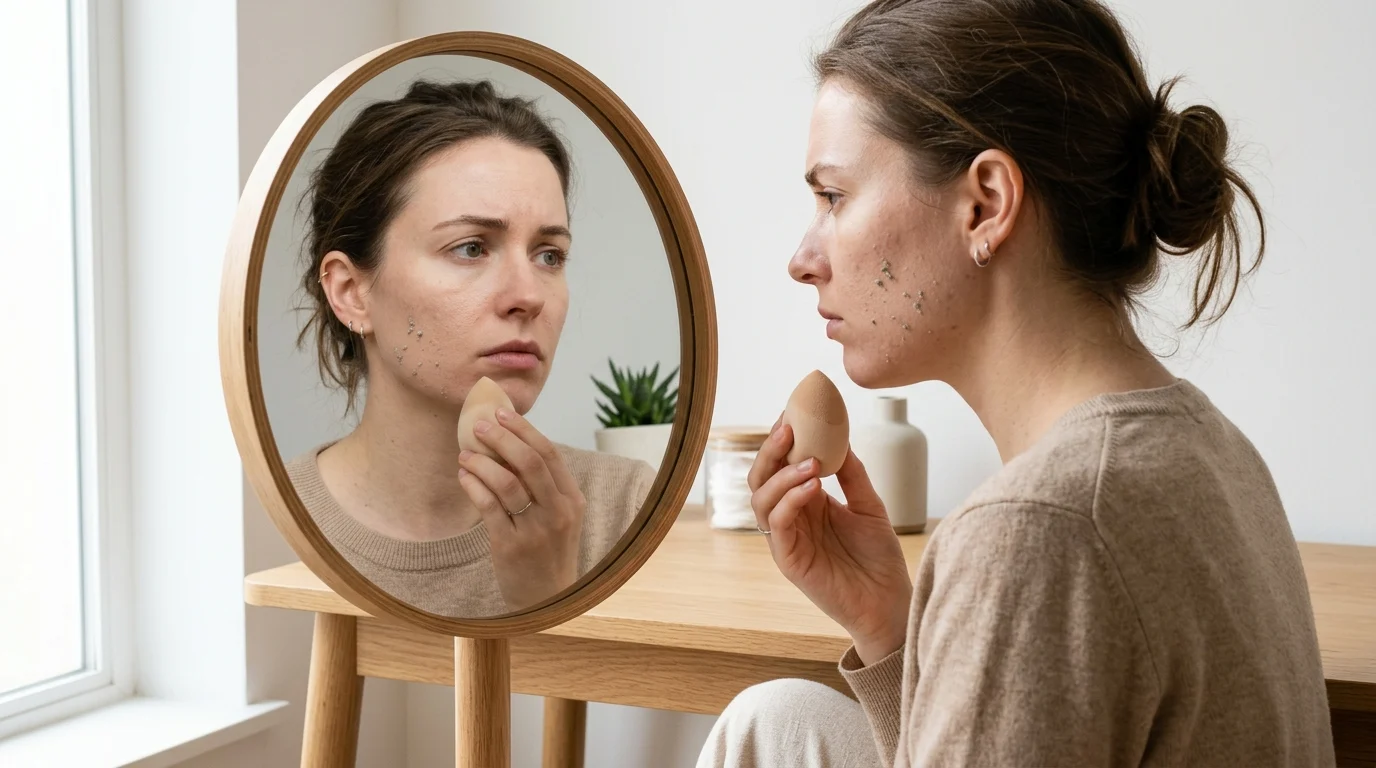
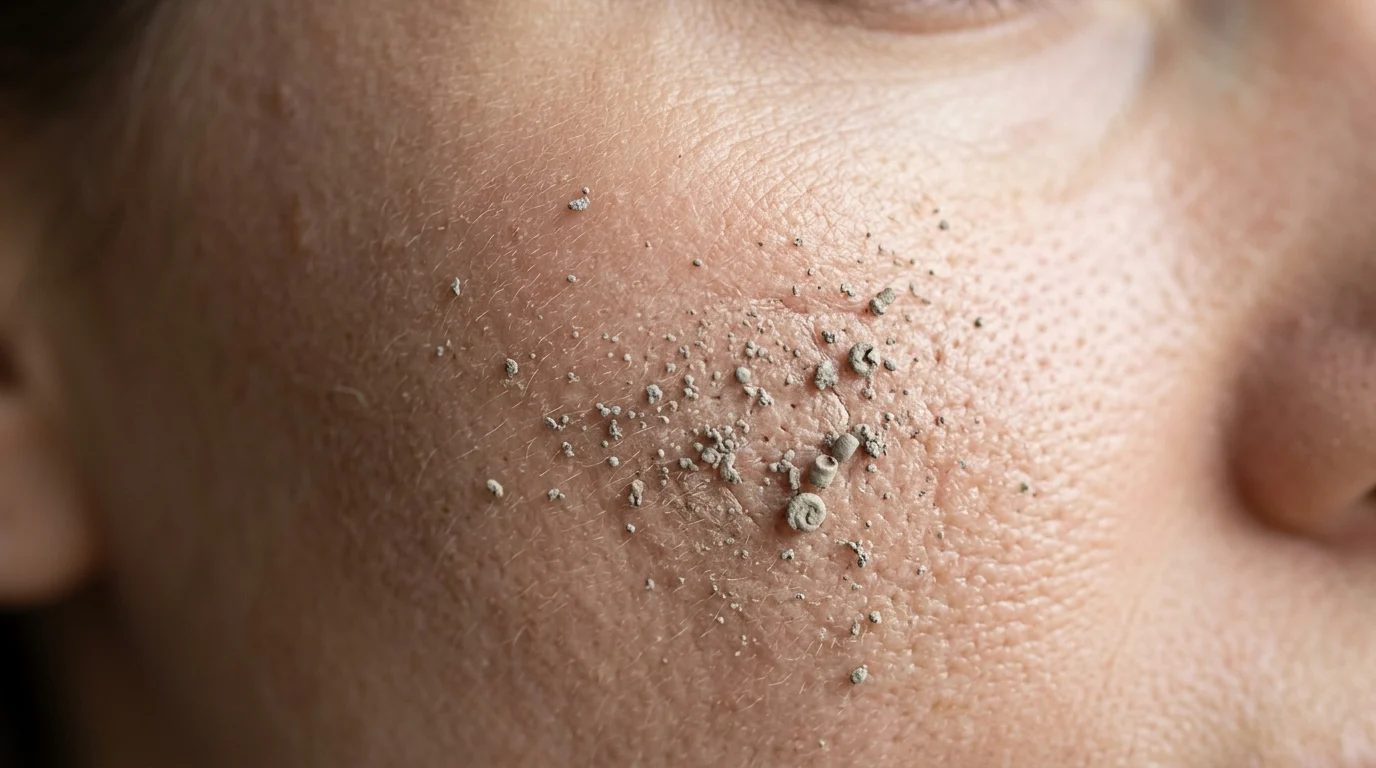
Picture this: twenty minutes of careful skincare. A vitamin C serum patted in methodically, a peptide moisturizer pressed in with warm hands, a mineral SPF blended to a finish. Then foundation — applied with a damp sponge, exactly as always. And then, as the blending begins, something goes wrong. The foundation starts to roll. Small grey-beige balls gather under the sponge like rubber eraser shavings. The face is washed clean. The process is repeated. The same thing happens again.
This is makeup pilling — and it is not a technique problem in isolation. It is not simply a foundation problem. At its core, it is believed to be a formulation problem: one driven by how the film-forming layers within skincare and makeup interact — or fail to integrate — when applied in sequence. Every product deposited onto the skin contributes a layer of film-forming molecules. When those layers fail to integrate properly — whether due to timing, layering order, or product volume — the friction of blending can cause them to aggregate into those frustrating rolled particles. Understanding foundation pilling causes means understanding what is actually happening at the surface level of each product layer.
What Is Makeup Pilling — And Why Does It Happen at a Chemical Level?
Pilling is the formation of small, rolled particles on the skin surface when layers of makeup and skincare fail to form a cohesive film together. In simple terms: the layers fail to integrate, and under friction, they clump instead.
Film-Forming Agents: The Root of the Problem
The chemistry behind this involves film-forming agents — polymers present in virtually every modern skincare and makeup product. A polymer, practically speaking, is a long-chain molecule that, when applied to skin and allowed to dry, is designed to form a thin continuous film. That film is what gives a serum its surface layer and what gives a foundation its coverage and staying power.
Think of it like two coats of paint. If a second coat is applied before the first has dried, the brush drags the wet first coat upward — it lifts, rolls, and clumps rather than building an even surface. A similar principle is thought to govern layering skincare and makeup. When a new film-forming layer is applied on top of one that has not yet stabilised, and friction is introduced through blending, the two layers may fail to integrate. Instead, they can aggregate into visible particles: the pilling effect.
Research on cosmetic polymer film formation and skin surface compatibility provides relevant context here, with findings on the surface behaviour of film-forming polymers in layered applications suggesting that film instability is a predictable, formulation-driven phenomenon rather than a random one.
Film Disruption: Why Pilling Is Predictable, Not Random
Consider film instability in cosmetics like applying two different types of glue in successive layers — each sets at a different rate, and under pressure, the layers are likely to separate rather than bond. Pilling, in this context, is not a fluke. It is a foreseeable consequence of layering film-forming systems under conditions that prevent them from integrating properly — particularly when timing and friction are not managed.
The Silicone Problem and Makeup Pilling: When Smooth Ingredients Reduce Adhesion
Silicones — dimethicone, cyclopentasiloxane, phenyl trimethicone — are the slip agents and film-formers responsible for the smooth, almost frictionless feel of so many modern products. They create a flexible, breathable surface film on the skin. They are also associated with one of the most common patterns of silicone pilling makeup.
Why Heavy Silicone Films Can Reduce Adhesion
The issue is not that silicone cannot adhere to silicone, but rather that heavy silicone films may slide over each other before they have fully set. Think of two pieces of cling film pressed together before either has had time to settle — they tend to shift and grip unevenly rather than lying flat. Applied in quick succession to the skin, two silicone-heavy products can behave similarly: the upper layer may slide across the lower one under blending pressure, reducing adhesion and increasing the likelihood of film disruption.
Primer and foundation pilling is the most common expression of this pattern. When a silicone-rich primer is layered beneath a silicone-heavy foundation before the primer film has fully stabilised, the mechanical action of blending may be enough to disrupt both films and cause visible rolling.
High-Silicone Products Most Likely to Contribute to Pilling
- Silicone-based primers — likely the most frequent pilling contributor in the makeup routine
- Silicone-heavy SPF formulas — particularly chemical sunscreens with a smooth, cosmetically elegant texture
- Serums that contain dimethicone as a texture-smoothing agent
- Long-wear and transfer-resistant foundations with high silicone content
Sunscreen and Foundation Pilling: The Most Common Incompatible Pair
Sunscreen and foundation pilling is the scenario most frequently reported by those experiencing persistent makeup pilling — and it is arguably the most formulation-sensitive pairing in any makeup routine.
Chemical Sunscreens: Film Instability Under Blending Pressure
Chemical UV filters often rely on film-forming polymers to help maintain their distribution across the skin surface. Foundation is also polymer-based. When foundation is applied before the sunscreen film has fully stabilised — which is thought to take longer than the surface tactile feel suggests — the friction of blending may disrupt both film-forming layers simultaneously. Rather than integrating, the two layers can aggregate into the rolled particles characteristic of pilling.
Mineral Sunscreens: A Different Mechanism, A Similar Result
The mechanism shifts with some mineral sunscreen formulations. Richer mineral sunscreens containing zinc oxide or titanium dioxide may create a thicker surface film that reduces foundation adhesion — not through the same film-layer conflict seen with chemical filters, but by presenting a surface that foundation struggles to grip. The result can look similar — foundation rolling off skin — but the cause is likely surface-level adhesion limitation rather than film-layer disruption. It is worth noting that many modern mineral sunscreens are formulated to be lightweight and may not cause this effect.
Understanding how barrier condition and product layering affect makeup adhesion and pilling is particularly relevant here, because skin health may directly affect how well any product film — including SPF — can adhere and stabilise in the first place.
Serums, Actives, and the Absorption Timing Problem
Serum under foundation pilling is one of the least understood contributors — because a serum may feel dry on the skin within seconds. That tactile dryness can be misleading. The surface may feel dry well before the film has fully stabilised.
Why 30 Seconds May Not Be Enough
Applying foundation over a serum that has been on the skin for thirty seconds may be meaningfully different from applying it over one that has been absorbing for several minutes. In the first case, the serum’s film-forming process may not have completed. Applying foundation over an incompletely stabilised layer — and introducing blending friction — may be enough to cause both films to aggregate rather than integrate.
Serum Types That May Elevate Pilling Risk
- Hyaluronic acid serums: may form a hydrophilic (water-attracting) surface film that can limit the adhesion of oil-based foundations if not given adequate time to stabilise
- Vitamin C serums (L-ascorbic acid): their low acidic pH is thought to affect the surface environment of the skin, which may in turn influence how film-forming layers above them behave
- Peptide serums with polymer carriers: associated with higher pilling risk when foundation is applied quickly — the carrier polymers may need time to stabilise before additional film layers are introduced
- Niacinamide serums: generally considered lower risk, though heavier, gel-textured formulations may contribute when layered without adequate wait time
Understanding how common skincare actives interact with makeup layers and contribute to pilling gives useful context for building a routine that is less likely to create film instability between the active treatment layer and the makeup layer above it.
Over-Moisturizing: When Skincare Limits Foundation Adhesion
There is a point at which generous skincare application becomes counterproductive for makeup not sitting on skin — and it is a threshold many routines cross without realising.
The Wet-Paint Effect
When a thick moisturizer is applied generously and foundation is introduced before it has been absorbed, the moisturizer layer may reduce foundation adhesion significantly — leaving the foundation with a surface it struggles to grip. Under blending friction, the foundation can slide and roll rather than adhere. This mirrors the wet-paint scenario: applying a second coat before the first has dried does not build coverage — it risks lifting and rolling the layer beneath it.
Moisturizer Ingredients That May Increase Pilling Risk
Ingredients associated with this effect at higher concentrations include petrolatum, shea butter, fatty alcohols such as cetyl and stearyl alcohol, and ceramide-heavy formulations with an occlusive base. None of these are problematic as ingredients — they are well-regarded for supporting skin health. In the context of makeup layering, they are most likely to limit foundation adhesion when applied in excess or without allowing adequate absorption time before makeup application.
Why Rubbing Makes Makeup Pilling Worse
Even when the layering order is correct and timing has been respected, the physical act of blending can be enough to trigger pilling — particularly when technique involves significant friction against the skin surface.
Friction as a Mechanical Trigger
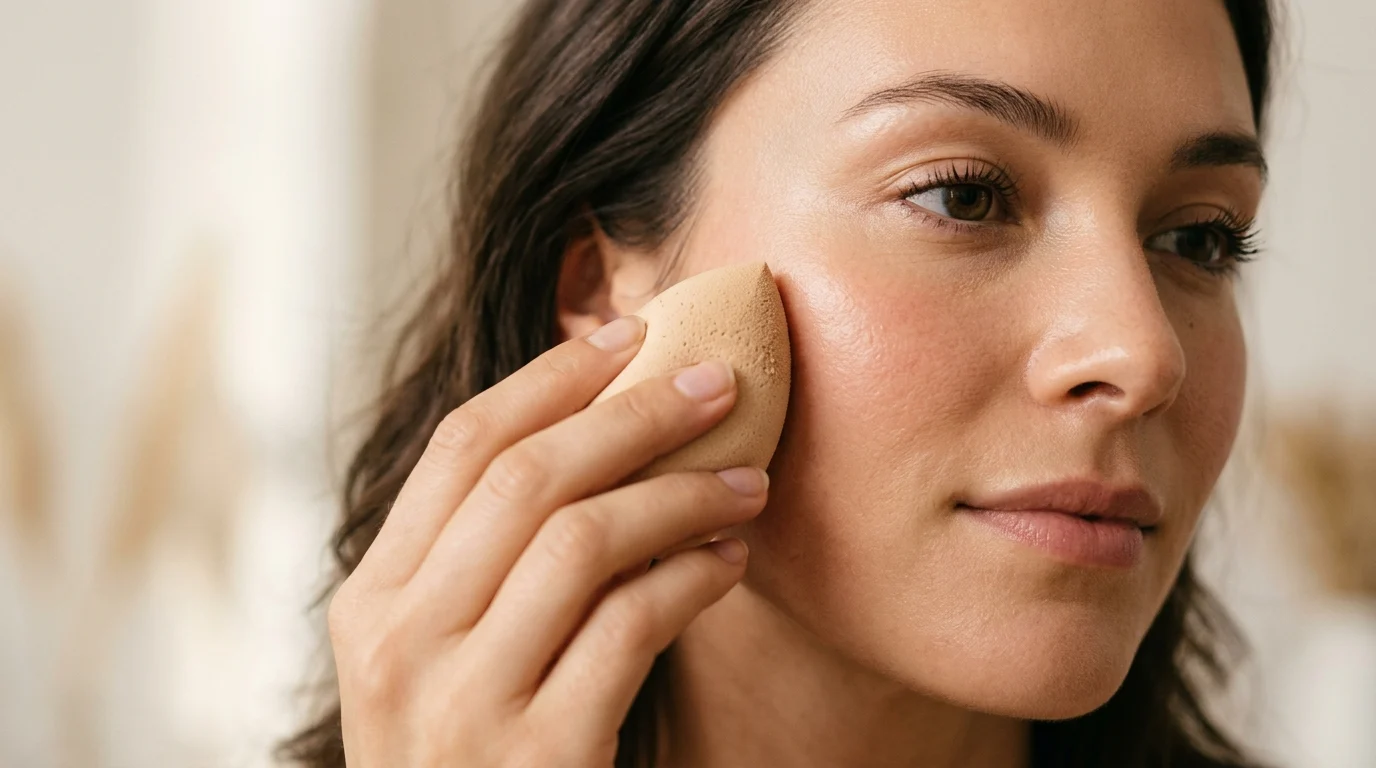
When a film-forming layer has not fully stabilised, it remains in a vulnerable, partially-set state. Introducing mechanical friction at this stage — through buffing with a brush, rubbing with a beauty sponge, or pressing repeatedly in the same area — applies shear force to that film. Rather than smoothing it into the skin, friction is thought to disrupt the partially formed film, causing it to gather and roll into the small grey-beige particles associated with pilling.
Think of it like rubbing a partially dried layer of latex paint with a cloth. The surface feels dry to the touch, but the underlying film is still forming — and friction at that point does not smooth the surface; it rolls it.
Application Technique and Pilling Risk
- Buffing brushes — the circular, back-and-forth motion generates more friction than most other tools and is associated with higher pilling rates, particularly over silicone-based primers
- Excessive rubbing with a beauty sponge — dragging the sponge across skin, rather than pressing and lifting, creates similar shear forces on film layers that have not yet set
- Tapping and pressing — the preferred technique for minimising pilling: pressing or stippling the foundation into skin applies far less disruptive force than dragging or buffing
- Multiple passes over the same area — revisiting an area before the foundation has had time to begin setting increases the likelihood of film disruption
It is worth noting that technique alone rarely explains persistent pilling when formulation incompatibility is also present. Addressing both the product layering and the application method typically produces better results than adjusting technique in isolation.
Too Much Product Can Increase Pilling
Across every category — serum, moisturizer, sunscreen, primer, and foundation itself — the volume of product applied has a direct relationship with pilling risk. More is rarely better when it comes to layered film stability.
Why Thicker Films Are Less Stable
A thin, well-applied film-forming layer is generally more likely to stabilise evenly across the skin surface than a thick one. Thicker films take longer to set, retain more moisture, and are more susceptible to disruption under friction. When multiple layers are each applied generously, the cumulative film depth increases — and the likelihood that any given layer remains partially unstabilised when the next is introduced also increases.
Applying more product does not improve adhesion. In most cases, excess product actively works against it.
Where Over-Application Most Commonly Causes Problems
- Excess sunscreen: a thicker SPF film takes longer to set and may be more likely to conflict with a foundation applied too soon above it
- Excess primer: a heavy primer application — particularly a silicone-based one — creates a thicker base film that is more prone to sliding under foundation blending pressure
- Excess moisturizer: as covered above, generous moisturizer application is directly associated with limiting foundation adhesion
- Excess foundation: applying foundation in thick layers rather than building coverage gradually can cause the lower film to remain unstabilised while the upper layer is still being blended, increasing pilling risk from within the foundation layer itself
The practical implication is straightforward: apply the minimum effective amount at each step, allow adequate time, and build coverage in thin layers rather than attempting full coverage in a single application.
Skincare and Makeup Incompatibility: How Layering Order Affects the Outcome
Skincare and makeup incompatibility is not solely about which products are used — it is also about the order they are applied and the time allowed between each step.
The Logic of Correct Order
As a general principle in formulation, lighter products are applied before richer, silicone- or oil-based ones. This is partly because thinner, water-based formulas are typically designed to absorb into the skin first, while heavier products are meant to sit on top and form an outer film. When this order is reversed — or when adjacent layers share incompatible bases without adequate setting time between them — the risk of poor film cohesion and pilling increases.
Layering Logic That May Reduce Pilling
- Sequence: Cleanser → toner → water-based serum → lightweight moisturizer → sunscreen → primer (if used) → foundation
- Timing: Each layer benefits from at least 60–90 seconds before the next is applied; sunscreen in particular is generally advised to be given several minutes to stabilise fully before makeup is applied
- Base matching: Silicone primer under silicone foundation; water-based primer under water-based foundation — applying adjacent layers with differing base chemistry is associated with higher pilling risk
- Texture principle: Applying oil-based products over water-based products can create a surface interface that limits the adhesion of layers applied above
Serum-Infused Foundations: A Formulation Approach to Reducing Layering Conflicts
The growing category of serum-infused foundations addresses foundation pilling causes from an interesting angle — by reducing the number of separate film-forming layers in the routine.
One Film System Instead of Two
Rather than a separate serum film plus a separate foundation film being applied in sequence, a serum-infused foundation integrates both functions into a single formulation. This approach may reduce the likelihood of conflicts between separate film-forming layers, because the active treatment ingredients and the coverage medium share a single film-forming system rather than competing as distinct layers.
The Trade-Off Worth Knowing
Coverage is typically lighter with these formulas, and skin preparation still matters — applying any foundation over a non-set sunscreen or a thick, unabsorbed moisturizer can still cause issues. But for those whose pilling is primarily associated with serum-foundation layering, serum-infused foundations and how they reduce layering incompatibility represent a practically motivated formulation solution rather than a marketing concept.
How to Prevent Makeup Pilling: Evidence-Informed Strategy
Every strategy below addresses one of the mechanisms discussed above. None require expensive new products — most involve timing adjustments, volume reduction, and a small number of formulation swaps.
Application Technique Adjustments
- Wait between every layer. Likely the single most effective adjustment. Allow at least 60–90 seconds per skincare step; after sunscreen, allowing several minutes before foundation application often reduces pilling noticeably.
- Press and pat rather than rub. Blending with friction before a layer has stabilised is a key mechanical trigger for pilling. Pressing or stippling foundation into skin causes less disruption to underlying films than buffing or dragging.
- Use less product at every step. Excess volume increases film instability. Thin, well-applied layers are more likely to stabilise fully before the next step is introduced.
- Build foundation in layers. Rather than applying a single heavy coat, apply a lighter layer, allow it a moment to begin setting, then add more coverage if needed.
Formulation and Product Swaps
- Match base chemistry in adjacent layers. Silicone-based products above silicone; water-based above water-based. Mixing the two in adjacent layers is associated with poor film cohesion and increased pilling risk.
- Reconsider the primer. Test a water-based primer under a water-based foundation — or assess whether primer is contributing to film instability by skipping it for a week and observing the difference.
- Reduce moisturizer quantity. A thin, well-absorbed layer is less likely to limit foundation adhesion than a generous application that has not had time to settle.
- Test sunscreen-foundation compatibility in isolation. Some sunscreen-foundation combinations may pill regardless of timing due to the specific film-forming systems involved. Identifying an incompatible pair early avoids persistent frustration.
Myth: Pilling means the foundation is poor quality. It does not. Pilling is entirely independent of product quality or price point — it is a film stability and timing problem. A £5 drugstore foundation and a £90 prestige formula may both pill when layered over the same incompatible skincare routine. The formulation chemistry of every layer in the routine is what determines the outcome — not the quality or cost of any single product. A high-performance serum and a carefully chosen SPF can, in combination, still create conditions that lead to pilling beneath even a very well-formulated foundation.
If skin consistently resists makeup adhesion despite correct layering technique and product selection, it may indicate a barrier condition worth discussing with a dermatologist — compromised or inflamed skin surfaces can affect how all topical products, including makeup, behave on application.
FAQs: Makeup Pilling Explained
Why does my foundation pill even when I use the same brand for primer and foundation?
Same-brand products are not automatically formulated for film compatibility. Brands often develop primers and foundations as separate products, and the two may contain different film-forming systems or varying concentrations of silicone. The shared brand name does not guarantee that the two films will integrate smoothly — the formulation of each individual product is what determines compatibility, not the label.
Does sunscreen always cause pilling under makeup?
No — but it is among the most commonly identified contributors. The key variables are the sunscreen’s texture, its specific UV filter system, and the time allowed between SPF application and foundation. A lightweight, fast-setting formula given adequate stabilisation time is unlikely to cause significant pilling. A heavier, silicone-rich SPF applied with minimal wait time before foundation is associated with a much higher pilling risk. Compatibility between sunscreen and foundation is worth testing separately before committing to a full routine.
What is the single most effective way to reduce foundation pilling?
Allowing adequate time between skincare layers — particularly after sunscreen application — is consistently associated with a meaningful reduction in pilling. Allowing several minutes between SPF and foundation often improves adhesion without any product changes. If pilling continues after addressing timing, the next step is reviewing base chemistry: switching to a water-based primer under a water-based foundation, or reducing product volume at each step, frequently resolves cases that do not respond to timing adjustments alone.