

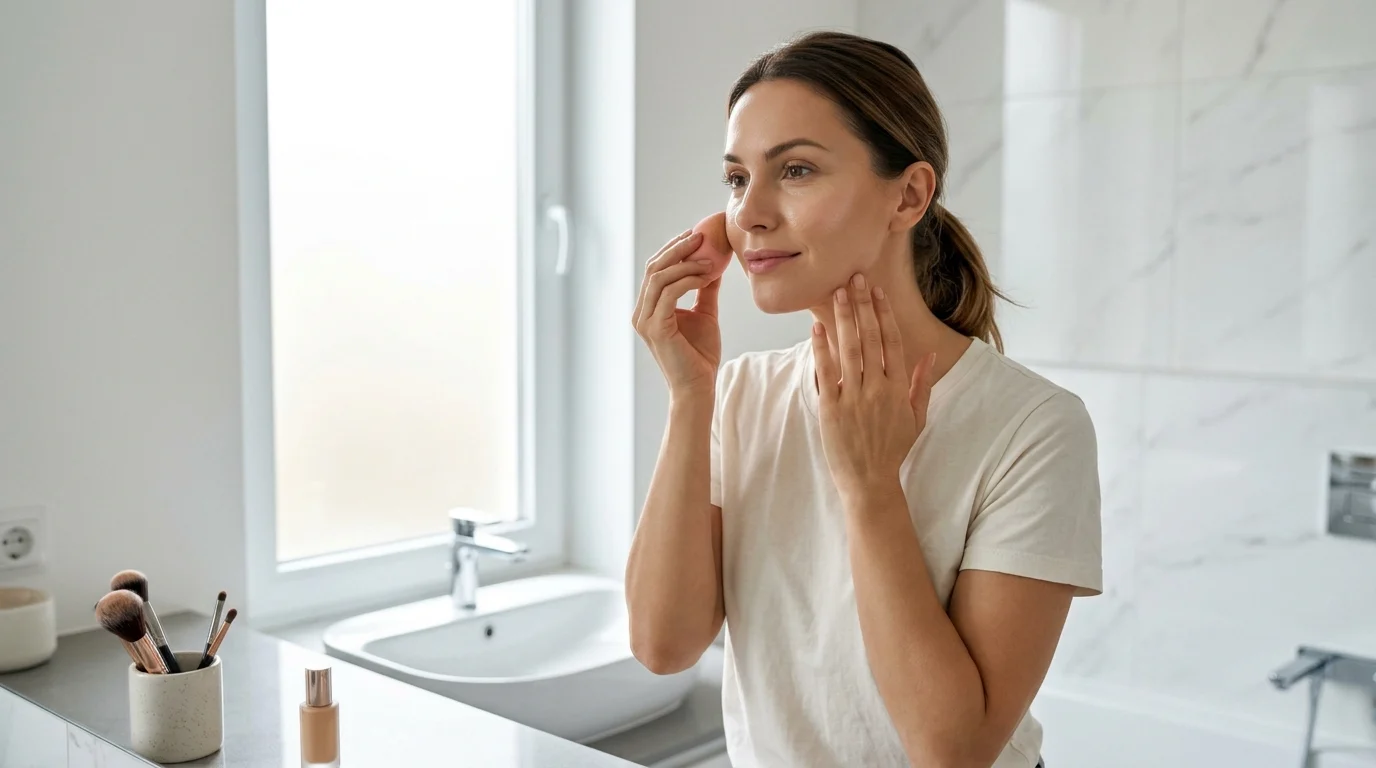
Picture this: a woman who has worn SPF 30 foundation every single day for years. Year-round, rain or shine, outdoor brunches and beach walks included. She has never burned. Her skin looks fine. She considers herself sun-protected. What she does not know is that she is applying approximately one-quarter of the product thickness required to achieve the SPF 30 value printed on her foundation label — meaning her real daily protection is closer to SPF 6–8 at best. And regardless of that SPF number, many foundations provide limited or insufficient UVA protection compared with a dedicated broad-spectrum sunscreen — a gap that has real consequences for long-term skin health. Makeup SPF is not the same as sunscreen SPF. The difference is not a rounding error — it is the difference between actual protection and the convincing feeling of it.
How SPF Is Actually Tested — And Why Real-World Application Changes Everything
SPF values are not measured on skin the way foundation is actually worn. In laboratory conditions, every SPF product — sunscreen, moisturiser, foundation — is tested at a precise application amount of 2 milligrams per square centimetre of skin. That is a deliberately generous, standardised quantity designed to produce a measurable, reproducible result.
In practice, most people apply foundation at roughly 0.5mg/cm² — approximately one-quarter of the test thickness. The instinct is to blend, to even out, to avoid heaviness. Nobody applies foundation the way a lab technician applies product for SPF measurement.
Here is where the chemistry becomes uncomfortable. SPF protection does not scale down proportionally with application thickness. Think of it like printing a document at 20% ink density and expecting it to look identical to 100%. You do not get 20% of the image — you get something far less legible than that. The relationship follows a square-root pattern: reducing application to one-quarter of the test amount does not deliver one-quarter of the SPF — it delivers considerably less, and the drop is far more dramatic than most people assume.
- Tested at 2mg/cm²: SPF 30 delivers the labeled protection
- Applied at 1mg/cm² (half the test amount): effective protection drops substantially — research indicates the reduction is far greater than a simple halving of the SPF value would suggest
- Applied at 0.5mg/cm² (typical makeup application): effective protection is reduced to a fraction of the labeled SPF — dermatological evidence consistently points to a dramatic collapse in real-world protection at this thickness, though the precise value varies by formula
- Uneven coverage from blending technique: reduces protection further in patchy areas
The British Association of Dermatologists’ photographic evidence on SPF performance in cosmetic products makes this collapse visible — literally. UV photography of participants wearing SPF moisturisers at real-world application thickness revealed significant unprotected patches across the face, including consistently missed zones around the eyes and nose.
UVA vs UVB: Why the SPF Number Does Not Tell the Whole Story
The SPF number on any product — foundation, moisturiser, dedicated sunscreen — measures one thing only: protection against UVB radiation. That is the short-wave, high-energy radiation that causes sunburn. UVB is the burn ray. It damages the skin’s surface visibly and quickly, and SPF filters block it with varying effectiveness depending on the formula and concentration.
UVA radiation is an entirely different matter. UVA is the long-wave, lower-energy radiation that penetrates far deeper into the dermis. It does not cause immediate redness. You will not feel it. But it is responsible for collagen degradation, hyperpigmentation, and the cumulative photoaging that shows up as fine lines, loss of elasticity, and uneven tone over years. If UVB is the burn ray, UVA is the aging ray — slower, quieter, and considerably more difficult to detect because it leaves no visible short-term evidence.
- UVB: causes redness, burning, immediate visible damage → measured by SPF number alone
- UVA: penetrates dermis, causes collagen breakdown, pigmentation, and photoaging → NOT measured by SPF number; requires separate broad-spectrum testing and designation
Many foundation formulas either lack UVA filters entirely or include them at concentrations that are too low to provide clinically meaningful broad-spectrum coverage. The British Skin Foundation sunscreen fact sheet on UVA and UVB protection is unambiguous on this point: SPF alone is an incomplete measure of sun protection, and UVA protection must be evaluated separately.
For anyone applying foundation with SPF because they are concerned about photoaging — which is among the most common motivations — the SPF number on the label is protecting against the wrong type of UV radiation to meet that goal.
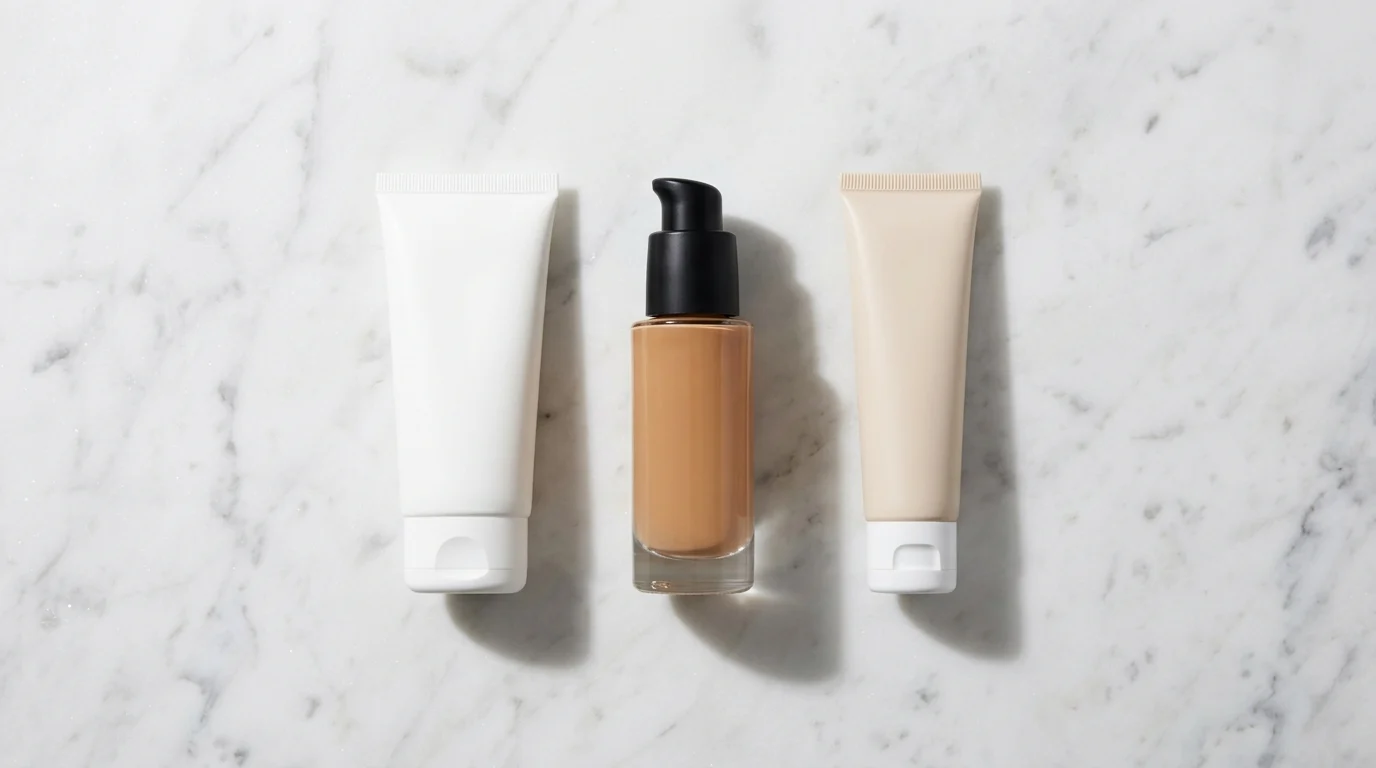
Why Foundation Application Behavior Makes SPF Even Less Effective
There is a behavioral dimension to this problem that is just as significant as the chemistry. Foundation and sunscreen are applied with fundamentally different intentions — and those intentions shape the technique, which shapes the outcome.
Sunscreen is applied for protection. The recommended method is deliberate: generous, even coverage across all exposed areas, including the hairline, ears, and jawline. The objective is complete coverage. Makeup is applied for appearance. The technique involves blending, feathering edges, adjusting coverage by zone, and achieving a specific finish. These are different physical behaviors producing genuinely different levels of skin coverage.
Research published in the dermatology journal commentary on SPF under-application and sun protection gaps confirms that under-application of SPF products is a documented, widespread issue — even with dedicated sunscreen use. With foundation, the problem is compounded by the fact that the application technique is optimised for a completely different outcome.
Then there is the reapplication problem. Even a correctly applied SPF 30 sunscreen requires reapplication every two hours in direct sun exposure. Reapplying foundation every two hours to maintain UV protection is not a realistic behavior — and attempting to do so would not replicate the protection of proper sunscreen reapplication in any case, given the thickness and technique issues already established. Foundation SPF, in any meaningful outdoor UV condition, provides no sustained ongoing protection.
What Foundation SPF Is Actually Good For
This is not an argument that makeup SPF is worthless. It provides some UV protection — the number is not zero. The issue is precision: knowing when it is genuinely sufficient and when it is not.
Foundation SPF adds real value in specific, limited contexts:
- Layered over a dedicated broad-spectrum SPF 30+ sunscreen in low UV index conditions — it contributes an additional layer rather than acting as a standalone strategy
- Incidental, very brief sun exposure — walking between a car and a building, passing a window — where cumulative UV dose is genuinely minimal
- In combination with an SPF-containing moisturiser — layering adds some cumulative benefit, though SPF does not stack arithmetically (more on that below)
- Winter months in low-UV latitudes with minimal direct sun exposure, particularly for indoor-focused days
The foundation with SPF in these scenarios is a sensible addition to a broader routine. It is not a foundation (in any sense) for sun protection on its own.
SPF and Sun Exposure: When Foundation Is and Is Not Enough
The question of whether foundation SPF alone is adequate depends entirely on context — specifically, the UV index, duration of exposure, and whether meaningful time outdoors is involved. The table below maps common real-life scenarios against the practical adequacy of foundation SPF and the recommended level of protection for each.
| Scenario | UV Exposure Level | Foundation SPF Alone: Adequate? | Recommended Sun Protection |
|---|---|---|---|
| Office work, minimal window exposure | Very low | Likely sufficient as supplement | SPF moisturiser + foundation with SPF |
| Daily commuting (walking 10–15 min) | Low–moderate | Insufficient as sole protection | Dedicated broad-spectrum SPF 30+ under makeup |
| Outdoor lunch (30–60 min midday) | Moderate–high | No | Broad-spectrum SPF 50 + reapplication via SPF powder or spray |
| Beach day | Very high | No | Broad-spectrum SPF 50 applied generously; reapply every 2 hours; makeup SPF irrelevant as standalone |
| Hiking or extended outdoor activity | High–very high | No | Dedicated broad-spectrum SPF 50; reapplication essential; SPF setting products as supplement only |
| Winter, overcast, primarily indoors | Low | Reasonable as supplementary layer | SPF moisturiser + foundation with broad-spectrum SPF |

What “Broad Spectrum” Means on a Foundation Label — And When It Matters
Broad-spectrum designation on any product signals that it has passed testing demonstrating protection against both UVA and UVB radiation. In the US and EU, the term carries regulatory meaning — it cannot appear on a label without passing a specific testing protocol. In Asian markets, UVA protection is communicated through the PA+++ system, where more plus signs indicate stronger UVA coverage.
The practical distinction matters more than it might seem. A broad-spectrum SPF 15 foundation provides low-level but genuine coverage across both UV types. An SPF 30 foundation without a broad-spectrum designation may deliver higher UVB protection — but offers no reliable or tested UVA defence.
For anyone applying foundation SPF with anti-aging concerns as the primary motivation, the broad-spectrum designation is the more critical variable — not the SPF number. Photoaging is driven by UVA exposure. A higher SPF number without broad-spectrum coverage does not address the mechanism causing the concern.
Building a Realistic Daily UV Protection Routine Under Makeup
The AAD sunscreen statistics and clinical sun protection recommendations establish a clear clinical benchmark: broad-spectrum SPF 30 or higher, applied generously to all exposed skin, reapplied every two hours in direct sun. These recommendations apply to dedicated sunscreen — they cannot be met by foundation SPF regardless of the number on the label.
A functional daily routine that works under makeup:
- Apply a dedicated broad-spectrum SPF 30+ as the final skincare step — before primer or foundation, not mixed into either
- Allow sunscreen to fully set for 3–5 minutes before applying makeup — this preserves the sunscreen film and significantly reduces pilling risk
- Check formula compatibility — silicone-heavy sunscreens under water-based foundations are a common source of pilling; test before committing to a combination
- For outdoor days, use an SPF setting spray or SPF powder for mid-day reapplication — these are not equivalent to sunscreen reapplication but provide better cumulative protection than nothing
- For primarily indoor days with incidental sun exposure, a well-formulated SPF moisturiser plus foundation with SPF may be genuinely sufficient
It is also worth noting that consistent evening skincare supports skin repair from daily UV exposure — a well-structured night skincare routine supports skin repair from daily UV exposure in ways that no amount of daytime SPF alone can replicate.
Blue Light and Makeup: What Foundation Does Not Protect Against
UV radiation is not the only environmental stressor that foundation offers no meaningful defence against. Blue light — high-energy visible light emitted by screens, LED lighting, and sunlight — is an emerging area of dermatological research. Evidence suggests it generates oxidative stress in skin tissue independently of UV exposure, and is increasingly associated with pigmentation changes, particularly in deeper skin tones.
Most foundation SPF formulas are not designed or tested for meaningful blue-light protection. The filter systems in cosmetic SPF formulas are UV-specific, targeting UVB and — when broad-spectrum — UVA wavelengths. That said, foundations containing iron oxides — the pigments responsible for skin-tone matching in tinted products — may provide limited incidental protection against visible light, including portions of the blue-light spectrum. This is a side effect of pigment chemistry rather than an engineered protective mechanism, and it should not be interpreted as equivalent to dedicated blue-light defence. For a measured and accurate review of what the current science actually supports, what the research actually says about blue light and skin protection provides a grounded, evidence-based starting point without overclaiming.
Myth: SPF Products Stack Arithmetically
A widespread belief in beauty circles holds that an SPF 15 moisturiser worn under an SPF 20 foundation produces SPF 35 protection. The idea that SPF values simply add together is a common misconception — and one with real consequences for anyone relying on it. SPF does not add. It does not stack. Layering an SPF 15 and an SPF 20 product does not produce SPF 35 — the effective protection is approximately equivalent to the highest single SPF in the combination. And only at the application thickness actually used — which, for any of the layers, is typically well below the tested amount.
If you are concerned about cumulative UV exposure, photoaging, or have a history of skin conditions aggravated by sun exposure, consult a dermatologist for personalised sun protection recommendations — daily SPF selection is a clinical decision as much as a cosmetic one.
Frequently Asked Questions
Does foundation SPF count as sun protection?
It provides a partial, limited degree of UV protection — primarily UVB, and only when applied at sufficient thickness. At typical real-world application amounts, the effective SPF of most foundations is a fraction of the labeled value. Foundation SPF is an addition to a proper sun protection routine, not a replacement for one.
If I wear SPF 30 foundation every day, am I protected from skin aging caused by UV?
Unlikely, for two reasons. First, at typical application thickness, your effective SPF is considerably lower than SPF 30. Second, the aging associated with UV exposure is driven primarily by UVA radiation — which many foundations either do not filter for, or filter insufficiently. For anti-aging sun protection, a dedicated broad-spectrum sunscreen applied correctly is the clinical standard.
How do I reapply sunscreen over makeup without ruining it?
Liquid sunscreen reapplication over a full face of makeup is genuinely difficult to execute without disrupting coverage. The most practical options are: SPF setting sprays (hold 20–30cm from the face and mist evenly), SPF-containing powder formulas applied with a clean brush, or a minimalist touch-up approach using a damp sponge to press a small amount of SPF product over the areas with the highest sun exposure — cheeks, nose bridge, forehead.
Final Thoughts
Foundation with SPF is not without value. Used thoughtfully — layered over a dedicated broad-spectrum sunscreen, worn on low UV index days, or combined with an SPF moisturiser for incidental indoor exposure — it contributes a meaningful supplementary layer to a well-considered routine. The problem is not the ingredient; it is the expectation placed on it.
The evidence is consistent: real-world application thickness collapses the labeled SPF value well below what the packaging suggests, UVA protection in most cosmetic formulas is insufficient for genuine photoaging defence, and the behavioral realities of how makeup is applied are fundamentally at odds with the technique required to achieve the tested SPF. Foundation SPF is a useful addition. It is not, and cannot be, a substitute for a dedicated broad-spectrum sunscreen whenever meaningful UV exposure is expected — whether that means a midday commute, an outdoor lunch, or any time spent in direct sun.
The standard remains straightforward: broad-spectrum SPF 30 or higher, applied generously, reapplied as needed. Everything else — including foundation SPF — works best when it supplements that foundation, not when it replaces it.