


There is a recognizable pattern among those who approach skincare with real rigor: a well-constructed routine, evidence-backed ingredients, consistent SPF — and yet, somewhere in the mid-thirties or forties, the pace of visible improvement slows. Not because the products have stopped working, but because topical skincare, by its very nature, operates at the surface. It cannot address what is happening several layers deeper, where cellular metabolism gradually shifts with age. This growing awareness is part of why red light therapy skin benefits are receiving serious attention — not as a replacement for a well-formulated routine, but as a biologically distinct approach that targets different pathways entirely. Photobiomodulation (PBM) uses specific wavelengths of red and near-infrared light with the aim of influencing cellular signaling, mitochondrial activity, and inflammatory processes. The clinical picture is still evolving, but the science behind the mechanism is substantive enough to merit a careful look.
What follows is not a product review or a device recommendation. It is a grounded look at what photobiomodulation skin research actually proposes — and what remains to be confirmed at scale.
Why Skin Cells Lose Energy in the First Place
Skin aging is not simply a surface phenomenon. Underneath the visible changes — loss of firmness, uneven tone, slower healing — lies a gradual decline in cellular efficiency driven by a combination of intrinsic aging, oxidative stress, UV exposure, and chronic low-grade inflammation. One of the most consequential aspects of this decline occurs inside the mitochondria — the organelles responsible for producing the energy that powers cellular function. As mitochondrial efficiency decreases, cells have less capacity for repair, regeneration, and routine maintenance. This is the context in which photobiomodulation becomes relevant to mitochondria and skin repair.
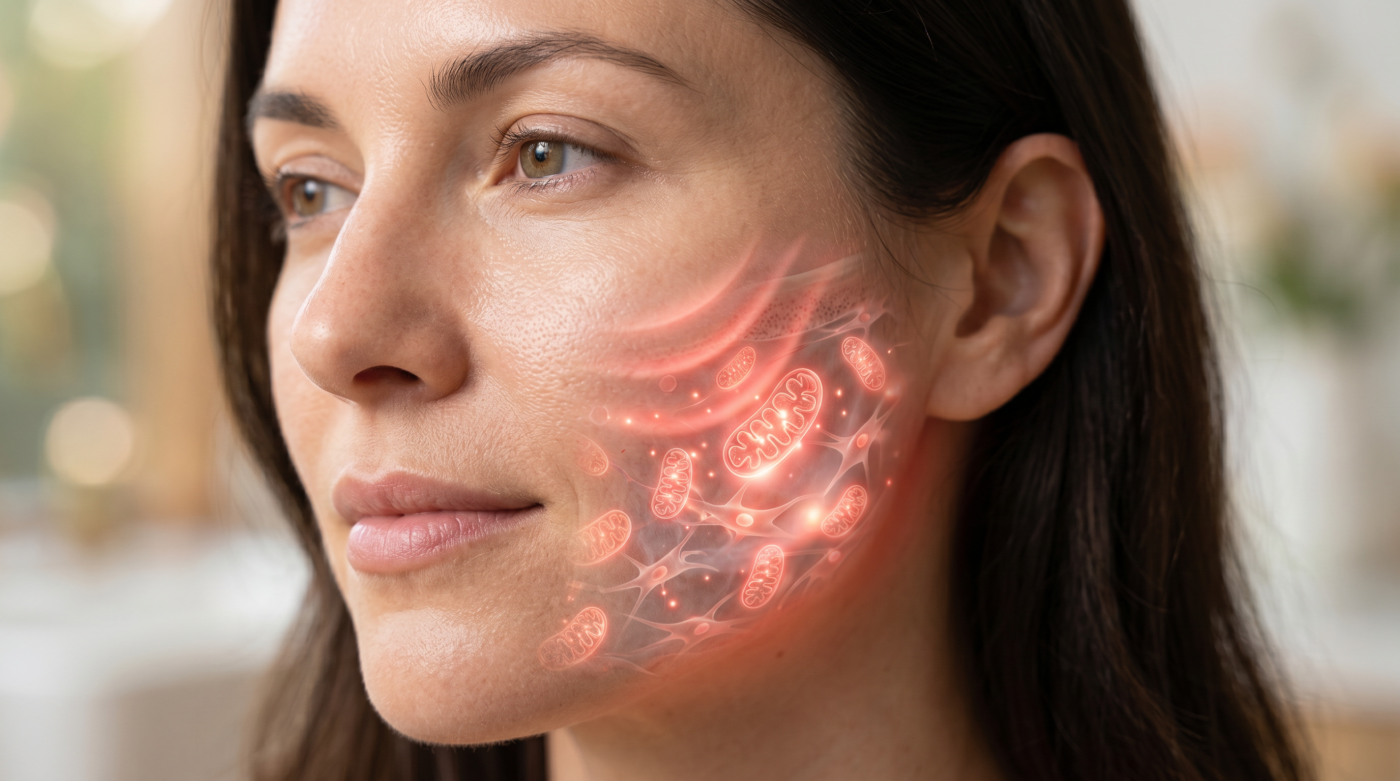
At the centre of the proposed mechanism is an enzyme called Cytochrome c Oxidase (CcO). Located at the end of the mitochondrial respiratory chain, CcO plays a critical role in the process by which cells use oxygen to generate energy. Under conditions of cellular stress — aging, inflammation, oxidative damage — nitric oxide is thought to competitively bind to CcO, partially inhibiting its activity and reducing the cell’s energy output. Think of it as a gradual restriction on an engine’s airflow: the engine is still running, but not at full capacity. According to a foundational review on photobiomodulation in dermatology, red and near-infrared wavelengths are absorbed by CcO, which may prompt the displacement of nitric oxide and partially restore the enzyme’s oxygen-processing activity. Simply put, researchers propose that certain wavelengths of light may help cells use oxygen more efficiently — though the degree to which this translates to meaningful outcomes in intact human skin remains an area of active investigation.
ATP: The Cellular Currency Behind Skin Repair
ATP — Adenosine Triphosphate — is the molecule that powers virtually every biological process in the body. It is produced through a series of complex biochemical reactions within the mitochondria, and its availability directly influences how much a cell can do at any given time. Aging and oxidative stress are known to reduce the efficiency of this process. A cell running on diminished ATP is not simply slower — it prioritises survival functions over maintenance ones. Repair, regeneration, and structural protein synthesis are among the first processes to be deprioritised.
If photobiomodulation does influence CcO activity as proposed, one downstream effect would be a shift in ATP skin cell energy availability. Rather than a dramatic “recharge,” the proposed effect is more a modest restoration of metabolic headroom — enough, in theory, for the cell to allocate more resources toward:
- Cellular repair processes that typically slow with age
- Clearing misfolded or damaged proteins that accumulate in stressed cells
- Signalling pathways associated with tissue regeneration and cellular repair skincare outcomes
It is worth stating plainly: this is a proposed mechanism, supported by in vitro and some clinical data, but not yet fully confirmed across diverse human populations and device types. The science is credible — and ongoing.
Fibroblasts and the Collagen Synthesis Cascade
Fibroblasts are the dermal cells primarily responsible for synthesising collagen and elastin — the two structural proteins that give skin its firmness and resilience. Collagen forms the dense, cross-linked scaffolding that maintains structural integrity; elastin provides the recoil, the ability of skin to spring back after movement or compression. Both decline measurably with age. Both are produced by fibroblasts that are, themselves, subject to the same age-related metabolic slowdown described above.

Photobiomodulation is proposed to influence fibroblast activity through the cascade of cellular signalling events downstream of mitochondrial stimulation. The distinction worth making here is between signalling and outcome: PBM may stimulate the signals that prompt fibroblasts toward increased collagen-related activity, but whether that translates into clinically measurable structural improvement depends heavily on wavelength, irradiance, treatment consistency, and the individual’s baseline biology. Research on 611–650 nm light and skin structural improvement has demonstrated increased collagen density markers and improved elasticity scores in controlled settings — meaningful findings, though results from small trials should be interpreted with appropriate caution. It is also worth acknowledging that photobiomodulation operates within a broader context: how stress accelerates collagen loss represents a parallel and significant variable that light therapy alone cannot address.
The key takeaway for red light therapy collagen discussions: some studies suggest increased collagen markers following consistent PBM exposure. The mechanism is biologically plausible. But the word “restores” belongs to marketing copy, not dermatology literature.
Inflammaging: How Red Light Therapy Targets the Root Cause of Skin Aging
Inflammaging — a portmanteau of inflammation and aging — describes the chronic, low-grade inflammatory state that accumulates in the body over time. Unlike the acute inflammation of a wound or breakout, inflammaging is a persistent background signal: quiet, systemic, and structurally corrosive. It is now widely recognised in dermatology as a primary driver of accelerated skin aging, implicated in collagen degradation, impaired barrier function, and the worsening of chronic conditions including acne, rosacea, and psoriasis. The connection between inflammation and skin aging is not incidental — it is mechanistic.
Photobiomodulation is thought to engage with inflammatory pathways in several ways. In vitro and clinical studies suggest it may downregulate pro-inflammatory cytokines such as TNF-α and IL-6, while potentially upregulating anti-inflammatory mediators. There is also evidence of improved microcirculation following PBM exposure — better local blood flow meaning more efficient oxygen delivery and metabolic waste clearance in the dermis. Clinical evidence on photobiomodulation for skin conditions published in the Aesthetic Surgery Journal supports the view that PBM may offer meaningful modulation of inflammatory responses across a range of dermatological presentations, though study heterogeneity means blanket conclusions remain premature. For those invested in inflammaging skincare, the implication is clear: managing chronic inflammation is a long-game strategy — and one that connects directly to skin barrier repair and inflammation, an equally fundamental pillar of skin longevity.
Red Light Therapy vs. Topical Anti-Aging Ingredients: Are They Compatible?
The more useful framing is not “versus” but “different tools, different biological pathways.” Topical actives and photobiomodulation do not occupy the same lane. The question is whether they can be intelligently combined — and the evidence suggests they can, provided expectations are calibrated correctly.
Retinoids remain among the most robustly evidence-backed topical ingredients available for collagen support, accelerating keratinocyte turnover and influencing collagen gene expression via nuclear retinoic acid receptors. Vitamin C provides meaningful antioxidant protection and is a required co-factor in collagen synthesis. Peptides may support signalling pathways associated with skin repair, though the evidence base varies considerably by peptide type. None of these ingredients, however, directly address mitochondrial signalling or cytokine modulation in the way PBM is proposed to.
This is not a hierarchy — it is a map of mechanisms. A skin in good barrier health, supported by well-chosen topical actives, is likely better positioned to benefit from the cellular-level effects PBM may offer. For a considered approach to niche anti-aging ingredients that work, the principle holds: layer strategically, not competitively. This is the slow-beauty logic that evidence-based wellness increasingly supports.
What to Realistically Expect: Wavelengths, Frequency, and Time
For anyone approaching red light therapy for anti-aging or barrier support, understanding the key parameters is more useful than reading device marketing copy. Three variables determine whether a device is likely to produce clinically relevant results:
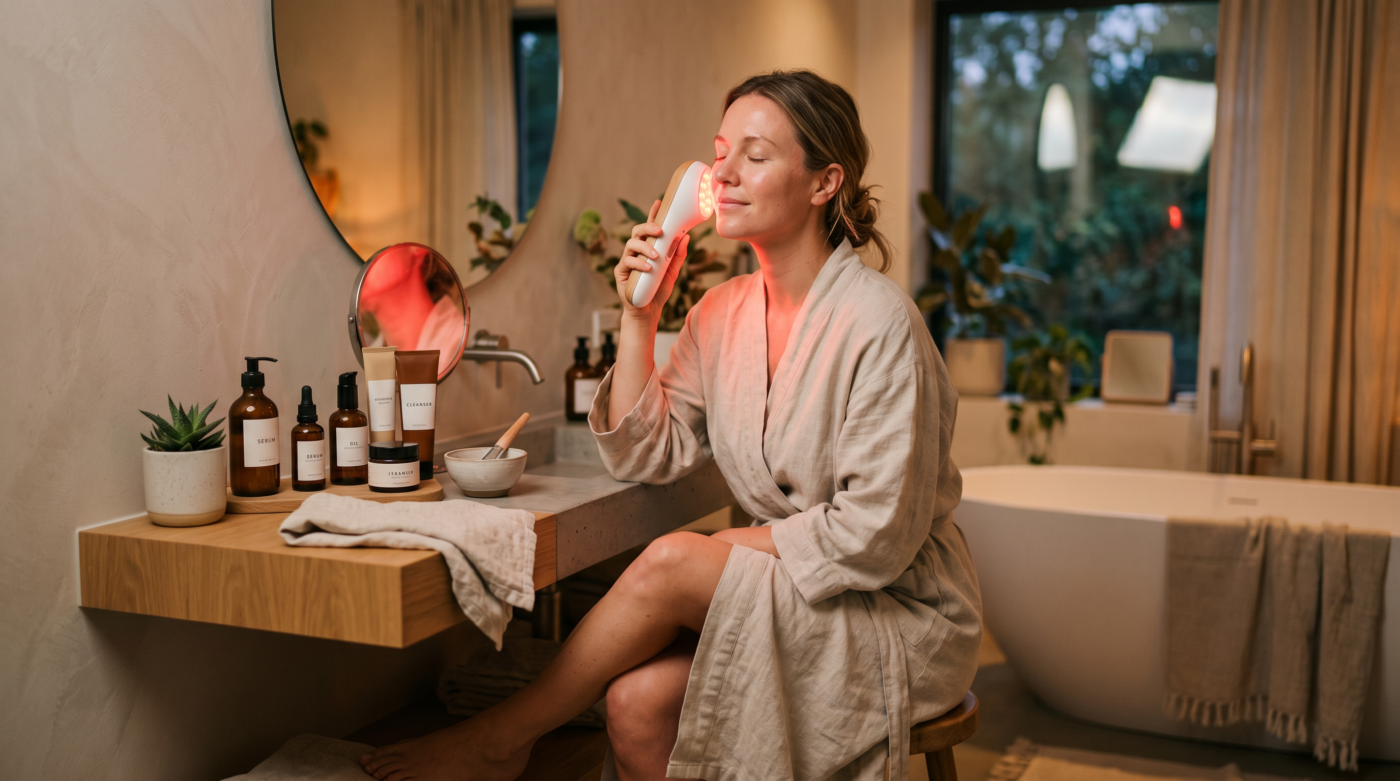
- Wavelength — the type of light used. Red wavelengths (630–660 nm) are primarily absorbed in the epidermis and upper dermis, where they may influence surface-level collagen signalling, barrier function, and mild inflammation. Near-infrared light therapy skin wavelengths (810–850 nm) penetrate deeper into the dermis and subcutaneous tissue, where structural changes and deeper inflammatory modulation are proposed to occur. Many clinical-grade devices combine both.
- Irradiance — the amount of energy delivered per unit area (measured in mW/cm²). This is arguably the most under-discussed variable in consumer conversations about red light therapy at home. The proposed therapeutic window sits between approximately 10–100 mW/cm²; below this, photobiomodulation may not occur at biologically meaningful levels.
- Dose — the combination of irradiance and treatment time, expressed as energy density (J/cm²). A low-irradiance device used for longer does not necessarily deliver equivalent biological stimulus to a properly powered device used at the correct distance. Clinical results depend on whether a device delivers scientifically relevant parameters — not simply whether it emits the right colour of light.
On timelines: early changes in skin tone and texture may become perceptible within 4–6 weeks of consistent use (typically 3–5 sessions per week). Measurable structural shifts — in collagen density markers or elasticity scores — have generally required 8–12 weeks in clinical settings. These figures come from controlled trials; real-world results will vary. Skin longevity is a cumulative project, and photobiomodulation, at its most credible, is a contribution to that project — not a shortcut through it.
A Note on Device Quality Not all red light devices are equivalent, and the gap between a clinically validated panel and an underpowered consumer device can be significant. Clinical results depend on whether a device delivers scientifically relevant parameters — appropriate wavelength, sufficient irradiance at treatment distance, and consistent output over time. A device emitting red-spectrum light without meeting these thresholds may produce negligible photobiomodulation, regardless of how its marketing describes the technology. Before investing in a red light therapy at home device, look for published irradiance data measured at the stated treatment distance — not at direct contact with the panel.
Always consult with a dermatologist or healthcare professional before beginning a red light therapy protocol, particularly if you have a diagnosed skin condition or are taking photosensitising medications.
Frequently Asked Questions
How long does it take to see red light therapy results on skin?
Early improvements in tone and texture may appear within 4–6 weeks of consistent use. Structural changes — such as increased collagen markers or improved elasticity — typically take 8–12 weeks in clinical settings. Individual results vary based on device quality, protocol consistency, and baseline skin condition.
Can red light therapy replace retinol for collagen stimulation?
No — and the two should not be positioned as alternatives. Retinoids remain among the most evidence-backed topical tools for collagen support. Photobiomodulation operates through different biological pathways — mitochondrial signalling and cytokine modulation — that topicals do not reach. Used together, they address more variables than either does alone.
Is red light therapy safe for all skin tones and types?
Current evidence suggests PBM is generally well-tolerated across all Fitzpatrick skin types, including deeper tones — notably, red and near-infrared light do not target melanin, which reduces the hyperpigmentation risk associated with some other energy-based treatments. That said, individual health factors, medications, and device parameters all matter. A dermatologist consultation remains the responsible first step.