


Everyone talks about expensive anti-aging creams, but the most overlooked longevity tool may already be outside your front door. The relationship between zone 2 exercise and skin health is one of the most clinically compelling — and commercially underreported — conversations in modern dermatology. While the beauty industry directs billions toward retinoids, peptide serums, and mitochondria-targeting topicals, the evidence increasingly points to something far more fundamental: the way you move your body at a specific, sustained intensity may meaningfully influence the cellular environment in which your skin exists. No serum operates at that depth.
This is not a call to abandon your skincare shelf. It is a case for understanding what topical products structurally cannot do — and recognising that aerobic exercise, performed at the right intensity, may work on the very biological machinery responsible for collagen production, cellular energy, skin barrier resilience, and inflammatory regulation.
What Is Zone 2 Training — And Why Does It Matter for Skin?
Zone 2 training refers to a specific band of aerobic effort: the intensity at which you can hold a full conversation, feel your breathing deepen noticeably, but are not gasping. In physiological terms, this corresponds to roughly 60–70% of your maximum heart rate — a range where your body relies predominantly on fat oxidation and aerobic metabolism rather than anaerobic glycolysis.
What makes this zone biologically distinct is not how hard it feels. It is what happens inside the cell. Zone 2 is the sweet spot for mitochondrial adaptation — it places just enough demand on cells to stimulate mitochondrial biogenesis (the creation of new mitochondria) and improve existing mitochondrial efficiency, without generating the physiological stress response associated with high-intensity efforts. For the skin, this distinction is significant. It is the foundation on which every other mechanism in this article rests.
Casual walking around the house does not reliably reach this threshold. A sprint interval session blows past it. Zone 2 sits precisely where the most meaningful cellular work happens — which is why the emerging science around zone 2 cardio benefits extends well beyond cardiovascular endurance into the skin’s structural biology.
The Mitochondria Connection: Where Skin Aging Actually Begins
Think of mitochondria as the power stations of each cell — they convert nutrients and oxygen into usable energy. When those power stations deteriorate, the cell’s ability to repair itself, produce collagen, regulate inflammation, and maintain barrier integrity all decline in parallel. This is not metaphor. It is the cellular basis of visible skin aging.
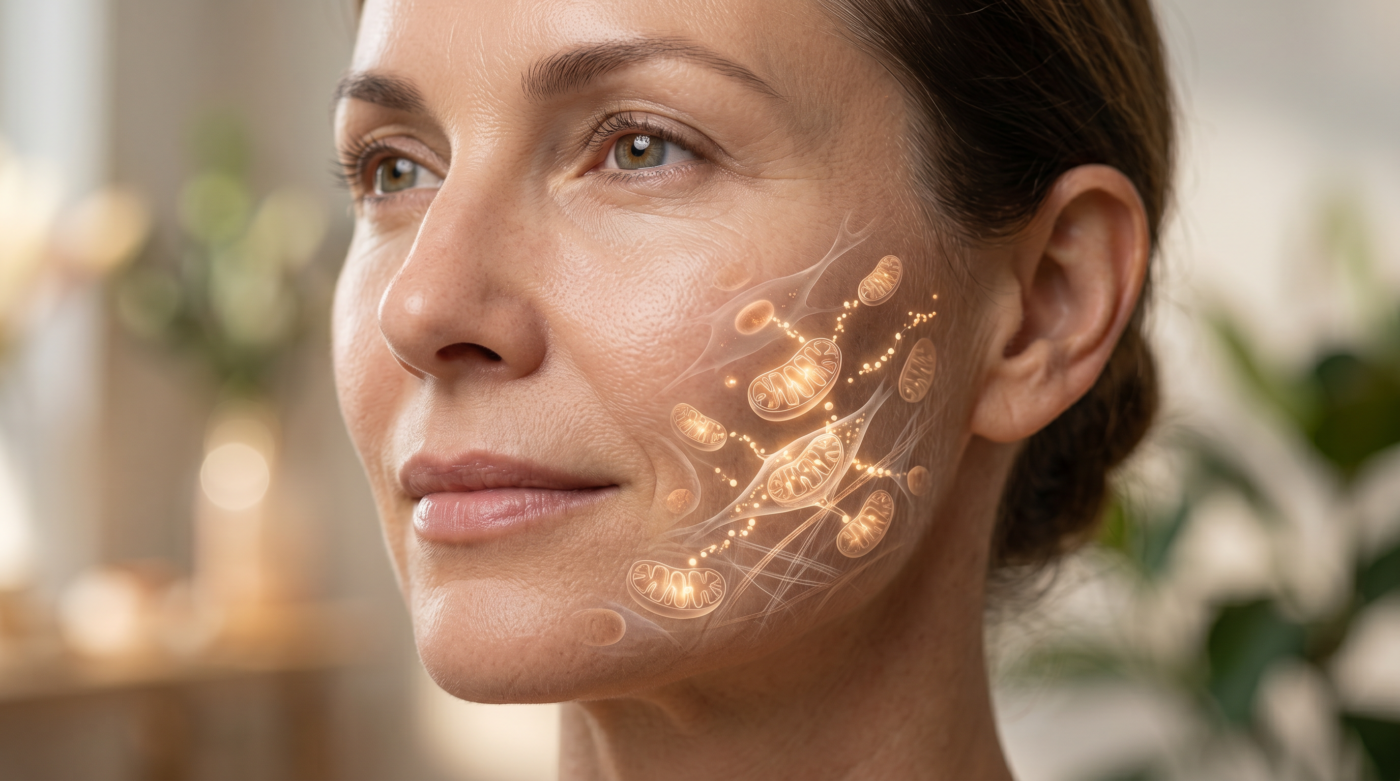
As skin ages, mitochondrial function measurably diminishes. Research on mitochondrial decline in aging skin from Newcastle University demonstrated that mitochondrial Complex II activity — a key marker of cellular energy efficiency — declines significantly in aging skin cells. The result is a cascade: less energy available for collagen synthesis, slower cellular turnover, reduced antioxidant defences, and accelerated structural degradation. Wrinkles and laxity are symptoms. Mitochondrial dysfunction is a root cause.
Zone 2 training is one of the most reliably studied interventions for improving mitochondrial density and function in human tissue. Regular low-intensity cardio stimulates mitochondrial biogenesis — essentially prompting the body to build more power stations and maintain existing ones more efficiently. This is precisely why walking benefits for skin health extend beyond the cosmetic. The aerobic base built through consistent zone 2 activity supports the cellular infrastructure on which healthy skin depends.
The practical implication is this: no topical antioxidant can replicate the effect of training the cell’s own energy system from within. Skincare can support the surface; consistent aerobic activity may help sustain the cellular infrastructure beneath it.
How Exercise Signals Your Skin to Produce More Collagen
Muscles do not simply move the body. They communicate with it. During sustained aerobic exercise, working muscles secrete signalling molecules called myokines — chemical messengers that travel through the bloodstream and influence distant tissues, including the skin.
One of the candidates attracting research attention is IL-15 (Interleukin-15). Elevated during moderate-intensity exercise, IL-15 has been associated in some research with changes in skin tissue composition and is thought to play a role in the cross-talk between muscle and skin. The precise pathway from IL-15 to collagen synthesis in human skin is still being characterised — but the broader principle is well-supported: working muscles release signalling molecules that appear to influence distant tissues, including the dermis.
The clinical evidence is notable. Research on aerobic exercise and cutaneous aging from McMaster University examined sedentary adults over 65 who began a programme of regular moderate-intensity aerobic exercise. After several months, skin biopsies revealed measurable changes in skin composition. Their stratum corneum — the outermost layer of dead skin cells that thickens with age and contributes to that dull, crepe-like texture — appeared thinner and more refined. Meanwhile, their dermis — the deeper, collagen-rich layer responsible for firmness and bounce — showed signs of increased thickness. The study’s authors noted these structural markers were moving in a direction associated with younger skin profiles. This was not a topical intervention. It was a systemic, exercise-associated finding.
Understanding how stress drives collagen loss is equally important here — because the same biological systems that exercise positively activates can be degraded by chronic stress. The two sides of this equation are inseparable when considering collagen synthesis and exercise as a long-term skin strategy.
Zone 2 vs. High-Intensity Training: The Cortisol Difference
Not all exercise creates the same internal environment. This is a nuance the wellness industry rarely surfaces — and it is worth understanding, particularly for anyone prone to inflammatory skin conditions.
High-intensity interval training (HIIT) and sustained heavy lifting produce acute spikes in cortisol, the body’s primary stress hormone. In small, well-timed doses, cortisol is functional and even necessary. The concern arises when training volume outpaces recovery — or when high-intensity sessions compound an already stressed system. Chronically elevated cortisol, from any source, is associated with meaningful downstream effects on skin biology.
Research on stress, cortisol, and skin aging suggests that chronic cortisol elevation may suppress skin barrier function, contribute to collagen breakdown via matrix metalloproteinase (MMP) activation, and fuel inflammatory pathways associated with conditions like acne, rosacea, and eczema. The connection between the brain, the stress axis, and the skin — sometimes called the brain-skin axis — is a well-documented area of dermatological research. Explore the full picture of cortisol and skin health to understand the systemic scope of this relationship.
Zone 2 training may offer a more skin-compatible hormonal environment for many people — not because HIIT is inherently damaging, but because zone 2 keeps cortisol within a regulated range while still driving meaningful mitochondrial and vascular adaptation. Its particular advantage may lie in sustainability: it is an intensity that most adults can maintain consistently without accumulating systemic stress. For those managing reactive skin conditions, this distinction is worth considering when structuring an exercise routine around cortisol and skin health principles.

Inflammaging and Microcirculation: The Slow Burn Your Skin Can’t Afford
“Inflammaging” — a portmanteau of inflammation and aging — describes the chronic, low-grade inflammatory state that accumulates in the body over decades. It is not a dramatic, acute reaction. It is quiet, persistent, and structurally erosive. For skin, inflammaging translates to gradual collagen degradation, impaired wound healing, dull tone, and accelerated cellular senescence. It is one of the most significant — and least discussed — mechanisms behind visible aging.
Zone 2 aerobic activity is among the more studied lifestyle-based strategies for managing inflammaging, and part of the proposed mechanism is vascular. During sustained, moderate-intensity exercise, the body is thought to increase nitric oxide production — a molecule that signals blood vessels to dilate. This improved vascular tone may enhance skin microcirculation: the delivery of oxygen, nutrients, and immune cells to the skin’s deeper layers, alongside more efficient clearance of metabolic waste.

Research on aerobic exercise and microvascular function published in Frontiers in Physiology highlights associations between regular aerobic exercise and improved capillary density and microcirculatory efficiency in peripheral tissues. For the skin, this has meaningful implications: better microcirculation may support nutrient delivery to fibroblasts (the collagen-producing cells of the dermis), assist in clearing pro-inflammatory molecules, and help maintain a cellular environment less conducive to the progression of inflammaging. The research does not permit sweeping conclusions — but the vascular case for consistent, low-intensity aerobic activity is credible and accumulating.
How to Apply Zone 2 Principles for Skin Longevity
The science is compelling; the application is refreshingly accessible. Zone 2 training requires no gym membership, no specialist equipment, and no dramatic disruption to daily life. What it requires is consistency and a basic understanding of intensity calibration.
- Target heart rate: Zone 2 corresponds to 60–70% of your maximum heart rate. A simple field estimate: subtract your age from 220 to find your approximate maximum HR, then calculate 60–70% of that figure. A 45-year-old, for instance, targets roughly 105–122 beats per minute.
- Accessible activities: Brisk walking, light cycling (indoors or outdoor), easy swimming, hiking on moderate terrain, and relaxed rowing all fall reliably within zone 2 when paced correctly. The “talk test” remains a useful real-world check — if you can speak in full sentences but feel your breath working, you are likely in range.
- Frequency and duration: The evidence base broadly supports 3–5 sessions per week at 30–45 minutes per session for meaningful mitochondrial and systemic benefit. Daily 30-minute brisk walks are a legitimate, clinically credible starting point.
- Realistic timeline for skin-visible results: The McMaster University research observed measurable skin composition changes after approximately three months of consistent aerobic activity. Subjective improvements in skin tone and circulation may become noticeable within 4–6 weeks for some individuals. Structural changes take longer — research suggests 3–6 months of consistent adherence is a reasonable frame. Individual results vary. This is not a fast-acting intervention; it is a compounding one.
Always consult with a healthcare professional before beginning a new exercise protocol, particularly if you have cardiovascular concerns or a diagnosed skin condition.
Myth-Busting Note The pervasive belief that only sweat-heavy, high-intensity workouts deliver anti-aging results is not well-supported by the dermal science. For skin specifically, zone 2’s hormonal profile — characterised by regulated cortisol output, sustained nitric oxide activity, and meaningful mitochondrial signalling — may offer distinct advantages over high-intensity protocols for many adults, particularly in terms of sustainability, systemic stress management, and microcirculatory benefit. Effort is not the currency of skin adaptation. Consistency at the right intensity may be.
FAQs
Can walking actually improve skin quality over time?
Research suggests it may — provided the pace is sufficient to reach zone 2 intensity (brisk, with deepened breathing). At this level, walking is associated with mitochondrial adaptation, improved microcirculation, and the kind of systemic signalling that may influence skin tissue over time. Leisurely strolling is beneficial for general wellbeing but unlikely to reach the physiological threshold where these mechanisms are meaningfully activated. Pace matters.
How does zone 2 exercise compare to red light therapy for anti-aging?
They operate through distinct but partially overlapping mechanisms. Red light therapy (photobiomodulation) acts locally — stimulating cytochrome c oxidase in mitochondria within treated tissue. Zone 2 exercise acts systemically — improving mitochondrial function, microcirculation, hormonal regulation, and myokine signalling across the entire body simultaneously. For comprehensive anti-aging impact, the systemic reach of consistent aerobic training is broader. Red light therapy is a useful adjunct, not a replacement for the metabolic and vascular changes that exercise produces.
Will exercising more make acne or rosacea worse?
Intensity determines the answer. High-intensity training can exacerbate both conditions through cortisol spikes, increased core temperature, and post-exercise inflammatory signalling. Zone 2 training, by contrast, keeps cortisol regulated and supports anti-inflammatory pathways — making it the more appropriate modality for those with reactive, inflammation-driven skin conditions. Post-exercise hygiene (prompt cleansing, barrier-supportive skincare) remains important regardless of intensity.