


She is thirty-eight. The cleanser is expensive. The retinol is prescription-grade. And yet, along her jawline, a constellation of deep, cystic breakouts has appeared — the kind she last saw at sixteen — while the skin around her eyes has started to look softer in a way she cannot quite name, as though something underneath has quietly shifted. She has tried what the bathroom shelf can offer. The likely explanation is that the trigger sits somewhere her skincare cannot reach. It is in her internal chemistry.
This is the gap that most beauty conversations tend to skim over. Hormonal skin health is the variable that a topically focused industry rarely addresses with the same seriousness it brings to ingredients. Estrogen, insulin, cortisol, and androgens all appear to influence skin density, barrier integrity, sebum production, and the rate at which collagen breaks down. No serum, however thoughtfully formulated, can rewrite an endocrine signal on its own. What follows is a closer look at what research suggests is happening beneath the surface: collagen loss, glycation, barrier disruption, and the hormonal turning points that gradually redraw the face across the decades.
Estrogen and Collagen: Why Menopause Is a Skin Event, Not Just a Reproductive One
Estrogen behaves, in many ways, like a skin hormone as much as a reproductive one. It appears to signal fibroblasts — the small cells in the dermis responsible for producing collagen, elastin, and hyaluronic acid — to keep building the scaffolding that holds the face together. As estrogen declines, that activity tends to slow. Skin can thin, lose some of its water-binding ability, and gradually forfeit the structural tension that the eye reads as youth.
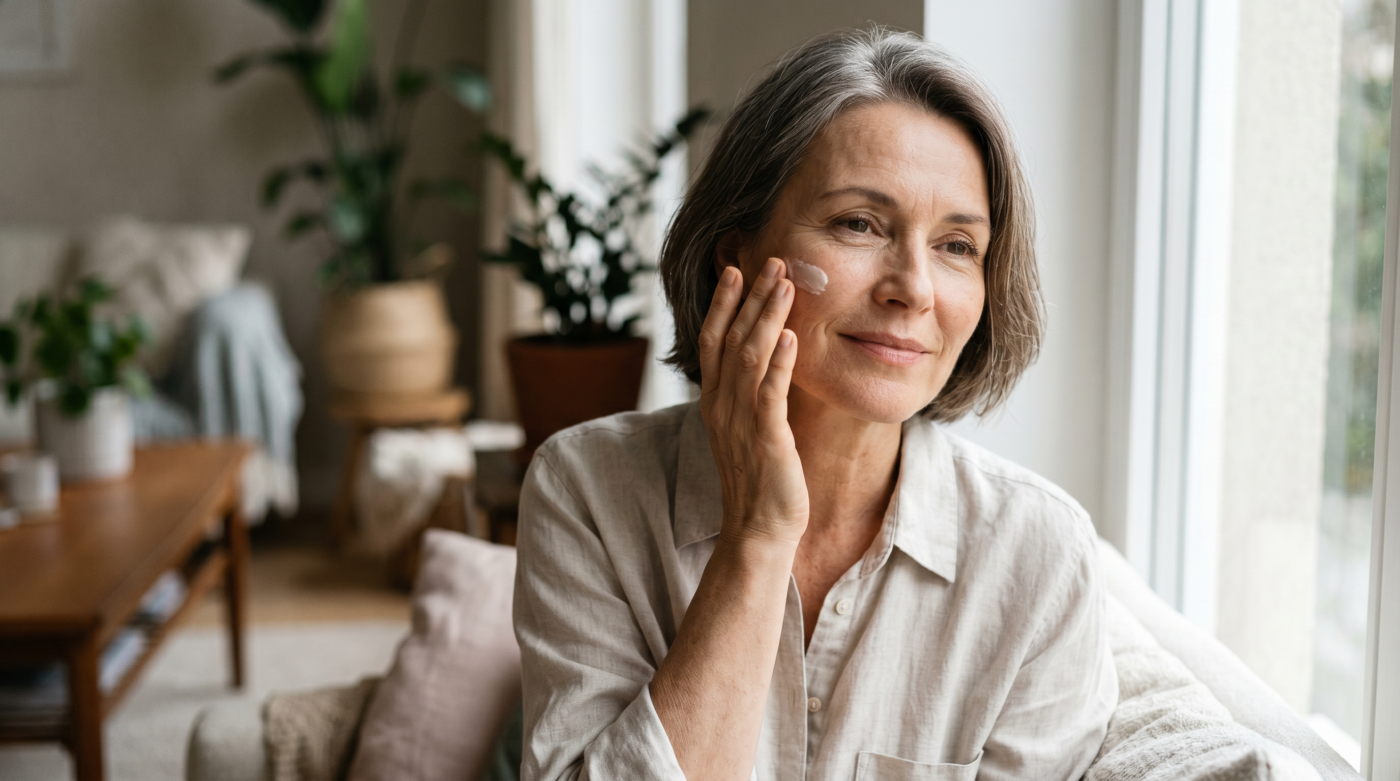
The numbers are more striking than most women are told. According to clinical findings on estrogen and collagen density, skin is reported to lose approximately 30% of its collagen within the first five years following menopause, with a further decline of roughly 2.1% per year afterward. That is not a slow drift. It is a structural shift compressed into a relatively short window — the dermal equivalent of quietly removing some of the load-bearing beams from a building and expecting the façade to behave the same way.
Topical skincare cannot replicate estrogen. Retinoids may stimulate some fibroblast activity, peptides can offer modest support, and consistent sun protection helps limit further loss — but none of these address the hormonal signal itself. They are forms of mitigation rather than reversal. And because how stress compounds collagen loss can further accelerate this decline, the menopausal skin event is rarely a clean, single-variable story. It tends to layer on top of years of cortisol exposure that few of us track.
Insulin, Sugar and Glycation: How Your Blood Sugar Shows Up on Your Face
Insulin is not usually invited into skincare conversations, which is precisely why it deserves a seat at the table. When blood glucose rises sharply, some of the glucose in circulation can begin binding non-enzymatically to nearby proteins — including the collagen and elastin in the dermis. This process is called glycation, and the compounds it produces are known as AGEs, or Advanced Glycation End-products.

The visible consequence is structural. Young collagen tends to behave like a fresh elastic band — it stretches and recoils. Heavily glycated collagen is thought to behave more like overcooked caramel: stiffer, more brittle, slightly yellowed, and less able to return to its original shape. Clinical data on AGEs and collagen degradation suggest that this process becomes more measurable from the mid-thirties onward, and is associated with chronically elevated insulin, blood sugar swings, and oxidative stress.
This is biochemistry, not moralism. The point is not that sugar is sinful — it is that repeated, sharp insulin spikes over years are associated with a gradual stiffening of the dermal matrix. Steadier blood glucose, sufficient protein, and meals built around fiber and healthy fats are not a virtue test. They are a quiet form of infrastructure maintenance for the collagen framework already in place.
Cortisol and the Skin Barrier: The Hormone That Quietly Dismantles Your Skin
Cortisol is one of the most underestimated actors in modern skin science. Acute cortisol is useful — it mobilizes the body during stress. Chronic cortisol, the kind produced by years of compressed deadlines, broken sleep, and ambient anxiety, appears to behave very differently in the skin. Research suggests it can suppress the production of ceramides and hyaluronic acid in the epidermis, the two materials most responsible for keeping water inside the skin and irritants outside it.
The result, over time, can be a quiet erosion of barrier function. Transepidermal water loss may rise. The complexion can start to look tired or reactive, stinging under products that previously caused no issue at all. This is the kind of relationship between cortisol and skin health that no single serum is likely to resolve, because the upstream issue is signaling rather than surface.

There is a second layer to this, and it may be even more interesting. Cortisol has been shown to shift the composition of the gut microbiome and can increase intestinal permeability, allowing inflammatory signals to circulate more freely. Research on the gut-skin axis and stress hormones documents how this inflammation may surface on the skin as eczema flares, rosacea, or persistent adult acne. The gut-skin axis and inflammation is not a wellness slogan — it is an emerging area of physiology, and one that may help explain why many topical treatments underperform in people living with chronic stress.
Perimenopause: Why You Are Getting Acne and Fine Lines at the Same Time
Perimenopause produces one of the most disorienting paradoxes in female skin: breakouts and aging arriving together. The mechanism becomes easier to follow once named. Estrogen begins to decline several years before menopause itself, while testosterone and other androgens often remain relatively stable. The ratio between them shifts. Androgens can become proportionally more dominant, even though their absolute levels have not necessarily increased.
That relative androgen excess is thought to stimulate sebaceous glands, thicken follicular walls, and contribute to the deep, jawline-clustered cystic acne so often misread as a hygiene issue. At the same time, the falling estrogen appears to accelerate collagen loss and barrier thinning. A review of hormonal effects on skin across life stages outlines how estrogens, androgens, and progesterone interact differently at each stage — and perimenopause is where this interaction tends to become most visibly contradictory.
- Puberty: androgen surge → increased sebum → acne-prone skin
- Pregnancy: progesterone and estrogen peaks → melasma, glow, or heightened sensitivity
- Perimenopause: falling estrogen, relative androgen excess → adult acne alongside collagen thinning
- Post-menopause: low estrogen → dryness, thinning, and gradual loss of structural density
What Hormonal Skin Health Actually Looks Like in Practice
Recognizing the hormonal architecture beneath skin changes tends to reframe the entire approach. Reactive product-layering — adding another acid, another serum, another mask every time something flares — can give way to a more systemic view. Skin starts to be read as an output of internal physiology, not as the system itself.
In practice, that often means giving sleep, glucose stability, stress load, and protein intake the same kind of attention usually reserved for choosing a moisturizer. It can also mean recognizing that when adult acne arrives at forty-two alongside fine lines, the answer is rarely a stronger benzoyl peroxide. It is more likely a closer look at where hormonal signaling has shifted. Bloodwork, when appropriate and clinically guided, can be a more useful starting point than another bathroom shelf product.
Always consult with a dermatologist or endocrinologist before making significant changes to your skincare or dietary routine based on hormonal concerns. Skin tends to be a reasonably honest narrator of internal physiology when it is read carefully and without panic.
Myth-busting note: Hormonal acne is widely assumed to be a teenage condition that resolves with adulthood. The clinical picture is more nuanced. Adult hormonal acne — particularly in women aged 35 to 55 — is increasingly recognized as a distinct phenomenon associated with the androgen-estrogen imbalance of perimenopause, rather than with inadequate cleansing or skincare hygiene. Treating it as a teenage problem with teenage products often intensifies barrier damage without addressing the underlying cause.
FAQs
Can you reverse collagen loss caused by estrogen decline?
Probably not in a literal sense. Topical retinoids, peptides, and certain in-office procedures may stimulate some new collagen synthesis, and hormone therapy under medical supervision can help slow the loss for appropriate candidates. Meaningful preservation — rather than full reversal — is the more realistic and honest goal.
Does cutting sugar actually improve skin quality?
Stabilizing blood glucose, rather than eliminating sugar in a punitive way, is associated with reduced glycation over time, which may help preserve collagen elasticity. Effects tend to be gradual and are usually measured in months, not days, but they appear to be real.
How do you know if your acne is hormonal?
Hormonal acne often clusters along the lower face and jawline, may flare cyclically, tends to be deep and cystic rather than superficial, and frequently resists conventional topical treatment. A dermatologist or endocrinologist can confirm with clinical evaluation and, where indicated, hormonal panels.
Pingback: Makeup Aging: Why Your Foundation Looks Worse After 35 (And How to Fix It) - Denyva
Pingback: Skin Glycation Explained: How Sugar Accelerates Wrinkles, Sagging and Skin Aging - Denyva
Pingback: Blood Sugar Spikes and Skin Aging: The Metabolic Habit Nobody Talks About - Denyva