


She eats well — or at least by every conventional measure, she does. Salads, lean protein, the occasional treat, nothing extreme. She exercises four times a week. Her skincare shelf is curated and consistent: a well-formulated retinol, a peptide serum, SPF without fail. Yet the jawline breakouts persist. A low-grade dullness has settled into her complexion. The texture her skincare routine should have resolved stubbornly remains. Her dermatologist found nothing wrong. Her hormones came back unremarkable. The missing variable — the one nobody thought to ask about — is what her blood glucose is doing between meals. Blood sugar spikes and skin aging appear to be connected through a cascade of metabolic events most skincare conversations never reach. And that gap has real consequences for how skin behaves, ages, and responds to treatment.
This is not the glycation article. Glycation — the chemical binding of glucose molecules to collagen and elastin — is one downstream consequence of chronic glucose excess, and it deserves its own detailed treatment. But evidence suggests that blood sugar spikes trigger multiple, faster, and more immediate pathways that may compromise skin structure and function long before glycation sets in: insulin signaling, IGF-1 activity, sebaceous gland stimulation, pro-inflammatory cytokine release, and matrix metalloproteinase activation. Those mechanisms are the subject here.
Source note: This article draws on peer-reviewed research in dermatology, endocrinology, nutrition, and metabolic health, including studies indexed through PubMed, PMC, and Harvard Health. Lifestyle recommendations reflect current evidence and are not a substitute for medical advice.
How Blood Sugar Spikes Work — And Why Frequency Matters
When carbohydrates are consumed, glucose enters the bloodstream, the pancreas releases insulin to facilitate cellular uptake, and blood glucose returns to baseline. In a metabolically healthy person, this cycle is efficient and largely unremarkable. A single post-meal spike — after a generous dinner, a celebratory dessert, a stressful morning without breakfast — is well within normal physiological range. The system is built to handle intermittent demand.
The picture changes with repetition. When spikes are frequent and large — driven by a sustained pattern of refined carbohydrates and high-glycemic foods — the spike-and-return cycle becomes progressively less efficient. Insulin is secreted in higher volumes more often. Over time, cells may respond less readily to those signals, a process that current research identifies as the gradual development of insulin resistance. This is not a binary state but a spectrum, and its metabolic consequences accumulate well before clinical thresholds are reached. The Harvard Health overview of glucose and metabolic health provides useful grounding for understanding how this spectrum unfolds, and Harvard nutrition research on carbohydrates and blood sugar response outlines how different dietary patterns produce distinct glucose profiles.
One way to frame it: a single wave breaking on a shoreline is absorbed and dispersed. A tide that never fully retreats begins to erode what lies beneath. Glucose and skin aging appear to be linked not by the occasional spike, but by the sustained metabolic pattern that prevents blood glucose from reliably returning to baseline.
Insulin, IGF-1, and Why Your Skin Breaks Out After a High-Glycemic Meal
Insulin does not act in isolation. When blood glucose rises and the pancreas responds, it also stimulates the production of IGF-1 — Insulin-like Growth Factor 1 — a signaling molecule with documented activity at the sebaceous glands. These oil-producing structures in the dermis carry receptors that respond to both insulin and IGF-1. When those signals arrive at chronically elevated levels, sebaceous gland activity may increase, producing more sebum. Follicular channels become more prone to congestion. The conditions associated with breakouts are not created by what contacts the skin surface — they are established internally, through what the endocrine system signals the skin to do.
A secondary mechanism compounds this. Elevated insulin has been linked to increased androgen activity — both through heightened androgen receptor sensitivity and, in some cases, elevated androgen concentrations in circulation. Androgens are already well-established drivers of sebum output. The combination of insulin-driven and androgen-driven stimulation may produce a stronger sebaceous response than either pathway alone. This is the traceable biochemical sequence connecting a high-glycemic diet and acne — not a vague anti-sugar generalization, but a hormonal cascade with identifiable steps. Research on insulin resistance, diet and acne from the Indian Journal of Dermatology, Venereology and Leprology examines this mechanism with clinical specificity. How hormones and insulin interact to affect skin health provides further context for why androgen-driven sebaceous activity tends to concentrate along the jawline.
High glycemic diet skin responses are not arbitrary. Current research indicates they follow a predictable endocrine logic.
Inflammation, MMPs, and the Collagen Connection
A glucose spike is not a neutral event at the cellular level. Research indicates that acutely elevated blood glucose can activate NF-κB — a transcription factor that regulates inflammatory gene expression and is among the most studied nodes in the cellular inflammatory response. When activated, NF-κB promotes the release of pro-inflammatory cytokines: signaling proteins that shift tissue toward a state of heightened defensive activity. In the skin, repeated episodes of that inflammatory shift appear to have structural consequences.
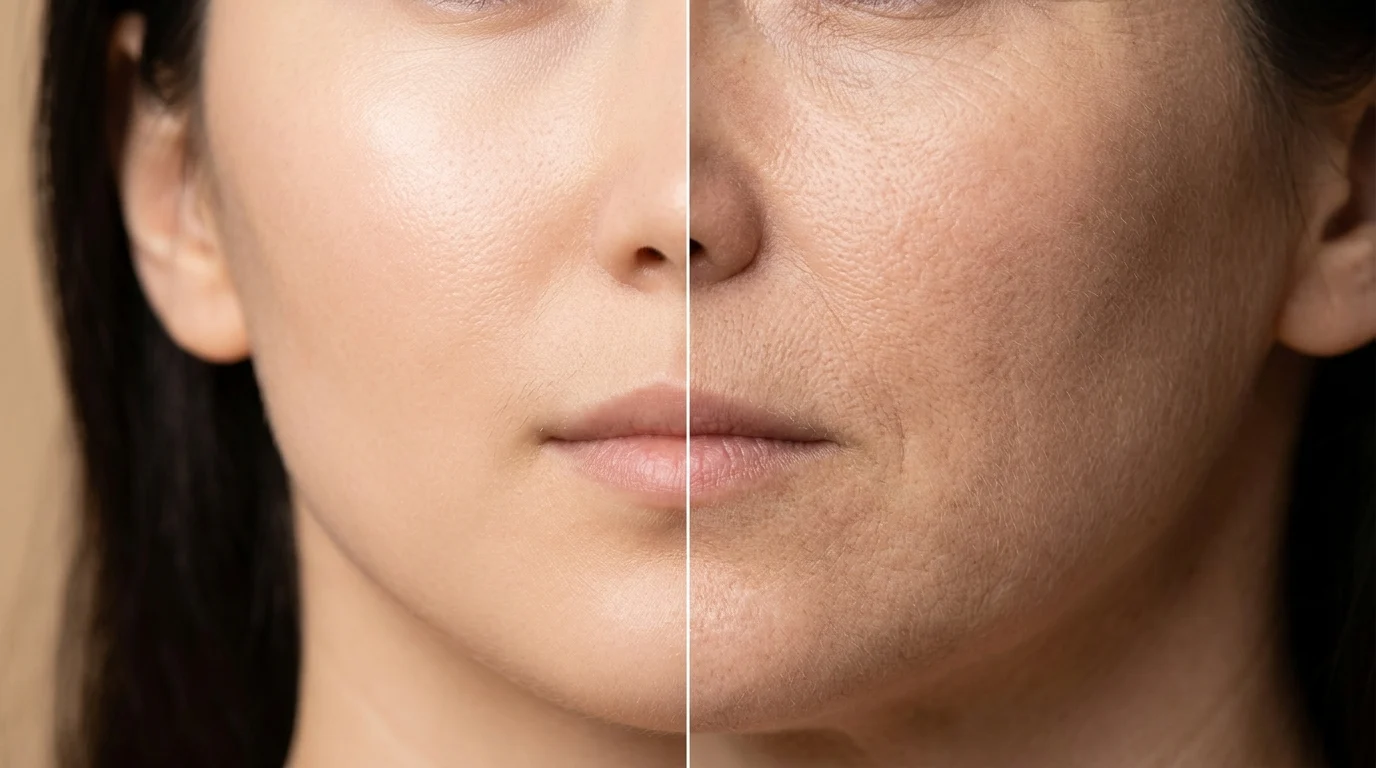
Central to those consequences are matrix metalloproteinases — MMPs. These enzymes are responsible for remodeling the extracellular matrix, the dense collagen-rich framework that gives skin its structural firmness. Under normal conditions, MMP activity is tightly regulated. In a chronically inflamed tissue environment, however, that regulation may break down. MMP activity becomes elevated and less selective, degrading collagen fibers at a rate that outpaces their renewal. Over repeated inflammatory episodes, this process is associated with measurable loss of dermal structural density — a mechanism distinct from glycation, operating on a faster timescale and through a different biochemical route. Research on glucose-driven inflammation and collagen degradation documents this pathway in detail. It is also worth noting that cortisol — elevated during psychological and physiological stress — independently raises blood glucose through hepatic glucose release, meaning the two processes can reinforce each other. How cortisol and glucose-driven inflammation compound skin aging outlines that combined dynamic.
The association between blood sugar and wrinkles appears to run, in part, through this inflammation-driven collagen degradation — a process that may be more responsive to metabolic intervention than the structural changes that follow long-term glycation.
Where Glycation Begins: The Bridge From Acute Spikes to Chronic Damage
When blood glucose remains chronically elevated — not merely spiking, but failing to return efficiently to baseline over months and years — glucose molecules begin to bond non-enzymatically to collagen and elastin proteins. This process, glycation, produces Advanced Glycation End-products (AGEs): structural modifications that render collagen fibers stiffer, more cross-linked, and less amenable to normal remodeling. Skin that has sustained significant AGE accumulation tends to lose resilience and elasticity, and in more advanced cases may develop a denser, less luminous appearance.
Crucially, this is a slow-accumulating process rather than an acute response. Research on glycation and skin collagen structure indexed on PubMed indicates that AGE accumulation in dermal tissue reflects sustained glucose excess over time, not individual postprandial spikes. The distinction has practical implications: blood sugar spikes cause immediate hormonal and inflammatory events that may damage skin structure within hours; glycation represents the long-term structural record of repeated glucose excess over years. The two are connected by chronicity, not by identical mechanism. For the full mechanism of skin glycation and how it differs from acute glucose effects, the dedicated article covers AGE formation, cross-linking dynamics, and the evidence base for interventions that address them.
Acute spikes set conditions in motion. Glycation is what those conditions, left unaddressed over years, may leave behind.
The Population Evidence: Does Diet Pattern Actually Show Up in Skin?
Translating cellular mechanisms into population-level conclusions requires some methodological restraint. Nutritional epidemiology is inherently difficult — dietary recall is imprecise, confounding variables are numerous, and long-duration randomized trials examining dietary pattern and skin aging outcomes remain scarce. What the available evidence does offer, consistently, is a directional signal.
Research on diet patterns and skin aging markers identifies associations between sustained high-glycemic dietary habits and accelerated markers of skin structural aging. Clinical findings on metabolic health and skin aging outcomes further suggest that insulin sensitivity status correlates with measurable differences in skin aging trajectories across populations. These are associations, not causal proofs — but they are consistent across independent data sets, which strengthens the hypothesis.
The more defensible claim is this: sustained dietary patterns appear to be a contributing variable in how skin ages, operating alongside UV exposure, genetic predisposition, and topical skincare rather than in place of them. A single meal is unlikely to determine long-term skin outcomes; a dietary pattern maintained over years may well do so. How gut health and dietary patterns influence skin aging from within examines an additional layer of this relationship, particularly where gut microbiome composition intersects with insulin resistance and skin inflammation.
The broader questions of hyperinsulinemia skin effects and insulin resistance as a driver of visible skin aging are gaining traction in metabolic and dermatological research — no longer peripheral hypotheses, but active areas of clinical inquiry.
The Glucose Conversation in Mainstream Wellness: Cultural Shift or Lasting Science?
Jessie Inchauspé — the biochemist behind the “Glucose Goddess” framework — has achieved something substantive: she brought postprandial glucose literacy to a mainstream audience that had largely never engaged with the concept. Her work, particularly Glucose Revolution, popularized ideas around spike frequency, meal sequencing, and dietary pairing as tools for moderating blood glucose response. For many readers, it was the first time the relationship between food and metabolic physiology had felt personally applicable.
Several of her core concepts do align with current metabolic research. The importance of spike frequency and magnitude, the documented effect of food sequencing on postprandial glucose curves, and the general direction of a lower-glycemic dietary pattern are all supported by published evidence. Where the framework becomes less straightforward is in the translation of those principles into universal prescriptions. Individual glucose responses vary substantially — a point consistently demonstrated by continuous glucose monitoring studies, which show that ten people eating identical meals may produce ten meaningfully different postprandial curves. Some of Inchauspé’s more specific practical recommendations, such as precise sequencing rules and the use of vinegar before meals, have a more limited evidence base than her broader messaging implies.
This is not an unusual problem in science communication: the core signal is real, but the path from peer-reviewed finding to actionable popular advice inevitably involves simplification. The cultural shift toward metabolic awareness has been largely constructive. Where it warrants scrutiny is in the gap between population-level associations and individually reliable interventions — a distinction that clinical evidence does not always support collapsing. The oversimplification is where informed reading remains necessary.
What Actually Helps: Practical Interventions With Evidence Behind Them
The following represent evidence-informed inputs — not a prescriptive dietary protocol, but documented levers with measurable effects on glucose dynamics and, by extension, on the skin aging mechanisms described above.

- Pair carbohydrates with fiber, protein, or fat. Consuming carbohydrates alongside these macronutrients slows gastric emptying and attenuates glucose absorption, which may meaningfully reduce peak spike magnitude. The practical form is straightforward: rice alongside a protein source and vegetables, rather than consumed alone.
- Prioritize lower-glycemic foods as a dietary pattern, not a rigid rule. Whole grains, legumes, and non-starchy vegetables are associated with lower postprandial glucose responses than their refined counterparts. Sustained dietary shifts in this direction are likely to reduce average insulin load over time — without requiring the elimination of entire food categories. A lower glycemic dietary approach for skin longevity is less about restriction than about consistent substitution.
- Post-meal movement has a documented effect on postprandial glucose. Studies have shown that a 10-minute walk after eating can reduce postprandial glucose excursions. During physical activity, muscle contraction facilitates glucose uptake independently of insulin signaling — an effect that is available immediately and requires no special equipment.
- Sleep quality is a metabolic variable. Research suggests that even a single night of disrupted sleep is associated with measurably reduced insulin sensitivity the following day, meaning identical meals may produce larger glucose spikes under sleep restriction. Skin longevity diet principles that ignore sleep are operating with an incomplete picture. Magnesium, insulin sensitivity, and sleep quality for skin longevity outlines targeted nutritional support for this connection.
- Sustained aerobic exercise is associated with improved insulin sensitivity. Zone 2 training — moderate-intensity aerobic exercise maintained consistently over time — has been linked to increased mitochondrial density and upregulation of glucose transporter expression in muscle tissue, effects that may improve insulin sensitivity durably. How Zone 2 exercise improves insulin sensitivity and skin aging outcomes examines this mechanism in the context of dermal aging specifically.
- Stress management has metabolic relevance. Cortisol stimulates hepatic glucose release — a physiological response that, when chronically activated, may drive blood sugar spikes independently of dietary intake. Reducing psychological stress load is, among other things, a form of glucose regulation.

If you suspect metabolic or blood sugar irregularities are affecting your skin or health, consult with a GP or endocrinologist — blood glucose management is a clinical matter that goes beyond skincare adjustment.
A note on the “sugar is bad for skin” binary: Glucose is the primary metabolic substrate for every cell in the body — including keratinocytes, fibroblasts, and the cells responsible for collagen synthesis. The issue is not glucose per se. Current evidence points instead to the frequency and magnitude of postprandial spikes, the low-grade inflammatory environment that repeated spikes may create, and the downstream hormonal cascade that follows chronically elevated insulin. A single high-glycemic meal in an otherwise well-regulated metabolic context is unlikely to be consequential. What the evidence consistently implicates is pattern — not any single food or occasion.
Frequently Asked Questions
Does cutting sugar from your diet actually improve your skin?
Eliminating sugar as a category is less meaningful than reducing the frequency and magnitude of glucose spikes overall. Refined carbohydrates, high-glycemic starches, and sugar-sweetened beverages appear to be the dietary factors most consistently associated with the insulin and IGF-1 responses linked to acne and collagen degradation. Whole fruit, for example, carries a meaningfully different glycemic profile than fruit juice despite both containing fructose — the food matrix matters. The more useful target is the sustained dietary pattern, not a single ingredient.
What is the difference between blood sugar spikes and glycation in terms of skin aging?
Blood sugar spikes are associated with a set of immediate downstream events: insulin and IGF-1 rise, sebaceous glands may increase sebum production, NF-κB-mediated inflammation activates, and MMP-driven collagen degradation may follow — all within hours of the glucose elevation. Glycation, by contrast, is a cumulative structural process: glucose molecules bind non-enzymatically to collagen and elastin over years of sustained excess, forming AGEs that progressively stiffen and alter dermal architecture. The spike is the acute physiological event; glycation is the structural record that may accumulate in its long-term wake.
Can exercise really reduce the skin impact of a high-glycemic meal?
Post-meal physical activity has been shown in several studies to reduce postprandial glucose excursions. The mechanism is direct: skeletal muscle contraction facilitates glucose uptake via GLUT4 transporter translocation independently of insulin signaling, which may lower peak blood glucose without requiring additional insulin secretion. That said, the magnitude of benefit varies depending on exercise intensity, meal composition, timing, and individual metabolic health status. A 10-minute walk after eating appears to offer a meaningful, accessible effect — but it is one input within a broader metabolic picture, not a standalone corrective.