

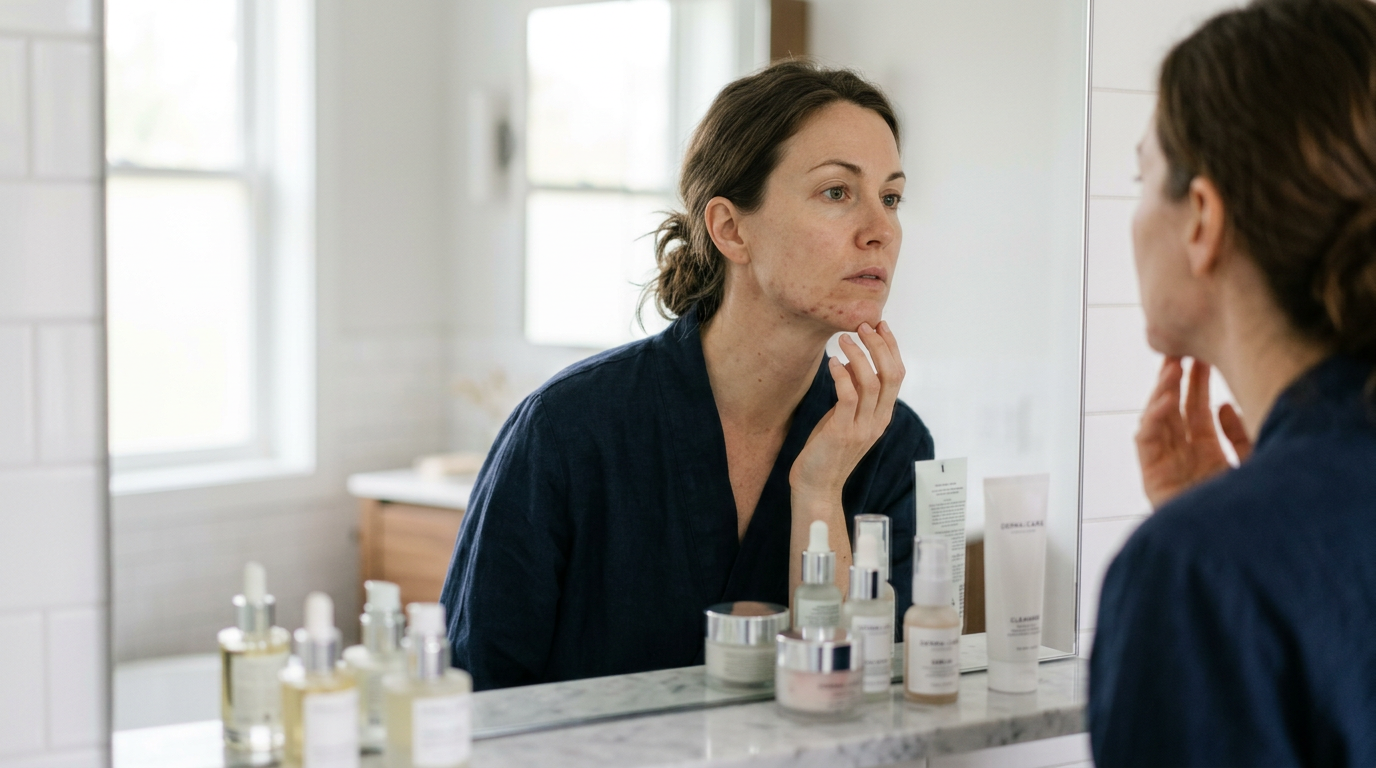
Imagine a 35-year-old woman with a skincare shelf most editors would approve of. She cleanses with a pH-balanced formula, layers actives strategically, reaches for the spot treatment before bed. And yet, every cycle — with near-clockwork reliability — she wakes to deep, tender knots along her jawline. Not surface blemishes. Painful, cystic formations that sit beneath the skin and take weeks, sometimes longer, to fully fade. She has changed cleansers, rotated serums, added exfoliating acids. Nothing moves the pattern. This is what hormonal acne tends to look like in adult women — and the crucial thing to understand is that her routine is not the problem. The source of this acne may be almost entirely internal, driven by hormonal shifts that most topical products were never designed to reach, and the damage being left behind may be mismanaged at a cellular level that goes far deeper than any serum can penetrate.
Adult female acne is not teenage acne revisited. It is a clinically distinct condition, shaped by shifting endocrine chemistry, altered receptor sensitivity, and a skin barrier that heals more slowly than it once did. Understanding why it happens — and why it leaves marks — requires looking beneath the surface. Literally.
Why Adult Acne and Teenage Acne Are Not the Same Condition
The comparison feels intuitive, but it can be deeply misleading. Both involve breakouts; almost everything else about them may differ significantly. According to a clinical review of adult female acne patterns, the distribution, hormonal drivers, and skin context of acne after 30 place it in an entirely separate clinical category from adolescent breakouts — one that may require a fundamentally different approach to treatment and recovery.
The geography of acne tells much of the story. Where breakouts appear on the face is rarely coincidental:
- Location: Teenage acne tends to concentrate in the T-zone — forehead, nose, chin — reflecting a generalized surge of puberty hormones across the system. Adult hormonal acne in women characteristically clusters in the U-zone: the jawline, chin, lower cheeks, and neck. This geographic shift is itself a diagnostic signal worth noting.
- Skin context: Teenage skin is typically oilier, more structurally resilient, and capable of faster cellular regeneration. Adult skin after 30 tends to be drier, its barrier more vulnerable to disruption, and its recovery from inflammation measurably slower.
- Hormonal driver: Puberty acne reflects a temporary systemic surge — hormones rising across the board. Adult female acne is more commonly associated with a relative imbalance in the estrogen-to-androgen ratio, a shift that can occur even when standard blood values appear entirely within normal ranges.
- Treatment response: Products formulated for teenage skin — high-strength benzoyl peroxide, aggressive exfoliating acids, stripping cleansers — may significantly worsen adult acne by compromising an already fragile barrier, triggering reactive sebum production, and amplifying inflammation rather than resolving it.
This is the core miscalculation in reaching for acne products designed for a 16-year-old when the biology in question belongs to a 35-year-old. The skin’s needs have changed. The approach, logically, may need to change with them.
The Estrogen Shift: Why Hormonal Acne Often Worsens After 30

Estrogen plays several regulatory roles within the skin, and one of the most relevant to acne is its capacity to suppress sebum production. It can modulate the activity of sebaceous glands, keeping oil output within a range that the pore can manage. After 30 — and often accelerating through perimenopause — estrogen levels may begin to fluctuate rather than decline steadily. They oscillate, dip, and become less predictable across the monthly cycle. As this happens, androgens — primarily testosterone and its more potent derivative DHT — can gain relative dominance, even without technically exceeding the clinical normal range.
The sebaceous gland responds to this shift. Research suggests it may begin producing thicker, more comedogenic sebum at greater volume — the kind that can trap debris, block follicles, and create the conditions for deep cystic breakouts. This pattern is widely observed in cases of perimenopause acne and tends to be far more difficult to manage with surface-level treatment than typical teenage congestion. According to research on local androgen activity and sebaceous glands, this sebum signal may be generated locally within the skin’s own sebocytes — not solely through the hormones circulating in the bloodstream. This helps explain why a standard hormone panel can return unremarkable results while the skin is experiencing a pronounced hormonal response.
For women navigating hormonal acne in women over 30, this disconnect between bloodwork and skin behaviour is one of the most frustrating aspects of the condition. The body’s internal chemistry may read as “normal” while the jawline tells a different story entirely. It is also worth understanding how hormonal stress shows on the face — because estrogen fluctuation and cortisol do not operate in isolation, and their combined influence on the skin can be considerable.
Cortisol, the HPA Axis, and Why Stress Writes Itself on Your Jawline

Women between 30 and 45 frequently carry some of the highest chronic stress loads of their lives — professional demands, caregiving responsibilities, disrupted sleep, financial pressure, the quiet accumulation of sustained vigilance. This is not a lifestyle observation; it has measurable physiological consequences. Chronic stress elevates cortisol, and cortisol is associated with a direct and clinically relevant relationship with acne.
Cortisol may bind to receptors in the sebaceous glands and signal for increased sebum output. More precisely, it can trigger the release of CRH — corticotropin-releasing hormone — which activates the skin’s own version of the HPA (hypothalamic-pituitary-adrenal) axis. This is a neurological signaling cascade. It originates in the brain, moves through the nervous system, and arrives at the skin’s glands with instructions that operate far below the level any topical product can reach.
This is why stress acne in adults tends to produce the most painful, the deepest-seated, and the most treatment-resistant lesions. A salicylic acid pad is not equipped to interrupt a neurochemical signal. Framing stress acne in adults as a clinical driver — rather than a lifestyle inconvenience — is an important shift in perspective. Understanding how chronic cortisol disrupts skin health makes the case compellingly: this is a systemic event, and it warrants a systemic response. Jawline acne that flares predictably around the luteal phase or during periods of sustained pressure may be less about what is being applied to the skin and more about what is happening within the adrenal and endocrine systems altogether.
Why Post-Acne Marks Last Longer After 30 (The TGF-β Problem)
Even when a breakout resolves, what it leaves behind in adult skin may be increasingly visible and slow to fade. Post-acne marks, hyperpigmentation, and subtle textural changes that once cleared within days may now linger for weeks — or considerably longer. The reasons are multiple and interconnected: reduced cell turnover, a more fragile barrier, slower collagen remodelling, individual genetic healing capacity, lesion depth, and the intensity of the initial inflammatory response all play a role. There is rarely a single cause — and that complexity is precisely why post-acne scarring can be so difficult to address uniformly.
One pathway that researchers have identified as particularly relevant to post-inflammatory skin repair is TGF-β — Transforming Growth Factor-beta. This signaling molecule plays a central role in how the skin initiates tissue repair after injury. When an acne lesion causes inflammation, TGF-β helps coordinate the healing response by activating fibroblasts — the cells responsible for producing collagen. In younger skin, this process can operate with reasonable balance. In adult skin, however, research suggests that TGF-β activity may become less regulated during the repair phase, potentially contributing to a fibrosis-like response in which fibroblasts convert into myofibroblasts — a type of repair cell associated with higher-volume, less organised collagen production.
A useful analogy: healthy skin collagen is arranged in a basket-weave pattern — flexible, multi-directional, structurally sound — like a wall built with well-fitted, interlocking bricks. When the repair process is dysregulated, the outcome may resemble emergency concrete being poured instead: fast and thick, but less architecturally precise. It is important to note, however, that this is only one factor among many. Not everyone who experiences adult acne will develop significant textural scarring, and the severity of post-inflammatory changes is influenced by genetics, pigmentation type, wound depth, and how quickly the initial inflammation was controlled. TGF-β dysregulation may contribute to suboptimal healing in some individuals — but it does not operate in isolation, and modulating it cannot guarantee scar-free recovery.
What the research does suggest, as detailed in clinical findings on post-inflammatory skin repair in aging skin, is that supporting more organised signaling during the healing phase may influence the quality of tissue repair — potentially reducing the degree of collagen disorganisation and post-inflammatory hyperpigmentation in susceptible skin. Collagen and acne recovery are more closely connected than many routines acknowledge. The structural quality of the repair response may shape how visible the aftermath of each lesion becomes over time. For those exploring adjunctive approaches during the recovery phase, red light therapy for post-acne skin repair has been investigated for its capacity to modulate inflammation and support cellular regeneration — particularly in the post-inflammatory window when tissue is still actively remodelling.
Why Skin Recovery Matters After Hormonal Acne Breakouts
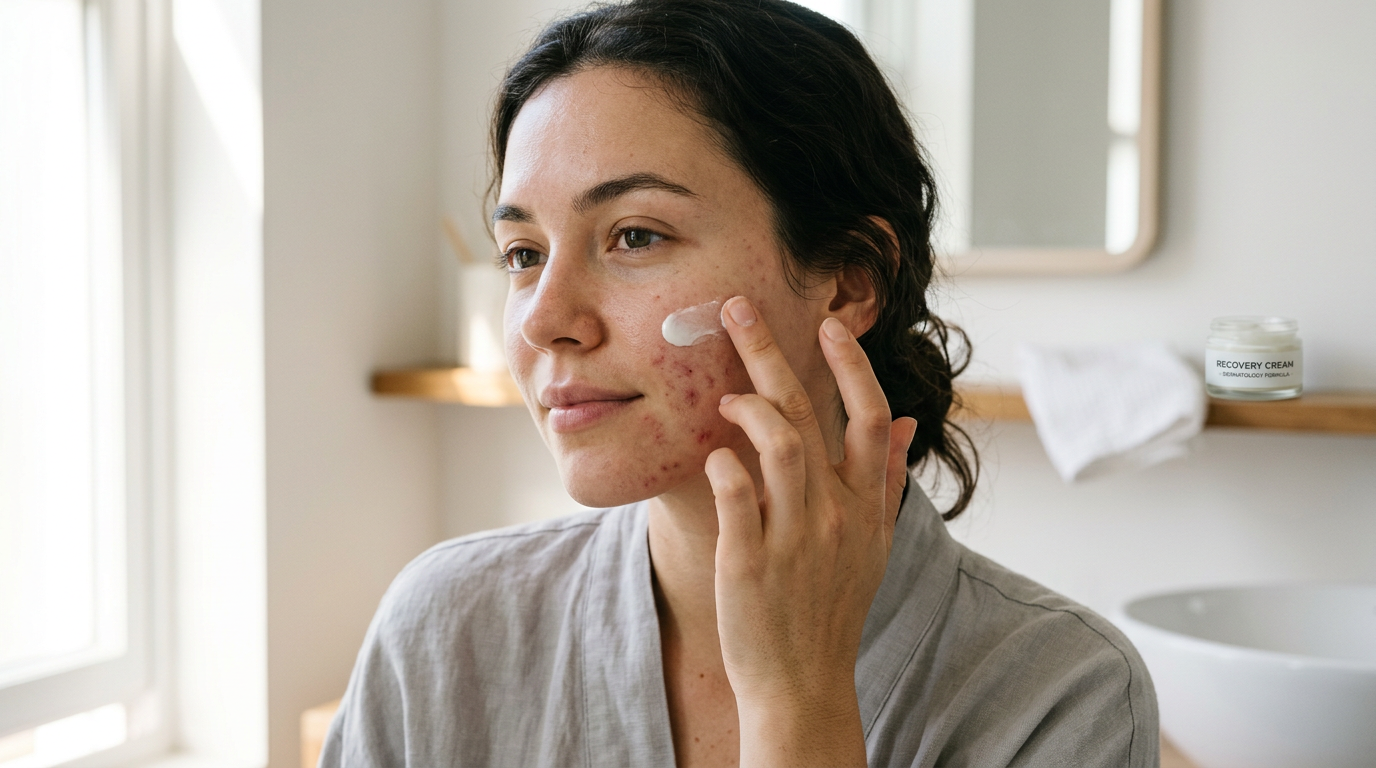
Most adult acne conversations focus on prevention: how to stop new breakouts from forming, how to keep pores clear, how to regulate sebum. These are valid goals — but they address only half of the picture. For women dealing with acne caused by hormonal fluctuations, what happens in the skin after each inflammatory episode may be just as consequential as what caused it. The recovery phase — the days and weeks following a resolved lesion — is where post-acne marks form, where the barrier is most depleted, and where the quality of long-term skin texture is quietly being determined.
After 30, this recovery phase slows perceptibly. Epidermal cell turnover decreases, meaning the skin surface takes longer to renew itself. Collagen production becomes less efficient, and the structural repair that follows each inflammatory event may lack the speed and precision it once had. The barrier — already more fragile than in younger skin — can be further compromised by the very treatments being used to manage the acne. This creates a layered challenge: the skin is trying to heal while simultaneously managing active breakouts and coping with treatment-induced sensitivity.
Aggressive acne treatments are effective for a reason. Retinoids accelerate cell turnover and reduce comedone formation. Benzoyl peroxide kills acne-causing bacteria. Salicylic acid clears congested pores. These are clinically supported tools — but they carry a documented cost to barrier function. Prolonged use can increase transepidermal water loss, thin the stratum corneum, and sensitise the skin to environmental triggers. In adult skin that is already more fragile, this cost may be more pronounced and slower to recover from. The result is a pattern many women describe intuitively: the treatment clears the acne, but the skin never quite returns to feeling calm or resilient.
Supporting barrier repair and organised healing is not a luxury layer in an adult acne routine — it may be an essential one. Without it, the skin can remain in a low-grade state of chronic vulnerability: reactive to minor stressors, slow to fade post-inflammatory pigmentation, and less able to mount an efficient repair response with each successive breakout. Recovery-focused skincare does not replace medical or hormonal intervention; it cannot address the endocrine drivers of jawline hormonal breakouts at their source. What it can do is meaningfully support the skin during and after active treatment — reducing the inflammatory aftermath, protecting the barrier, and creating the conditions for more organised, less visibly disruptive healing.
This is a distinction worth holding clearly: managing acne and supporting skin recovery are parallel processes, not the same one. The most effective adult acne protocols tend to address both — the root cause where possible through clinical means, and the cellular consequences through targeted, barrier-intelligent formulations designed for the specific demands of post-inflammatory adult skin.
What Actually Supports Hormonal Acne Recovery After 30
The necessary pivot for adult acne management can be framed simply: stop stripping, start supporting. The therapeutic goal shifts — from aggressive bacterial suppression toward barrier-intelligent management that may reduce inflammation without compromising the skin’s own structural defences. For women navigating adult hormonal acne, this shift is not optional; it may be the difference between a routine that stabilises the skin and one that perpetuates the inflammatory cycle.
Several evidence-grounded ingredients have demonstrated meaningful relevance in this context:
- Niacinamide (4–10%): Associated with sebum regulation, reduction of post-inflammatory hyperpigmentation, and barrier reinforcement. It tends to be well tolerated even on sensitised adult skin, making it one of the most reliably useful actives for adult female acne management.
- Azelaic acid (10–20%): Research suggests it can address both active lesions and residual discoloration with a degree of anti-inflammatory action and mild keratolytic activity. Critically, it may do this without the barrier compromise commonly associated with high-strength exfoliating acids — an important consideration for drier, more fragile adult skin.
- Barrier-repair ingredients: Ceramides, fatty acids, and cholesterol — in physiologically balanced ratios — can help restore the structural integrity that aggressive acne treatments routinely deplete. Retinoids and benzoyl peroxide may be effective actives, but they carry a meaningful cost to the skin barrier. That cost may need to be actively managed, not overlooked.
This is where recovery-phase science enters the picture — and where understanding the cellular biology becomes practically useful. Conventional acne products address bacteria, excess sebum, and surface congestion. What they cannot do is regulate the TGF-β signaling cascade that may drive post-acne micro-scarring. This is not a failure of formulation; it is simply a different biological target, one that requires a different class of ingredient to reach.
Published research in Frontiers in Medicine — available in full at research on TGF-β signaling and skin regeneration — has examined how deer antler velvet peptides (EVAP) may specifically modulate the TGF-β pathway. The findings are scientifically compelling: when this signaling pathway is regulated rather than allowed to run unchecked, skin healing may occur with considerably more precision. Collagen fibers may organise into the natural basket-weave structure of healthy dermis rather than the rigid, chaotic configuration associated with scarring. Sebaceous glands are more likely to be preserved. The risk of textural disruption and post-inflammatory marks may be meaningfully reduced.
It is this cellular recovery science that underpins the formulation of BIOVELVET™ Recovery Cream. Rather than functioning as another acne treatment in the conventional sense, it is designed to address what happens after the active lesion — the repair phase that most skincare routines leave entirely unmanaged. Based on available evidence, its potential role in a post-acne protocol may include:
- Supporting the reduction of inflammation and redness in active acne lesions during the resolution phase
- Accelerating post-breakout healing and potentially reducing the formation of post-acne marks
- Helping to restore barrier integrity that may have been compromised by retinoids, salicylic acid, or benzoyl peroxide — the established tools of acne treatment
- Addressing the cellular communication disruption — specifically in the TGF-β pathway — that standard acne treatments are not formulated to reach
It bears stating clearly: BIOVELVET™ does not treat the hormonal root cause of adult acne. Nothing applied to the skin’s surface can alter the endocrine shifts described above. What a well-formulated recovery cream may do is manage the cellular consequences of those shifts more intelligently — supporting cleaner healing, reduced post-acne pigmentation, and a more intact barrier through the active treatment phase. Recovery creams of this type are most appropriately used at night or on targeted dry and inflamed areas, rather than applied broadly over congested, oily skin. Precision is the operative word here. For those considering where it might fit within an adult acne protocol, why BIOVELVET is worth trying for post-acne skin offers a grounded clinical rationale worth reading before making the decision.
The acne skin barrier repair conversation is, ultimately, the missing layer in most adult acne routines. Inflammation damages the barrier. Treatment further depletes it. Without an active restoration phase, the skin may remain in a low-grade state of vulnerability — perpetually reactive, slow to heal, and prone to the kind of post-inflammatory marking that accumulates visibly over time.
Myth: Jawline breakouts mean your skincare routine is failing you. If acne concentrates along the jaw and chin and follows a predictable hormonal cycle, it is more likely a systemic signal than a skincare gap. U-zone breakouts in adult women are commonly associated with androgen activity and cortisol fluctuations that operate well beneath the level any topical product can address. What thoughtfully formulated topicals can do is manage the inflammatory aftermath — supporting healing, protecting the barrier, and reducing the visible damage that each cycle leaves behind. BIOVELVET™ Recovery Cream may address exactly this cellular layer — the post-breakout repair stage that most routines never account for at all.
A clinical note: Always consult with a dermatologist or endocrinologist if adult hormonal acne is persistent, cystic, or significantly impacts quality of life — a hormonal assessment may reveal drivers that skincare alone cannot address. Clinically validated options including topical and oral retinoids, spironolactone, and low-dose oral contraceptives have meaningful evidence in the management of hormonal acne in women and fall well outside the reach of any topical routine alone.
Why is my acne getting worse in my 30s even though I take care of my skin?
Because the primary driver may be internal rather than topical. After 30, estrogen can begin to fluctuate while androgens gain relative dominance — a shift that research suggests may stimulate sebaceous glands to produce thicker, more pore-blocking sebum. Cortisol can compound this through a separate neurological pathway. No amount of topical diligence is likely to intercept a hormonal shift occurring at the endocrine level — and applying products designed for teenage skin may actively worsen adult acne by stripping a barrier that is already more fragile than it was at 16.
What actually helps hormonal acne in adult women?
A dual-layered, clinically informed approach tends to be most effective: managing the internal root cause through medical means (such as spironolactone, low-dose contraceptives, or retinoids prescribed by a dermatologist), while simultaneously protecting the tissue with barrier-intelligent topicals (like niacinamide and azelaic acid) and dedicated cellular recovery formulas to manage the post-inflammatory phase.
Why do post-acne marks take so long to fade after 30?
Because the skin’s repair mechanism may become less precise with age — and because post-acne scarring is multifactorial. Research suggests that TGF-β signaling, one of the pathways involved in tissue repair, may become less regulated in adult skin, potentially contributing to less organised collagen production after inflammatory lesions. Cell turnover also slows progressively through the thirties and forties, meaning the surface takes longer to shed the discoloured cells sitting above the damage. Genetics, lesion depth, and individual pigmentation response all shape the outcome too — which is why recovery-focused formulations that aim to support more organised healing at the cellular level represent a meaningful, if complementary, addition to post-acne skin regeneration protocols.
Can hormonal acne go away on its own?
In some cases, yes — but the picture is rarely straightforward. For some women, hormonal acne may improve or resolve as the body stabilises after a period of hormonal flux, such as following pregnancy, discontinuing certain contraceptives, or moving through the perimenopause transition. However, the underlying hormonal imbalance driving the breakouts is unlikely to self-correct without some form of intervention — whether lifestyle-based, nutritional, or clinical. Without addressing the root cause, the pattern commonly persists, and the cumulative impact of repeated inflammatory lesions on adult skin may increase over time. Spontaneous resolution is possible, but relying on it as a management strategy — particularly when cystic lesions are involved — is not generally supported by clinical evidence.