


She wears SPF 50 every morning. She does not smoke. She eats reasonably, exercises, and uses a considered skincare routine. And somewhere around her mid-thirties, she notices her skin aging faster than she expected — a texture that feels subtly coarser, fine lines that are deepening without clear cause, a brightness that has quietly dimmed. The obvious factors are covered. What she has not addressed — because it is invisible — is the continuous cellular process of oxidative stress and skin aging operating beneath the surface. Driven by free radicals and reactive oxygen species, this process runs silently, cumulatively, and from multiple directions at once. SPF addresses one driver. It does not address the others. Understanding the distinction changes what a skin longevity routine actually needs to include.
What Is Oxidative Stress? The Pickpocket Analogy Explained
Every cell in the body — including skin cells — contains molecules that operate in a state of chemical balance. That balance depends on electrons being correctly paired within molecules. Free radicals, more precisely called reactive oxygen species (ROS), are molecules that have lost an electron and are now chemically unstable. To restabilize, they take electrons from neighboring molecules — damaging those molecules in the process, which then become unstable and take from their neighbors. A chain reaction of cellular damage follows.
Think of it as a crowd of pickpockets moving through a marketplace. Each one steals from the person beside them; that person, now missing something, steals from someone else. The whole environment deteriorates — not from a single dramatic event, but from a continuous series of small thefts. This is what ROS do at a molecular level inside skin tissue.
ROS arise from both external and internal sources. UV radiation, urban air pollution, and cigarette smoke all drive ROS production. But normal cellular metabolism does too — energy production inside every cell generates free radicals as a natural byproduct, regardless of environment. The skin’s defense against this is its endogenous antioxidant system — molecular bodyguards that donate electrons to free radicals, neutralizing them before they can cause damage. When production and neutralization stay in balance, the system holds. When ROS production outpaces the antioxidant response, the system tips into oxidative stress. The underlying science is documented in Nature’s research overview on oxidative stress and skin aging.
The Sources of Oxidative Stress Your Skincare Routine Isn’t Addressing
UV radiation earns the most attention in skincare, and rightly so — it is the most potent single extrinsic driver of ROS generation in skin. But the cumulative oxidative load on skin in contemporary urban life comes from several simultaneous sources that a well-formulated SPF was never designed to address.

- UV radiation: The most potent single extrinsic source — generates ROS directly within skin cells, triggering collagen degradation pathways and DNA damage.
- Particulate air pollution: Fine particulate matter, nitrogen dioxide, and ozone appear to generate ROS independently of UV exposure, as indicated by research on air pollution and oxidative stress in skin. Evidence from both in vitro and epidemiological studies associates chronic pollution exposure with accelerated skin aging markers.
- Blue light: There is emerging, though still limited, evidence that high-intensity visible light — particularly in the blue spectrum — may generate ROS in skin. Current research mostly involves laboratory settings with light intensities higher than typical screen exposure; the degree of oxidative burden from everyday screen use remains an open question.
- Chronic psychological stress: Sustained elevation of glucocorticoids, including cortisol, has been associated in experimental models with increased intracellular ROS production and reduced antioxidant enzyme activity, though the precise mechanisms in human skin remain under active investigation.
- Sleep disruption: Skin cell repair and ROS clearance are enhanced during sleep — a pattern that has been observed in circadian biology research, though characterizing this as the “majority” of antioxidant activity is not well-established. Disrupted sleep is reasonably associated with impaired nocturnal repair cycles.
- High-glycemic diet: Glucose metabolism generates ROS as a metabolic byproduct, and diets high in rapidly absorbed carbohydrates are thought to increase this internal oxidative burden — though the direct skin-aging effects of diet-derived ROS in humans are difficult to isolate and remain an area of active research.
This cumulative, multi-source burden is part of why oxidative stress compounds skin barrier dysfunction over time in ways that UV protection alone cannot prevent.
What Free Radicals Actually Do to Skin Structure
Oxidative stress is not an abstract biochemical concept — it produces specific, measurable structural damage. Understanding what ROS actually degrade clarifies why the visible signs of aging take the form they do.
- Collagen degradation via MMP activation: ROS activate matrix metalloproteinases (MMPs) — enzymes that break down collagen and elastin in the dermis. Picture rust dissolving a metal framework from within: the structure does not collapse suddenly, it weakens incrementally until it can no longer hold its form. The result is diminished firmness, sagging, and the deepening of lines over time.
- DNA damage: ROS generate oxidative lesions in cellular DNA — including the formation of 8-hydroxy-2′-deoxyguanosine (8-OHdG), a well-established marker of oxidative DNA damage. This impairs the cell’s ability to replicate correctly and maintain normal protein synthesis, including collagen production.
- Lipid peroxidation: The stratum corneum depends on an organised lipid matrix — ceramides, free fatty acids, and cholesterol — for its barrier function. ROS oxidize these epidermal lipids, compromising barrier integrity and increasing transepidermal water loss (TEWL).
- Protein oxidation: Beyond structural collagens, ROS modify other cellular proteins through carbonylation and other oxidative modifications, impairing their function and contributing to the loss of skin elasticity associated with oxidative stress and wrinkles.
Mitochondrial Oxidative Damage: Why Skin Cells Lose Energy as They Age
Inside every skin cell are mitochondria — structures responsible for producing the energy the cell needs to function, repair itself, and synthesise collagen. In generating that energy, mitochondria also produce ROS as an unavoidable byproduct of the electron transport chain. This makes them simultaneously a primary source of free radicals and a primary target of free radical damage.
Think of it as a power station corroding from within. As the internal corrosion accumulates, the station generates less power. In skin biology, the consequence is direct: as mitochondria accumulate oxidative damage over time, cellular energy output declines, collagen synthesis slows, and the cell’s capacity to repair UV-induced and pollution-induced damage diminishes. The cell is still present. It is operating at a fraction of its original capacity.
Peer-reviewed research on mitochondrial oxidative stress and skin aging has established this as a key mechanism of intrinsic biological aging — not a surface-level cosmetic concern. It operates from inside the cell outward, and it accumulates in ways that do not become structurally visible until damage is already significant. This framing is central to why oxidative stress management sits at the core of the healthy aging framework.

Oxidative Stress and Glycation: The Compounding Cycle
Oxidative stress does not operate in isolation. One of its more consequential interactions is with glycation — the process by which excess glucose molecules attach non-enzymatically to collagen and elastin fibers, forming Advanced Glycation End-products (AGEs) that progressively stiffen and discolor the skin’s structural tissue.
What makes this relationship damaging is that it is self-reinforcing. Oxidative stress is thought to accelerate glycation by destabilizing cellular proteins and increasing their susceptibility to glucose attachment. In turn, AGEs generate additional ROS — in part through activation of the receptor for advanced glycation end-products (RAGE), which triggers downstream inflammatory and oxidative signaling. Each process amplifies the other. The longer this cycle runs without intervention, the more entrenched the structural damage becomes. For a detailed account of how these mechanisms interact, see the full mechanism of skin glycation and how it compounds oxidative damage.
The Antioxidant Defense System: Why It Weakens With Age
The body does not rely entirely on topical skincare to manage oxidative stress — it maintains its own enzymatic defense system. Superoxide dismutase (SOD) converts superoxide radicals (among the most reactive ROS species) into hydrogen peroxide. Catalase then breaks down that hydrogen peroxide before it can generate the highly destructive hydroxyl radical. Glutathione, both directly and through glutathione peroxidase, scavenges residual ROS and helps regenerate oxidized antioxidants back to their active forms.
With age, this system loses efficiency. Enzymatic activity declines, glutathione concentrations fall, and the defense that once maintained oxidative balance with reasonable reliability is now operating below capacity. Evidence from research on topical antioxidants and oxidative stress in skin supports the argument that topical antioxidants serve as a measurable compensatory input — not cosmetic extras, but a rational response to a defense mechanism that is gradually losing ground.
The Most Effective Antioxidant Ingredients in Skincare — And What the Evidence Supports
Not all antioxidant ingredients carry equal weight in terms of evidence, mechanism, or formulation stability. The following have the strongest research base for addressing skin inflammation oxidative stress, structural collagen loss, and age-related cellular decline.
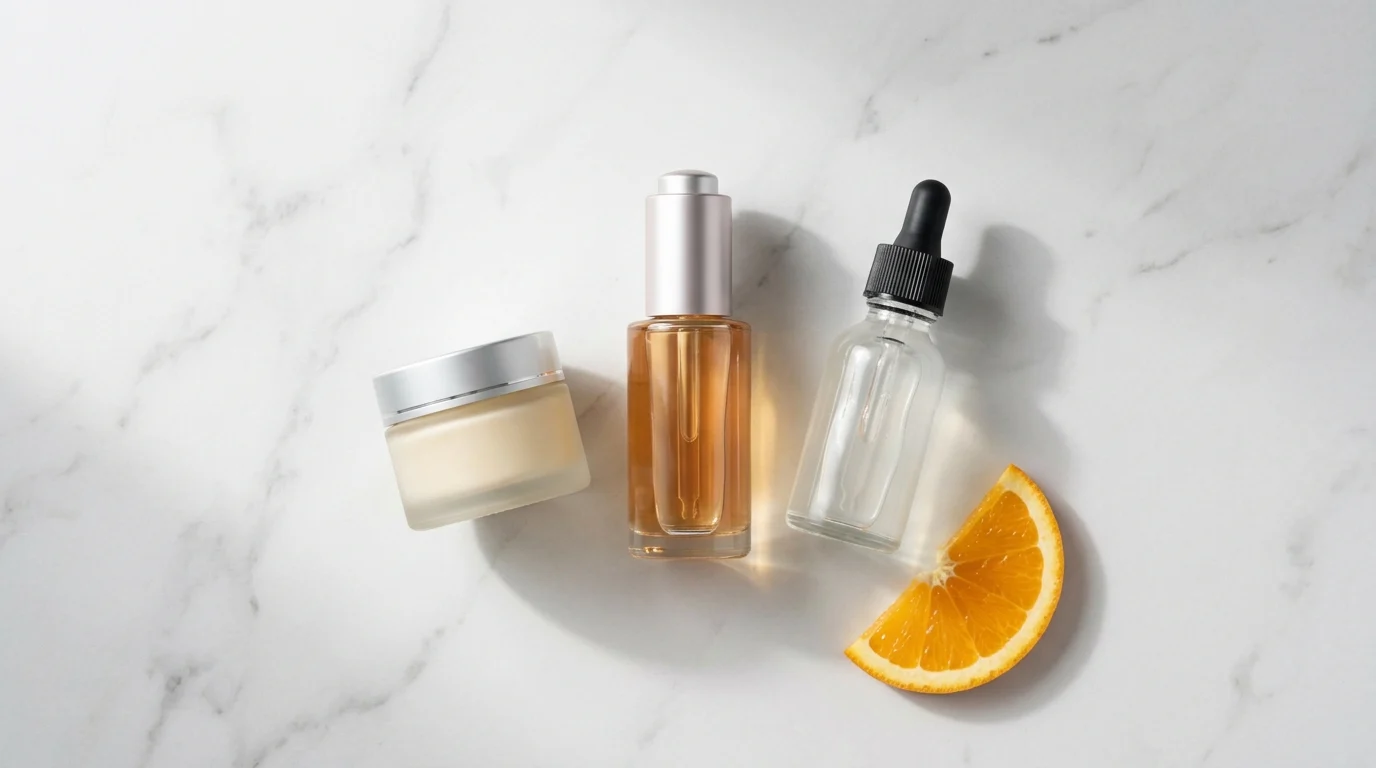
- Vitamin C (L-ascorbic acid): The most extensively studied topical antioxidant in dermatology. The vitamin C skin antioxidant role is multi-dimensional — it neutralizes ROS directly, acts as a cofactor for prolyl and lysyl hydroxylase enzymes essential to collagen synthesis, and inhibits melanin formation. L-ascorbic acid is most stable and well-absorbed at formulation pH below approximately 3.5, though this range requires careful tolerability consideration.
- Vitamin E (tocopherol): A lipid-soluble antioxidant that integrates into cell membranes, where it protects membrane phospholipids from peroxidation. It works synergistically with vitamin C — each helps regenerate the other’s active form — and ferulic acid extends this synergy considerably in formulation.
- Niacinamide: Its relationship to niacinamide oxidative stress pathways is primarily indirect. As a precursor to NAD⁺ and NADP⁺, niacinamide supports cellular metabolic processes including those involved in antioxidant enzyme function. It also reduces skin inflammation and supports ceramide synthesis in the stratum corneum — both of which limit the conditions under which ROS cause their most significant structural damage.
- Resveratrol: A polyphenol with a proposed mechanism involving sirtuin pathway modulation. It is worth noting that the evidence here is more nuanced than early research suggested — subsequent studies have raised questions about the original sirtuin-activation findings, and human skin data remains limited. Resveratrol is promising, but its clinical efficacy in topical application should be regarded as still emerging.
- Coenzyme Q10 (CoQ10): A mitochondria-associated antioxidant that declines measurably in skin with age. Its relevance to mitochondrial oxidative damage skin biology is well-reasoned, though the degree to which topical CoQ10 reaches mitochondria in meaningful concentrations remains an area of active investigation.
- Ferulic acid: A plant-derived antioxidant with a well-established role in stabilizing and extending the efficacy of vitamin C and vitamin E formulations, in part by reducing their photodegradation. It is rarely discussed as a standalone active, but it is arguably indispensable in combined antioxidant formulations.
For a broader view of how these ingredients fit into a skin longevity approach, see the antioxidant and peptide ingredients moving beyond retinol in skin longevity routines.
On SPF and oxidative stress: Sunscreen filters UV radiation — the most potent single extrinsic source of ROS in skin. That contribution is significant and irreplaceable. But SPF does not neutralize ROS generated by air pollution, blue light, chronic stress, disrupted sleep, or internal metabolic processes. A complete approach to oxidative stress skin aging requires topical antioxidants applied alongside UV protection — not as an alternative, but as the component that addresses the oxidative burden that SPF, by design, was never built to cover.
If you are considering introducing multiple antioxidant actives into your routine, consult a dermatologist or cosmetic chemist — some combinations are synergistic, while others may interact or destabilize in formulation.
FAQs
What is the most effective antioxidant ingredient for skin aging?
L-ascorbic acid (vitamin C) has the most extensive evidence base of any single topical antioxidant — for ROS neutralization, collagen synthesis support, and pigmentation. In practice, a combination of vitamin C, vitamin E, and ferulic acid has been shown to be significantly more effective than any one used alone. For those specifically concerned with cellular aging, CoQ10 is the most targeted option for mitochondrial support.
Does pollution really age the skin — or is UV the only thing that matters?
UV remains the most potent single extrinsic driver of skin aging. But evidence from both epidemiological studies and laboratory research has associated chronic exposure to particulate matter and traffic-related pollution with accelerated aging markers — independently of UV. In high-pollution urban environments, pollution and skin aging research suggests this is a meaningful, separate oxidative burden worth addressing in a skincare routine.
Can you reverse oxidative damage already done to skin?
Partially. The skin retains some capacity to repair oxidized lipids and certain protein modifications, and stimulating collagen synthesis through retinoids, vitamin C, and peptides can partially restore structural loss. Accumulated mitochondrial damage and AGE cross-links are not readily reversible through topical intervention. The more accurate framing: consistent antioxidant use appears to meaningfully slow the rate of future oxidative damage, while targeted actives support the repair that is biologically possible. Prevention accumulates over time. Correction has real limits.