


Picture this: a woman in a demanding senior role notices that her skin behaves like a barometer of her calendar. During high-pressure quarters — back-to-back deadlines, disrupted sleep, the low-grade hum of constant alerts — her complexion tightens, reddens, and breaks out along the jaw. Then she takes annual leave. She keeps exactly the same skincare routine, the same products in the same order. Within a week, her skin is noticeably calmer. She assumes it is coincidence, or perhaps the effect of better sleep. It is neither — or rather, it is both, and more. The relaxation benefits she is experiencing are not vague or metaphorical. They are physiological. Her nervous system has shifted modes, and her skin — a direct participant in that shift — has responded accordingly. The nervous system governs several of the biological processes that determine skin condition in real, measurable terms: sebum production, barrier integrity, inflammatory response, and microbiome balance. When that system moves from chronic activation into genuine rest, those processes change.
The Two Modes of Your Nervous System — And Why Skin Responds to Both
Sympathetic vs Parasympathetic: The Alarm and the Reset
The autonomic nervous system operates entirely below conscious awareness. It controls heartbeat, digestion, immune regulation, and dozens of other functions you never have to think about. It has two primary operating modes — and understanding both is the foundation of understanding relaxation and skin health.
The sympathetic nervous system is the alarm system. The moment it perceives threat — whether that threat is a predator, a looming deadline, or an inbox that never empties — it mobilises every available resource toward survival. Heart rate increases, blood is diverted to muscles, digestion slows, and the body enters a state of heightened alert. According to the Cleveland Clinic overview of the parasympathetic nervous system and its repair functions, this system’s counterpart — the parasympathetic nervous system — is the reset system. It governs rest, digestion, repair, and regeneration. When the alarm is off, the reset runs. Think of it as a building: the alarm system and the maintenance crew cannot operate at full capacity simultaneously.
The HSS health library on parasympathetic nervous system function describes this division clearly — and what matters for skin is that the two modes represent fundamentally different resource allocation patterns. Skin repair, barrier lipid synthesis, and immune regulation in the dermis are primarily parasympathetic-phase activities. In sympathetic dominance, blood is shunted away from skin toward muscles; sebaceous glands are upregulated via androgen amplification; and barrier repair is deprioritised. The skin is not passive in this division. It actively participates in both modes — and the nervous system skin connection is direct, not secondary.
Why Chronic Activation Is the Real Problem
A single stressful event is not the issue. The sympathetic response evolved to be acute and self-limiting — a burst of activation followed by a recovery period during which the parasympathetic system reclaims dominance. The problem is chronic stress: leaving the alarm on permanently. The building never enters maintenance mode, so damage accumulates unseen.

The chronic stress skin effects that dermatologists observe — persistent barrier dysfunction, recurring inflammatory flares, sebaceous overactivity — are rarely the result of one bad week. They are the cumulative consequence of sustained sympathetic dominance without adequate recovery periods between activations. It is the absence of the reset, repeated over months, that alters skin biology in lasting ways.
What Cortisol Does to Skin Under Chronic Stress
The HPA Axis in Plain Language
When the sympathetic system fires the alarm, a hormonal cascade follows. The HPA axis — the hypothalamic-pituitary-adrenal axis — is the body’s emergency dispatch chain. The hypothalamus (the brain’s command centre) signals the pituitary gland, which relays the message to the adrenal glands, which release cortisol and adrenaline. As the Harvard Health explanation of the stress response and its physiological consequences describes, this cascade is appropriate and effective in the short term. Cortisol is the hormone that mobilises emergency resources — it raises blood sugar, sharpens alertness, and suppresses non-essential functions. Useful in short bursts. Destructive when chronically elevated.
Understanding how chronic cortisol elevation affects skin barrier and inflammatory function begins with recognising that cortisol was never designed to be a permanent state. When it is, its effects on skin shift from incidental to structural.
The Specific Skin Consequences
Chronically elevated cortisol produces a cascade of well-established skin-level consequences. These mechanisms are supported by substantial research and can be stated with confidence:
- Ceramide synthesis suppression: Ceramides are the lipid molecules that form the skin barrier’s waterproof seal. Their production enzymes are pH- and energy-sensitive — cortisol disrupts both conditions, reducing the barrier’s capacity to retain moisture and repel irritants.
- Sebum amplification: Cortisol amplifies androgen activity, which directly stimulates sebaceous glands to produce more sebum. More sebum creates a more acne-favourable environment, particularly when barrier dysfunction allows bacterial imbalance to follow.
- Hyaluronic acid suppression: Cortisol inhibits the production of hyaluronic acid — the skin’s primary internal hydration molecule — reducing the skin’s capacity to retain water and increasing transepidermal water loss (TEWL).
- Barrier repair deprioritisation: Cellular energy during sympathetic activation is directed toward survival functions. The routine maintenance of barrier integrity — ceramide replenishment, tight junction reinforcement — is suspended. Recovery from environmental damage slows measurably.
These are not speculative effects. The relationship between cortisol and skin aging is mechanistically established — sustained cortisol exposure accelerates the degradation of collagen synthesis pathways and compounds the barrier dysfunction described above, producing visible signs of premature aging over time.
Neurogenic Inflammation: When the Nervous System Talks Directly to Skin
Here is where the biology becomes particularly interesting — and where stress and skin inflammation are more directly connected than most people realise. Cortisol is not the only pathway. The nervous system has a direct phone line to skin’s immune cells; cortisol is the slower postal system.
Nerve endings extend throughout the dermis. Under stress, those nerve endings release neuropeptides — specifically substance P and corticotropin-releasing hormone (CRH) — directly into skin tissue. As the Cleveland Clinic overview of inflammation and its role in chronic skin conditions explains, inflammation is the immune system’s response to perceived threat or damage: appropriate when acute, damaging when chronic. And as documented in the clinical reference on neurogenic inflammation and stress neuropeptide activity in skin, these neuropeptides activate mast cells and keratinocytes — the skin’s front-line immune cells — producing a local inflammatory response that is entirely independent of systemic cortisol.
This is why skin can flare during an acute stressful event even without a prolonged cortisol elevation. The nerve signal is faster and more local than the hormonal pathway. It bypasses the HPA axis entirely. This neurogenic inflammation mechanism explains the speed with which skin responds to emotional or psychological stress — and why nervous system regulation skin outcomes cannot be reduced to cortisol management alone.
The practical implication: someone managing cortisol through conventional means — sleep, exercise — may still experience stress-triggered skin flares if their baseline sympathetic tone remains high and their vagal recovery is insufficient.
The Relaxation Benefits for Skin: What the Evidence Shows
What Changes Physiologically When the Nervous System Rests
When the nervous system enters a genuine parasympathetic state — not just the absence of an acute stressor, but active rest-and-repair mode — a different set of biological conditions emerges. Relaxation and cortisol reduction are the most mechanistically established part of this picture. As cortisol falls, the enzymatic conditions for ceramide synthesis improve. Androgen amplification of sebaceous output moderates. The acute neuroinflammatory signal quiets. Cellular energy previously allocated to stress-response maintenance becomes available for repair.
Research published in a PMC study on stress reduction and skin condition outcomes provides some of the clearest available evidence linking relaxation interventions to measurable skin health outcomes. The cortisol-reduction and ceramide-recovery mechanisms involved are biologically well-established. However, it is accurate to note that the clinical evidence for visible skin improvement from structured relaxation practice specifically — while promising — is currently based on studies that are typically small in scale and limited in duration. The deep relaxation benefits for skin are directionally consistent across the literature; the clinical magnitude and longevity of those effects require more robust large-scale study before certainty is warranted.
What can be said with confidence: rest and skin repair share the same biological conditions. Parasympathetic dominance is not simply the absence of damage — it is when the scheduled maintenance actually runs.
The Microbiome as an Additional Variable
The skin surface hosts a complex community of microorganisms — collectively the skin microbiome — whose balance is sensitive to the local environment: pH, sebum composition, and barrier permeability. Stress-driven neuroinflammatory activity alters all three. Emerging findings from research on skin microbiome disruption and nervous system-driven inflammation suggest that chronic sympathetic activation may shift skin surface conditions in ways that favour dysbiosis — a disruption of the microbial balance that can compound barrier reactivity and inflammatory tendency.
Epistemic honesty requires a clear caveat here: the mechanism is biologically plausible, and the directional evidence is consistent, but the specific relationship between relaxation practice and microbiome recovery has not been established with the same clinical clarity as the cortisol-barrier connection. What is known is that chronic overstimulation affects the nervous system and skin health over time in ways that are likely to include this microbiome pathway — but the precise magnitude and reversibility remain under active investigation.
Practices That Support a Genuine Parasympathetic Shift
Breathwork and Vagal Activation
The vagus nerve is the main communication line between the brain and the body’s repair systems. It is the longest cranial nerve, running from the brainstem through the chest and into the abdomen, and its tone — how actively it engages — is one of the primary determinants of how readily the parasympathetic system can assert itself. High vagal tone means the reset system is responsive. Low vagal tone means the alarm system stays dominant longer than it should.
Slow, controlled breathing — particularly with extended exhalation — is one of the most consistently evidence-supported methods of stimulating the vagus nerve and activating the parasympathetic shift. The mechanism is well-established: extended exhalation activates baroreceptors in the chest that signal the vagus nerve to reduce heart rate, a process called respiratory sinus arrhythmia, which is measurable and reproducible. As a method of nervous system skin connection management, the evidence behind breathwork as a nervous system regulation and skin health practice is encouraging, though the skin-specific clinical outcomes from breathwork practice in isolation require more large-scale study to quantify with precision. For a deeper look at the structural connection, how vagus nerve health connects nervous system state to skin function clarifies the anatomical and signalling pathways involved.
Breathwork skin benefits are therefore best understood as downstream from vagal activation — the skin responds to the improved nervous system state, not to the breathing itself as a topical intervention.
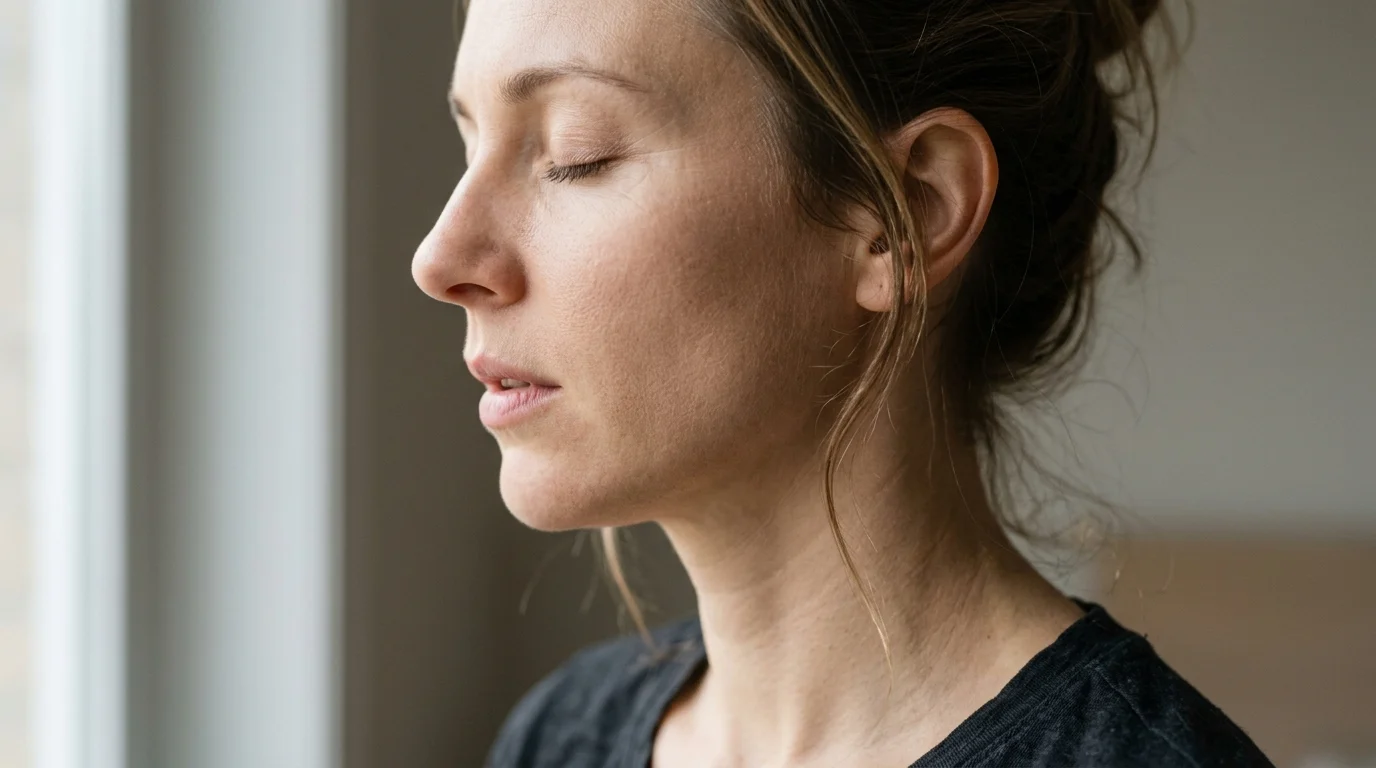
Practical Relaxation Inputs With Evidence Behind Them
Several practices support parasympathetic dominance with varying degrees of clinical evidence. The distinctions matter — not all relaxation inputs carry the same evidence weight for skin-specific outcomes:
- Consistent sleep onset timing: Measurably supports circadian cortisol regulation by anchoring the natural cortisol awakening response to a predictable rhythm. This connection is well-established in sleep and endocrinology research.
- Slow, extended-exhalation breathing: Activates vagal tone and reduces acute cortisol via the mechanism described above. The physiological mechanism is well-established; skin-specific outcome data from dedicated breathwork trials is emerging and promising.
- Low-intensity movement — walking, gentle yoga: Consistently associated with reductions in chronic inflammatory markers including pro-inflammatory cytokines. This is supported by a substantial body of exercise research; the skin-specific magnitude of benefit is variable across individuals and study designs.
- Reduced screen and notification load: Intermittent alert stimuli maintain low-grade sympathetic activation by repeatedly triggering the orienting response — a minor alarm-system engagement that, when accumulated across hours, sustains elevated baseline arousal. The mechanism is biologically plausible; direct skin research in this specific context remains limited.
- Nature exposure: Associated with parasympathetic activation and measurable cortisol reduction in observational studies. Directionally promising for vagus nerve skin health and systemic inflammatory modulation; clinical skin-specific data is limited in scale.

A note on the framing of relaxation: The parasympathetic state is not the absence of activity. It is a physiologically active mode — the period during which the body performs the repair, synthesis, and maintenance functions that stress suppresses. Treating relaxation as a productivity-adjacent health input rather than a lifestyle indulgence is not a reframe for rhetorical effect. It is biologically accurate. The maintenance crew only enters the building when the alarm is off. Consistently prioritising genuine rest periods is, in the most literal sense, when skin biology is permitted to do its job.
If skin conditions consistently worsen during high-stress periods and do not respond to barrier-supportive skincare, consulting a dermatologist is advisable — some stress-triggered skin conditions, including eczema and rosacea flares, benefit from clinical management alongside nervous system regulation strategies.
Frequently Asked Questions
Can reducing stress genuinely improve skin condition — or is it just placebo?
The mechanisms are physiological, not psychological. Cortisol directly suppresses ceramide synthesis and amplifies sebaceous output. Stress neuropeptides activate skin immune cells via nerve endings in the dermis. When chronic sympathetic activation decreases, these processes measurably change. The skin improvement is real — though the speed and degree vary considerably by individual, baseline skin health, and the consistency of the nervous system shift achieved.
How quickly do relaxation benefits for skin become visible after reducing chronic stress?
Neuroinflammatory activity can moderate relatively quickly — some individuals notice reduced reactivity within days of a significant drop in sympathetic load, which aligns with the speed of the direct nerve-to-skin neuropeptide pathway. Barrier recovery is slower: ceramide synthesis and replenishment of the lipid matrix take weeks of consistent conditions to show measurable improvement. Sustainable visible change is more likely measured in weeks to months than days — and requires the parasympathetic shift to be sustained, not occasional.
What is the most evidence-supported relaxation practice for nervous system regulation?
Slow breathing with extended exhalation has among the most mechanistically robust evidence for acute parasympathetic activation — the vagal stimulation pathway is well-characterised and reproducible. For longer-term nervous system regulation, consistent sleep timing and low-intensity daily movement carry strong support in the broader physiological literature. No single practice is universally optimal; the most effective approach is the one that can be maintained consistently, since the benefits of nervous system regulation are cumulative, not episodic.