


She works at a desk by 8am, commutes by car, and eats lunch at her screen. By the time she glances outside, it is past 10am and the quality of the light has already shifted. Over several months, her sleep becomes shallow and fragmented. Her energy craters around 2pm regardless of caffeine. And her skin — unchanged in terms of products or diet — is persistently dull, reactive, and somehow less resilient than it used to be. Her dermatologist finds nothing pathological. Her bloodwork is flagged: borderline low vitamin D. She cycles through serums, adjusts her retinol schedule, adds magnesium at night.
The missing variable is not a new ingredient. It is something withdrawn quietly, gradually, as indoor life replaced outdoor morning time: natural light, at the precise time of day when the body is biologically wired to receive it. The morning sunlight benefits most people overlook are not primarily about warmth or mood — they are about biological timing, and specifically about a daily calibration signal that the brain and skin both require to run their scheduled repair and regulation processes correctly.
The Circadian Clock: What It Is and Why It Needs Morning Light to Stay Accurate
What the Circadian Clock Actually Does
Think of the circadian clock as a biological alarm clock built into virtually every cell of the body — one that runs on a roughly 24-hour cycle and governs not just whether biological processes happen, but when. According to the NIH National Institute of General Medical Sciences fact sheet on circadian rhythms and biological timing, this internal system orchestrates sleep-wake cycles, hormone release sequences, immune activation patterns, cellular repair processes, and metabolic function throughout the day.
The critical detail most people miss: this clock is not self-sufficient. It runs slightly longer or shorter than exactly 24 hours — and without a daily environmental reset signal, it drifts. Like a mechanical watch that gains or loses a few minutes per day, it needs re-synchronizing. The most powerful synchronizer available to it is light, received at the right time of day. Without that signal — or with misaligned exposure such as blue light at night and no natural light in the morning — the internal clock gradually desynchronizes from actual time, and the biological processes it schedules begin to run at the wrong hours.
Understanding how the circadian clock governs skin repair timing and why synchronization matters for skin health reframes morning light from a lifestyle preference into a biological maintenance requirement.
How the Eye Detects Morning Light — The ipRGC Pathway
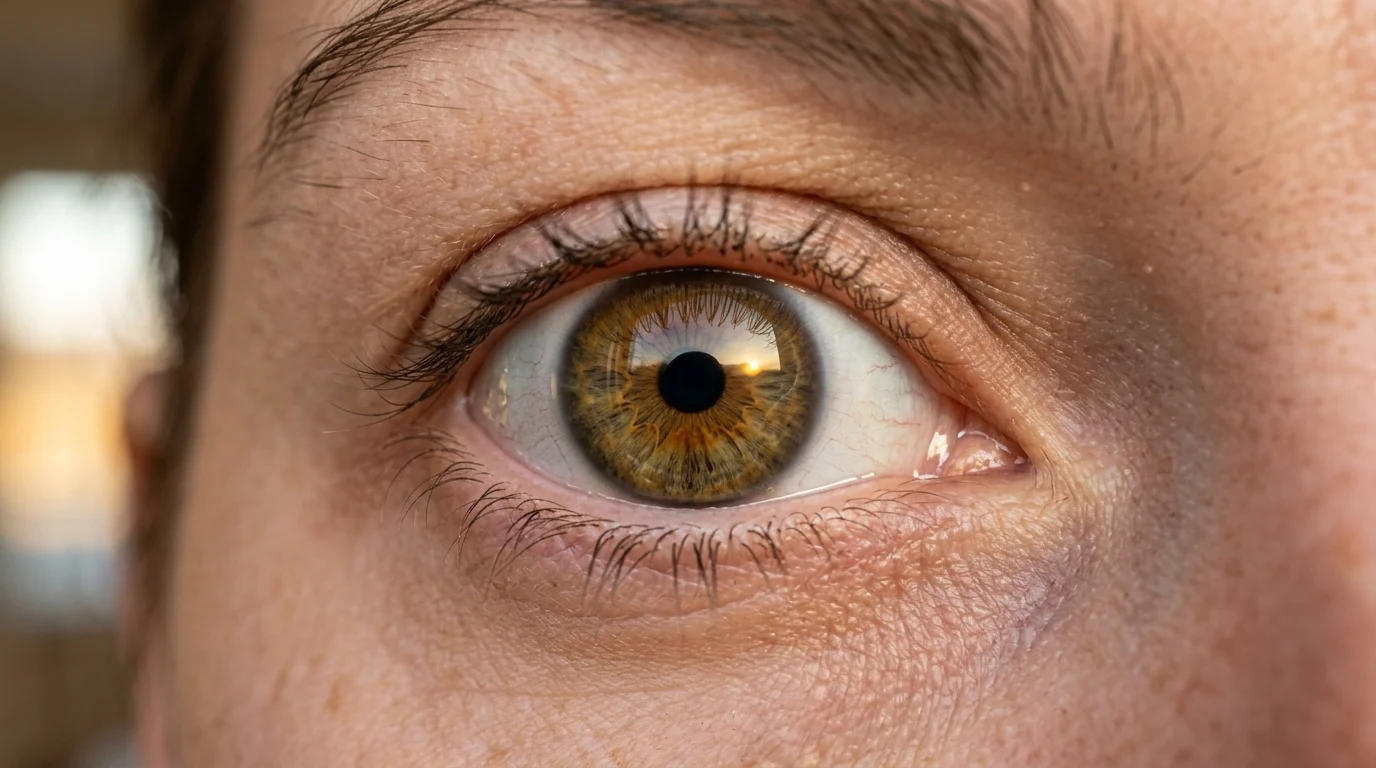
The eye contains a class of specialized light-sensing cells that have nothing to do with vision. These are called ipRGCs — intrinsically photosensitive retinal ganglion cells — and they function as dedicated biological timekeepers. When morning light enters the eye, ipRGCs detect the short-wave, blue-spectrum wavelengths that are naturally abundant in early daylight. They transmit this signal not to the visual cortex, but directly to a small structure in the brain called the suprachiasmatic nucleus, or SCN — the body’s master clock.
Think of ipRGCs as light sensors wired directly to the clock, bypassing the visual system entirely. The SCN receives the signal, interprets it as “morning has arrived,” and broadcasts a coordinated timing update to peripheral clocks throughout the body. As outlined in Harvard Medical School’s resource on circadian rhythms and the brain’s light-detection pathway, this mechanism operates independently of how we perceive brightness or colour.
One practical implication: standard window glass filters out a significant portion of the short-wave blue-spectrum light that ipRGCs respond to most strongly. Sitting beside a bright window, while pleasant, provides a meaningfully weaker circadian signal than direct outdoor exposure — even on an overcast day. Cloud cover reduces light intensity, but outdoor diffuse light on a grey morning still delivers far more circadian-effective illumination than most indoor artificial environments.
Morning Sunlight Benefits for Sleep, Serotonin, and the Hormonal Cascade
Melatonin Suppression and the Sleep-Wake Hormone Cycle
This is where the biology becomes counterintuitive. Morning light suppresses melatonin — the hormone most associated with sleep onset. And yet, morning light exposure is one of the most evidence-supported interventions for improving sleep quality that same night. The apparent contradiction resolves once the underlying chemistry is understood.
Melatonin is synthesized from serotonin. During daylight hours, light exposure supports serotonin production in the brain. That serotonin pool becomes the raw material from which melatonin is made in the evening, once darkness signals the pineal gland to begin conversion. A day with poor light exposure — and therefore insufficient serotonin synthesis — leaves the body with less substrate for melatonin production that night. The result can be delayed sleep onset, lighter sleep architecture, or fragmented waking. As explained in Harvard Health’s guidance on how natural light and darkness govern melatonin production and sleep quality, melatonin is fundamentally a darkness hormone — and its quality depends on the light exposure that preceded it.
This is also why how magnesium supports the same melatonin production pathway that morning light initiates has become a relevant consideration in integrated approaches to sleep and skin health.
The Cortisol Awakening Response
Within the first 30 to 45 minutes of waking, cortisol spikes — and this spike is a sign of a well-calibrated system, not a stress response. The cortisol awakening response is a calibrated hormonal activation that supports energy availability, cognitive alertness, and immune readiness in the early hours of the day.
Morning light exposure and cortisol are linked through the circadian system: the SCN’s morning signal helps orchestrate the timing and amplitude of this cortisol rise. Research examining disrupted circadian entrainment suggests that insufficient or misaligned morning light is associated with a flattened cortisol awakening response — which can manifest as low-grade fatigue, cognitive fog, and reduced energy throughout the day. The afternoon energy crash that many people attribute to diet or poor sleep is often, at least in part, a consequence of a morning that was never properly biologically initiated.
What Morning Sunlight Does for Skin Specifically
The Skin’s Peripheral Circadian Clock

Skin is not a passive recipient of what the rest of the body decides. It contains its own peripheral circadian clock — a molecular timing system embedded in keratinocytes, fibroblasts, and other skin cell populations. This clock governs the scheduling of specific biological functions: when barrier lipids are synthesized, when ceramide production peaks, when collagen synthesis is most active, and when transepidermal water loss regulation operates most efficiently.
Research detailed in published findings on circadian clock function in skin biology and repair timing and in PMC research on circadian rhythm and skin cellular function establishes this peripheral clock as real, functional, and molecularly distinct. The skin clock is synchronized — in part — by signals from the central SCN clock. The mechanistic chain is coherent: morning light sets the central clock, which synchronizes peripheral clocks, including the one running in the skin.
The epistemological caveat is important here. The existence of the skin’s peripheral clock and its synchronization with the central clock is well-established. However, the direct clinical effect of morning light exposure specifically — as an isolated variable from overall circadian alignment and sleep quality — on measurable skin repair outcomes requires more targeted research to confirm.
Why Circadian Skin Repair Requires a Synchronized Clock
Barrier repair does not occur at equal intensity throughout the day. It peaks during the nocturnal window — when the body is still, cortisol is low, and biological resources can be directed toward repair rather than alertness. Ceramide synthesis, collagen production, and the replenishment of barrier lipids are all timed processes that depend on the clock running accurately.
When the circadian clock is desynchronized — from insufficient morning light, irregular sleep, or night-shift light exposure — this repair scheduling may shift. Processes may run at a suboptimal biological hour or with reduced efficiency. The skin clock, like the master clock, requires accurate timing to execute its scheduled functions correctly. A desynchronized skin clock does not simply run the same processes later; it may run them less completely, or fail to execute the full repair cycle before waking.
This mechanism is established at the molecular and cellular level. The specific clinical skin outcomes — in terms of barrier strength, visible skin quality, or inflammatory tone — attributable to morning light exposure as an isolated variable remain an active area of inquiry rather than a settled question.
Vitamin D: The Chemical Reaction Your Skin Performs in Morning Light
How Vitamin D Is Made in the Skin
Vitamin D synthesis is, quite literally, a photochemical reaction — a process in which UV-B light energy drives a molecular conversion inside the skin. UV-B radiation strikes a cholesterol-derived compound called 7-dehydrocholesterol and converts it to pre-vitamin D3. Body heat then isomerizes this to vitamin D3, which is further activated by the liver and kidneys. Think of it as a form of photosynthesis happening in the skin: light triggers a chemical conversion that the body then refines into a usable form.
Standard window glass blocks UV-B — which is why sitting beside a sunny window will not produce meaningful vitamin D synthesis. According to the NIH Office of Dietary Supplements clinical fact sheet on vitamin D synthesis and skin health, vitamin D receptors are present in keratinocytes, where the vitamin plays a documented role in barrier function, inflammatory regulation, and immune modulation. Its deficiency is associated with impaired barrier integrity and increased inflammatory reactivity in the skin.
The epistemological note applies here too: vitamin D’s role in skin biology is well-established at the receptor and cellular level. The specific clinical skin appearance outcomes from optimizing vitamin D status via sunlight exposure — compared to supplementation or dietary sources — are less precisely characterized and merit further skin-focused research.
Supplementation vs. Sunlight — What the Evidence Actually Suggests
Vitamin D supplementation is clinically useful, particularly in deficiency contexts and for populations with limited UV access. It is not, however, a substitute for outdoor light exposure as a whole. Circadian entrainment, serotonin pathway activation, and nitric oxide release from UV exposure are independent physiological effects of sunlight that a capsule cannot replicate.
The other side of the equation deserves equal clarity. As detailed in Harvard Health’s analysis of the limits and risks of vitamin D supplementation, excessive intake is not benign — it can cause hypercalcaemia and other adverse effects. More is demonstrably not better. Moderate, regular outdoor morning exposure at appropriate UV index levels contributes to vitamin D synthesis in a self-limiting way — the skin naturally regulates its own production — while simultaneously delivering the non-vitamin-D benefits that supplementation cannot provide.
Practical Morning Sunlight Benefits: What the Research Suggests
The following guidance reflects current evidence — with epistemic honesty about the degree of certainty attached to each point.
- Timing: Outdoor light exposure within 30–60 minutes of waking appears most effective for circadian entrainment. Emerging evidence suggests this is the window during which the circadian system is most responsive to the reset signal, though individual variation exists and an optimal window has not been precisely defined for all populations.
- Duration: Some studies indicate that as little as 5–10 minutes of outdoor light can produce a measurable circadian signal. A range of 20–30 minutes is more commonly cited in the research literature as a reliably effective target. The appropriate duration will vary by individual, season, latitude, and ambient light intensity.
- Environment: Direct outdoor exposure outperforms window-filtered light in terms of circadian signal strength. Even on overcast days, outdoor illumination can exceed 10,000 lux — significantly more than the 200–500 lux typical of most indoor artificial environments.
- Sunglasses: The ipRGC pathway requires relatively unfiltered light reaching the retina to deliver its full circadian signal. Tinted lenses attenuate this. However, UV exposure to the eyes carries independent risks, and any decision to forgo eye protection should account for UV index, duration, and individual sensitivity.
- Movement: Pairing morning light with outdoor walking compounds the benefit — adding skin microcirculation support, cortisol modulation, and mild cardiovascular activation to the circadian signal. Research on why morning outdoor walking combines circadian light exposure and skin microcirculation in one evidence-supported habit reflects growing interest in how these mechanisms can be compounded through a single daily practice.

On the vitamin D framing: Morning sunlight is frequently discussed as though its primary purpose is vitamin D delivery. This framing undersells the more immediate and well-characterised benefit: circadian clock entrainment. The downstream effects of a properly calibrated circadian system — on sleep quality, hormonal sequencing, skin repair scheduling, and inflammatory tone — are broader and more mechanistically immediate than those attributable to vitamin D status alone. Both matter. But they are distinct mechanisms, and conflating them misrepresents the biology.
Morning light exposure for circadian benefit does not require prolonged UV exposure — and sun protection remains important for skin health, particularly during peak UV hours. Always apply broad-spectrum SPF before extended outdoor time, and consult a dermatologist if you have UV sensitivity or a photosensitive skin condition.
Frequently Asked Questions
How long do you need to spend in morning sunlight to get a circadian benefit?
Some research indicates that even 5–10 minutes of outdoor exposure can produce a detectable circadian signal. A range of 20–30 minutes is more commonly cited as reliably effective. The earlier in the morning this happens, the stronger the reset signal — not because light is brighter at that hour, but because the circadian system’s sensitivity to entrainment cues is highest in the post-waking window.
Does morning sunlight exposure still work on cloudy days?
Yes — with reduced but still meaningful effect. Outdoor light on an overcast morning can register 10,000 lux or more, far exceeding the 200–500 lux typical of indoor artificial lighting. The ipRGC pathway responds to that difference. Cloud cover attenuates the signal; it does not eliminate it.
Can morning light exposure actually improve skin quality — or only sleep?
The most direct and well-established pathway is through sleep and circadian alignment. Improved sleep quality supports nocturnal barrier repair, reduces inflammatory tone, and enables collagen synthesis to run on schedule — all of which have visible skin consequences. The hypothesis that morning sunlight benefits skin quality through its circadian effects is mechanistically coherent, and emerging evidence supports the broader link between circadian alignment and skin function. Whether morning light specifically — as an isolated variable from overall sleep quality improvement — produces measurable skin appearance benefits requires more targeted, skin-focused clinical research to confirm.