


SEO Meta Description: The slow beauty movement is a quiet rebellion against excess — discover intentional rituals, skin barrier health, and high-integrity essentials.
It is 12:47 a.m. The blue glow of a phone screen washes across a face that has not yet been washed. Somewhere between the third dermatologist reel and the fourteenth “shelfie” of glass jars stacked like trophies, a woman touches her cheek and feels it: that faint, papery tightness. A whisper of heat. The telltale sting of a skin barrier that has been asked to absorb too much, too fast, for too long. This is the quiet epidemic of our decade — The Great Exhaustion. And the slow beauty movement has arrived not as a marketing pivot, but as a necessary rebellion against it.
The symptoms are recognizable now: redness that lingers past noon, a strange dullness beneath highlighter, the way serums seem to sit on the skin rather than enter it. We have been sold a cathedral of steps. Ten, twelve, sometimes fifteen. Each one promising more — more glow, more youth, more virtue. What we received instead was overstimulation fatigue, both cellular and psychological. The movement asks a different question. Not what else can I add? but what was I supposed to feel before all of this began?
Why the Slow Beauty Movement Stands Out
Fast beauty operated on the logic of fashion: novelty as nutrition. A new acid every Tuesday. A retinoid alternative by Friday. Peptides stacked on peptides stacked on a sheet mask infused with something pronounced only by chemists. The skin, treated as a project, became a battlefield.
Intentional beauty rituals propose the opposite economy. Less, but better. Fewer touchpoints, deeper meaning. The shift is not aesthetic — it is philosophical.
Consider the psychological dividend. When the morning routine contracts from twelve steps to three, the nervous system exhales. Decision fatigue, that subtle tax on every modern hour, recedes. The bathroom counter ceases to resemble a pharmacy and begins to resemble an altar. There is space, again, for thought.
The physiological dividend follows. A skin barrier — that lipid-rich, microbially intelligent membrane — is not a passive surface. It is a living border. When bombarded with competing acids, retinoids, and exfoliants, it does what any overworked organ does. It inflames. It thins. It signals distress through the very symptoms most people then attempt to treat with more product. Anti-trend beauty interrupts the loop.
The Denyva Philosophy: High-Integrity Essentials
There is a phrase worth keeping close: high-integrity essentials. It belongs to a school of thought sometimes called the Denyva philosophy — the idea that luxury, properly understood, is not abundance but precision. A wardrobe of three perfect coats. A library of forty books one actually reads. A skincare shelf of formulations chosen the way one chooses a wine: for provenance, for craft, for the patience of its making.
Three names tend to surface in these conversations, each illustrating a different facet of the principle.
Vintner’s Daughter — The Botanical Patience
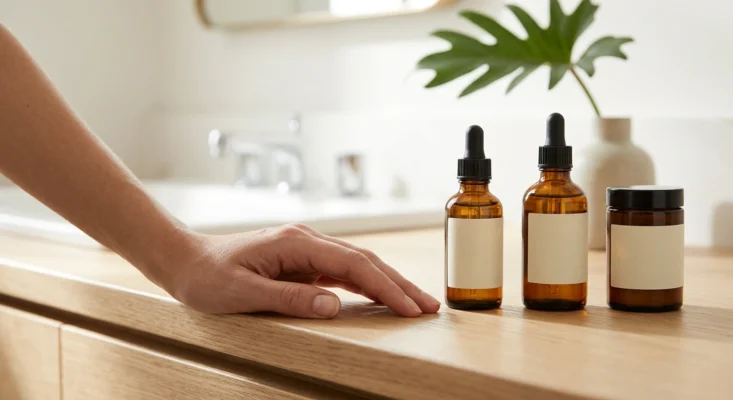
A single Active Botanical Serum takes three weeks to produce. Twenty-two organic ingredients, infused slowly, then pressed. There is no shortcut written into the formula because the formula refuses one. Using it is an exercise in trust — in the idea that nature, properly courted, does not need to be hurried.
Noble Panacea — The Molecular Precision
Born from the work of a Nobel laureate in chemistry, Noble Panacea encapsulates actives in organic micro-structures that release them at controlled intervals. The skin receives what it needs, when it needs it. Nothing oxidizes on a counter. Nothing is wasted. It is slow beauty translated into pharmaceutical exactitude.
DAY+ — The Internal Support
Skin longevity is not a topical conversation alone. DAY+ approaches the matter from within — supporting cellular processes through ingestible formulations grounded in nutritional science. The premise is honest: what we eat, sleep, and absorb writes itself eventually onto the face.
These are not the only names. They are, however, useful coordinates. Each demonstrates that intentional consumption is not deprivation. It is curation raised to the level of practice.
The Science of Stillness
The skin keeps time differently than the calendar does. Its renewal cycle is roughly twenty-eight days for younger skin, longer as we age — closer to forty, then fifty. This is the rhythm by which keratinocytes migrate from the basal layer to the surface, mature, and shed. No serum, however expensive, accelerates biology beyond what biology permits. Results that arrive in seventy-two hours are almost always inflammation in disguise.
Then there is cortisol. Chronic psychological stress elevates this hormone, and elevated cortisol is one of the more quietly destructive forces in dermatology. It degrades collagen. It impairs barrier repair. It thins the skin and dulls its tone. The research is not subtle on this point — stress ages the face in measurable, photographable ways.
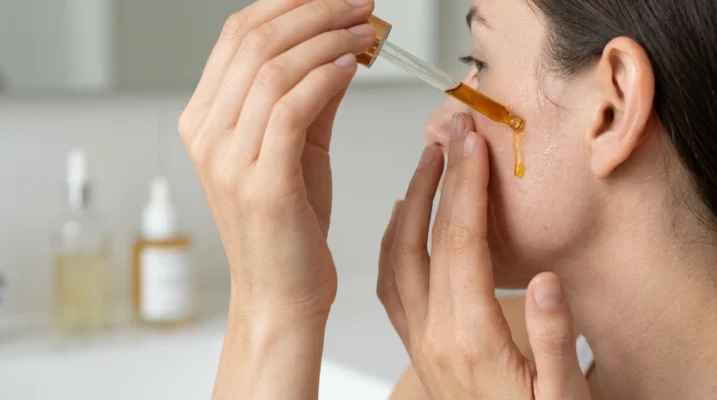
Here the slow ritual earns its scientific keep. The act of pressing oil into damp skin for ninety seconds, breathing through the nose, eyes closed — this is not theater. It is a parasympathetic intervention. The vagus nerve responds. Cortisol descends. The skin, biochemically, is now in a different conversation with itself.

Quality ingredients require this nervous system, this time, this twenty-eight-day patience. A vitamin C of pharmaceutical grade still needs cellular cooperation to brighten pigment. A bakuchiol needs weeks to remodel collagen quietly. The math of slow beauty is simply honest math.
Always consult with a healthcare professional before starting new treatments.
The Myth-Buster: Minimalism Is Not Sacrifice
A persistent misunderstanding circulates: that minimalist skincare is the aesthetic of those who have given up. Three steps, after all, sound like resignation in a culture that equates effort with virtue.
The arithmetic tells another story.
A twelve-step routine built on drugstore commodities may deliver a thin parade of glycerin, denatured alcohols, synthetic fragrances, and trace actives suspended in fillers. By volume, the skin receives mostly water and emulsifier. By outcome, it receives mostly irritation.
A three-step routine built on high-integrity formulations — a considered cleanser, a single concentrated serum, a barrier-supportive moisturizer or oil — can deliver more potent, more bioavailable nutrition in three applications than the longer ritual provides in twelve. The difference is not quantity. It is density.
Minimalism, properly practiced, is not the absence of luxury. It is luxury without the noise.
The Slow Beauty Pillars
For those building a practice rather than a collection, the principles tend to cluster into a few clear commitments:
- Fewer products, higher integrity. Choose formulations whose ingredient list reads like a sentence, not a paragraph.
- Rituals over routines. A routine is a task. A ritual is a practice. The difference is presence.
- Respect the twenty-eight-day cycle. Give a product six to eight weeks before judging it. Skin longevity is built in seasons, not in days.
- Protect the barrier first. Every other goal — brightness, firmness, clarity — depends on a barrier that is intact.
- Consume intentionally. Buy slowly. Finish what you own. Replace only what has earned its place.
- Include the internal. Sleep, hydration, and considered nutrition are not adjacent to skincare. They are skincare.
- Edit, do not accumulate. A shelf curated is a face uncrowded.
The Cultural Stakes
The movement is part of a wider correction. We are watching, in real time, the limits of acceleration as a value. Fast fashion has produced landfills. Fast content has produced anxiety. Fast beauty has produced compromised skin and exhausted wallets. The return to slowness is not nostalgia. It is recalibration.
There is a particular generation — those who grew up posting and now find themselves quietly logging off — for whom this is becoming an ethic. They are buying less. Researching more. Asking where ingredients come from, who formulated them, what the brand believes when no one is watching. Intentional consumption has become, for many, a form of self-respect.
The face one cultivates over a decade of this practice does not look airbrushed. It looks rested. There is a difference.
Frequently Asked Questions
How do I begin a slow beauty practice if my current routine is overloaded?
Begin by subtraction, not addition. For two weeks, use only a gentle cleanser, a single barrier-supportive moisturizer, and a mineral SPF. Allow the skin to reset. Once redness and tightness recede, introduce one considered active — a serum, an oil, a treatment — and live with it for a full cycle before adding anything else. The instinct will be to rush. The discipline is to wait.
How do I know if a product is genuinely “high-integrity” versus marketed as such?
Read the full ingredient list, not the front of the bottle. Look for short lists, recognizable botanicals or well-studied actives near the top, and an absence of synthetic fragrance and denatured alcohols in barrier-supportive formulations. Research the founder and the formulator. Ask whether the brand publishes clinical data or simply claims it. Quiet brands often speak the loudest through their formulas.
How long before I see results from a slow beauty routine?
Expect the first signals — reduced redness, a calmer barrier, a subtle return of softness — within two to four weeks. Deeper changes in tone, texture, and firmness require eight to twelve weeks, sometimes longer. The skin does not perform on a content schedule. It performs on a biological one. The reward of slow beauty is that the results, once they arrive, tend to stay.
The phone, eventually, goes dark. The face, eventually, is met with something simple and well-made. The ritual takes four minutes. The skin, after a season of this, begins to remember what it was before the noise. That is the quiet promise of the slow beauty movement — not a new self, but the original one, returned.