

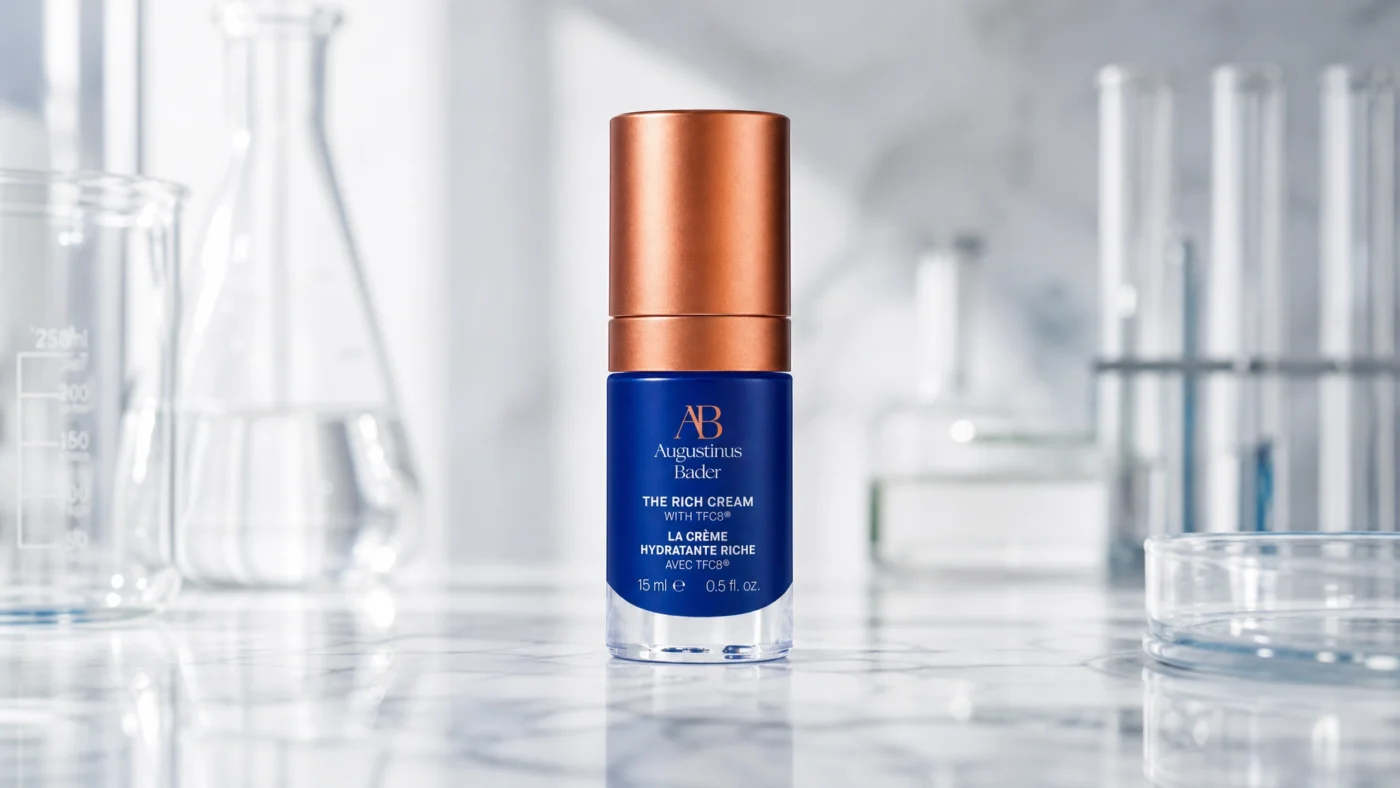
It does not announce itself. There is no tingle, no flush, no immediate sensation of something happening. The texture absorbs quietly. The skin settles. And then, a few mornings later, something shifts — not in the mirror, exactly, but in the way the skin feels before the mirror is even consulted. Calmer. Less braced for the day. Less reactive to the cold water, the dry air, the accumulated small insults of a morning routine. That is the moment most people describe when they try to explain what Augustinus Bader does differently. It is not a visual event. It is a biological one.
For sensitive skin — skin that has learned to expect irritation, that holds a low-level tension against every new product — this distinction matters enormously.
From Burn Ward to Blue Bottle: The Origin of TFC8®
The story behind Augustinus Bader is not a marketing narrative. It is a medical one, and it begins far from the beauty industry.
Professor Augustinus Bader, MD, PhD, is the Director of Applied Stem Cell Biology and Cell Technology at the University of Leipzig in Germany. His career spans more than 35 years of research in cellular repair, stem cell biology, tissue engineering, and regenerative medicine. He holds over 200 patents in his field and has published more than 190 peer-reviewed papers. These are not credentials assembled for a skincare launch. They are the record of a scientist who spent decades trying to solve one of medicine’s most painful problems: how to heal severely burned skin without surgery, without skin grafts, and without the lifelong scarring that follows.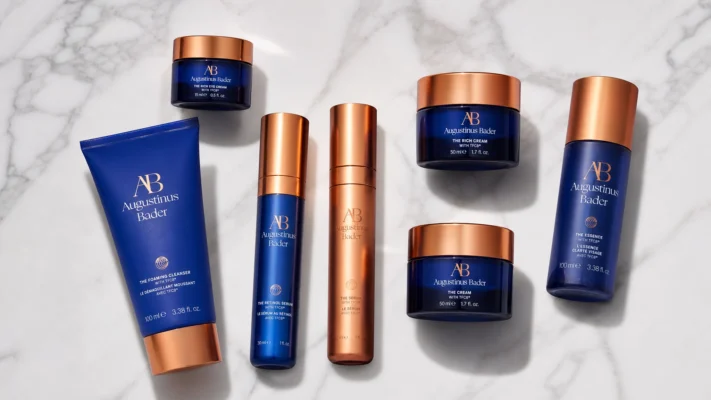
Early in his medical training, Professor Bader traveled to the Ruijin Hospital’s Burn Center in Shanghai, where he worked with burn victims — including children who required multiple surgeries to remove scar tissue that would otherwise restrict their physical development as they grew. The suffering he witnessed there became the driving force behind decades of subsequent research.
In 2008, that research produced a breakthrough: a medical-grade Wound Gel capable of activating cellular repair in traumatic wounds — including third-degree burns — without the need for surgery or skin grafts. The gel worked by delivering a precise set of healing signals to the site of injury, catalysing a response from damaged skin cells and facilitating an accelerated, self-directed restoration process. Documented cases showed near-complete healing of severe burns within days, with minimal scarring.
It was this Wound Gel — and the cellular signalling technology at its core — that eventually became the foundation of TFC8®, the patented complex present in every Augustinus Bader skincare product.
What TFC8® Actually Does: The Shift from Moisturising to Signalling
Most skincare products, even excellent ones, operate on a surface logic: hydrate, protect, occlude, reflect. They work with the skin’s exterior. TFC8® was designed to work with the skin’s interior — specifically, with the communication systems that govern how skin cells behave.
Professor Bader’s central insight, developed over decades of stem cell research, is that the skin does not lose its capacity to renew itself as it ages or becomes reactive. The stem cells responsible for repair and regeneration remain present. What diminishes is the quality of the signals that activate them. Age and trauma — including the chronic low-level inflammation that characterises sensitive skin — disrupt the cellular communication pathways that tell dormant repair cells to become active.
TFC8® (Trigger Factor Complex) addresses this at the signalling level. Rather than adding moisture or nutrients to the skin’s surface, it creates what Professor Bader describes as an “optimal environment” for the skin’s own renewal processes to resume. The complex guides key nutrients and bioactive molecules directly to the skin cells, restoring the conditions under which the body’s innate repair mechanisms can function as they were designed to.
This is the distinction that separates Augustinus Bader from the broader luxury skincare market. It is not a moisturiser with impressive ingredients. It is an enabling technology — one that asks the skin to do what it already knows how to do, and removes the obstacles that have been preventing it.
Scientifically Backed Ingredients: What TFC8® Contains
TFC8® is composed of approximately 40 ingredients — amino acids, peptides, high-grade vitamins, lipids, and synthesized molecules that are naturally found in the skin. Each component is selected for its role in cellular communication and barrier function, not for texture or fragrance. The formula is fragrance-free. It contains no synthetic dyes. The ingredient philosophy is, in the most precise sense, functional.
Always consult with a healthcare professional before starting new treatments, particularly if you have a diagnosed skin condition, known allergies, or are undergoing medical treatment that affects the skin.
Several components within the TFC8® matrix are worth understanding in detail:
- Amino acids (multiple, including key signalling peptides): Amino acids are the structural and communicative building blocks of skin proteins — collagen, elastin, and the enzymes that govern cellular turnover. In TFC8®, they serve a dual function: providing the raw materials for repair and acting as signalling molecules that direct stem cell activity. For sensitive skin, which often shows disrupted protein synthesis due to chronic inflammation, this is a meaningful intervention at the cellular level.
- High-grade vitamins (including Vitamin C derivatives and B-complex compounds): Vitamins within TFC8® are selected for their roles in collagen synthesis, antioxidant defence, and barrier regulation — not for their marketing appeal. Vitamin B5 (panthenol), for example, is one of the most well-documented barrier-repair agents in dermatological literature, with demonstrated ability to reduce transepidermal water loss and calm reactive skin. Its inclusion in a formula designed for cellular signalling is not incidental.
- Synthesized molecules naturally found in skin: This category includes lipid molecules that mirror the skin’s own barrier components — analogous in function to the ceramides discussed in the context of sensitive skin formulation. These molecules integrate into the skin’s lipid matrix, supporting barrier integrity from within rather than simply coating the surface. For skin that has been compromised by reactive episodes, harsh products, or environmental stress, this structural support is foundational.
- Proprietary peptides: The peptide component of TFC8® is where the technology most directly reflects its medical origins. Peptides act as cellular messengers — short chains of amino acids that carry specific instructions to skin cells. In the context of wound healing, peptides signal the cascade of repair events that restore tissue integrity. In the context of aging or reactive skin, they perform a quieter version of the same function: restoring the communication pathways that have been disrupted by time or inflammation.
The result of this combination is not a single dramatic effect but a cumulative one. Clinical trials of The Rich Cream showed a 145% improvement in skin hydration after four weeks, a 33% reduction in transepidermal water loss, and — most relevant for sensitive skin — 100% of participants agreeing that skin redness appeared calmed and reduced. These are not subjective impressions. They are measured outcomes.
Expert Tip: Debunking the Luxury = Heavy Fragrance Myth
There is a persistent assumption in the luxury skincare market that richness must be perceptible — that a premium product announces itself through scent, through a dense, almost greasy texture, through the immediate sensation of something potent being applied. This assumption has caused significant harm to sensitive skin consumers, who have learned to associate luxury with the very ingredients most likely to trigger a reaction.
Fragrance is the single most common cause of cosmetic contact dermatitis. It is also one of the most common markers of “luxury” in conventional skincare — a sensory signal that communicates indulgence to the consumer while simultaneously increasing the risk of sensitisation. Essential oils, which carry the same risk profile as synthetic fragrance compounds for reactive skin, are frequently used in premium formulas as a “natural” alternative. As explored in the context of sensitive skin formulation, natural origin does not confer safety. The skin responds to chemistry, not to sourcing narratives.
Augustinus Bader products contain no added fragrance. The texture of The Cream is light, almost serum-like in its absorption. The Rich Cream is denser but absorbs without residue. Neither product announces itself. Neither product needs to. The signal it sends is not olfactory. It is cellular — and it arrives, quietly, over the course of days.
True luxury, in this formulation philosophy, is the absence of unnecessary variables. It is a formula that does exactly what it claims, contains nothing it does not need, and asks nothing of the skin except to respond as it was designed to.
The Augustinus Bader Review for Sensitive Skin: What to Expect
For skin that has been reactive, sensitised, or simply exhausted by years of trial and error, the experience of using Augustinus Bader tends to follow a recognisable pattern.
- Week one: The absence of reaction is the first notable event. No tightness, no flush, no morning-after regret. For sensitive skin, this is not a small thing. It is the prerequisite for everything that follows.
- Weeks two to three: Hydration becomes more consistent. The skin holds moisture more evenly across the day, without the peaks and troughs that characterise a compromised barrier. Redness, where present, begins to quiet.
- Week four and beyond: Texture refines. The skin’s surface becomes more even — not through exfoliation or resurfacing, but through the gradual restoration of normal cellular turnover. Fine lines soften. The overall quality of the skin — its resilience, its response to environmental stressors — improves in a way that is difficult to attribute to any single ingredient, because it is not the product of any single ingredient. It is the product of a system working as it should.
This is the experience that has generated Augustinus Bader’s reputation — not through advertising, but through the accumulated testimony of people who expected another luxury cream and found something categorically different.
The same principle of formulation intelligence that makes serum-infused foundations so effective for skin health applies here with even greater depth. When a skincare product actively supports cellular communication rather than simply addressing surface symptoms, the results are not cosmetic. They are biological. And for sensitive skin — skin that has been asking, quietly, for something that works with it rather than on it — that distinction is everything.
FAQ: Augustinus Bader for Sensitive Skin
Is Augustinus Bader suitable for very reactive, rosacea-prone skin?
The formulation profile of both The Cream and The Rich Cream is well-suited to reactive skin. Both are fragrance-free, contain no synthetic dyes, and are built on a base of skin-identical molecules that support rather than challenge the barrier. The anti-inflammatory signalling properties of TFC8® — derived directly from the wound-healing research that produced the original medical Wound Gel — are particularly relevant for rosacea-prone skin, where chronic low-level inflammation disrupts normal cellular function. Clinical trial data shows 100% of participants reporting reduced skin redness after four weeks of use. That said, individual responses vary, and any new product introduction to highly reactive skin should be approached gradually. Always consult with a healthcare professional or dermatologist if rosacea is diagnosed or suspected.
The Cream or The Rich Cream — which is right for sensitive skin?
The distinction is primarily one of texture and lipid content, not of TFC8® concentration — both formulas contain the same core technology. The Cream is lighter, absorbs more quickly, and is better suited to combination or normal-to-sensitive skin types, or to warmer climates and summer use. The Rich Cream contains a higher proportion of emollient lipids and is designed for dry, very dry, or mature sensitive skin — particularly skin that has experienced significant barrier disruption. For skin that is both sensitive and dehydrated (a common combination, as a compromised barrier loses moisture more rapidly), The Rich Cream is typically the more effective starting point. The brand’s own guidance suggests that if skin feels tight after cleansing, The Rich Cream is the appropriate choice.
Can Augustinus Bader replace a multi-step sensitive skin routine?
This was, in fact, Professor Bader’s original intention when the brand launched in 2018 — that a single, well-formulated product containing TFC8® could replace a lengthy multi-step routine by addressing the underlying cellular conditions that multiple products typically attempt to manage separately. For sensitive skin, this is a meaningful proposition: every additional product in a routine is an additional variable, and additional variables increase the probability of a reactive event. A single, trusted formula that supports hydration, barrier function, cellular renewal, and anti-inflammatory response simultaneously is not a compromise. It is, for many sensitive skin types, the most intelligent routine available. The brand does note, however, that TFC8® technology can be integrated into an existing routine — it does not require exclusivity to be effective.
The science behind Augustinus Bader did not begin in a laboratory designed to produce luxury skincare. It began in a burn ward, with the question of how to help skin heal without leaving a permanent record of its suffering. That origin — rigorous, medical, deeply human — is present in every formula the brand produces. For sensitive skin, which has its own quiet history of suffering and recovery, that provenance is not incidental. It is the point.