

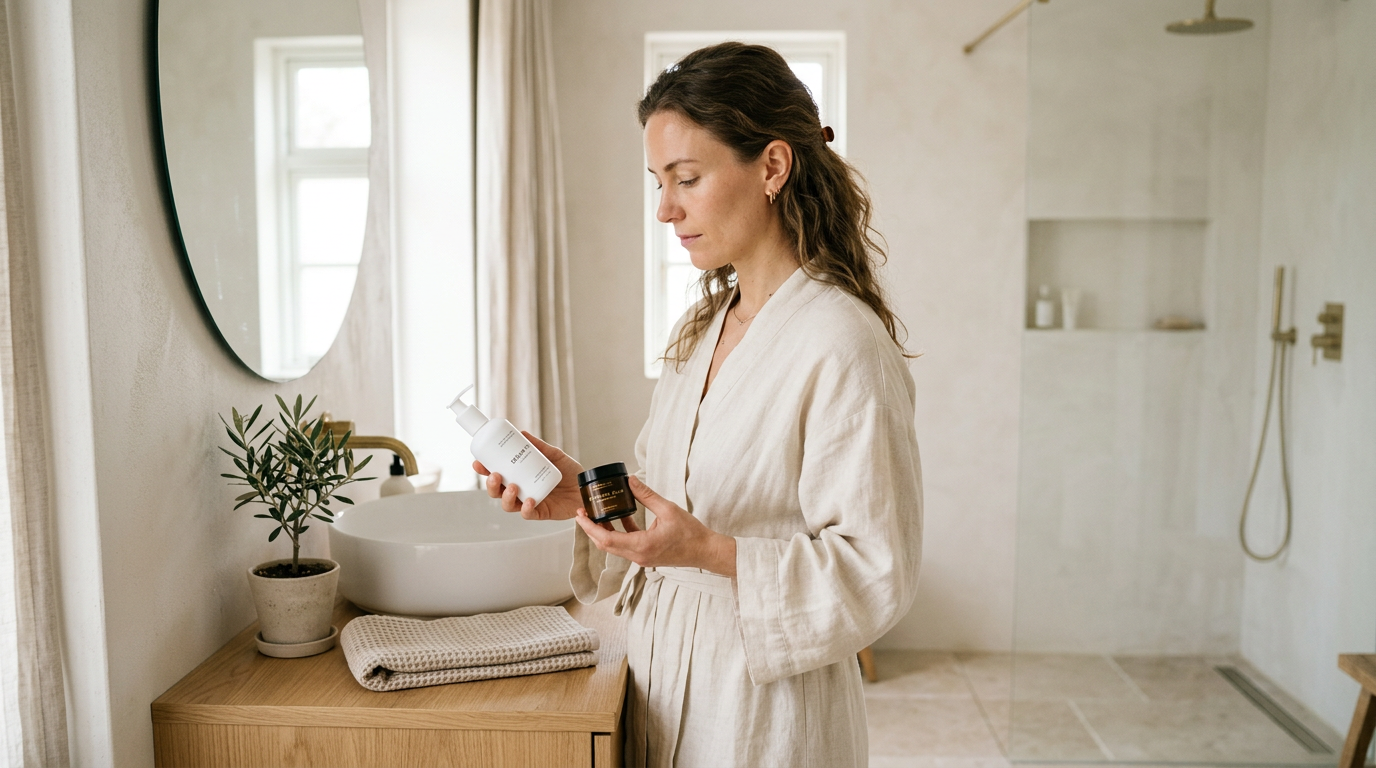
She had used the same La Roche-Posay moisturiser for six years. Her dermatologist approved it, the formula was gentle, and her skin never reacted badly. But somewhere around year four, she noticed something quietly unsettling: her skin had stopped improving. The redness that had once faded was creeping back. Her barrier felt persistently reactive. Then a colleague — someone who had abandoned pharmacy staples entirely in favour of a three-step niche routine built around microbiome support and peptide layering — walked in one morning with visibly calmer, more resilient skin. The contrast prompted a question worth examining seriously: in the debate of La Roche-Posay vs niche skincare, is one philosophy genuinely more effective, or is the answer more nuanced than either camp acknowledges?
This is not a takedown of pharmacy skincare brands. La Roche-Posay, Avène, CeraVe — these are clinically credible, broadly accessible, and for many people, genuinely effective. What this article examines is the growing divergence between the standardised, dermatologically-tested approach of mass-market pharmacy lines and the increasingly sophisticated, individualised philosophy of niche alternatives. The science is worth reading carefully.
The Rise of Barrier-First Skincare
The concept of barrier-first skincare has moved from fringe dermatology into mainstream beauty dialogue — and rightfully so. The skin barrier, composed primarily of ceramides, fatty acids, and cholesterol in a lamellar structure, is the primary interface between the body and environmental stressors. When it is compromised, sensitivity, inflammation, and accelerated ageing follow.
Pharmacy brands have long understood this. La Roche-Posay’s Cicaplast and Toleriane lines are built around ceramide replenishment and minimal irritant exposure. Yet the application is broad by design — formulated for the widest possible population. Niche skincare increasingly takes a different architectural approach: building entire routines around skin barrier repair as a primary philosophy rather than a damage-control afterthought. The distinction is subtle but meaningful in practice.
Clinical evidence supports the centrality of barrier health. Research on skin barrier function and moisturizers consistently demonstrates that ceramide-containing, lipid-rich formulas outperform single-ingredient or occlusive-only approaches for barrier restoration — and that dermatological care must account for individual skin characteristics, not just broad skin type categories.
From Pharmacy Skincare to Microbiome-Focused Beauty
Traditional pharmacy skincare brands built their reputations on reduction: reduce redness, reduce reactivity, reduce risk. It is an effective strategy for acute skin concerns, and the thermal spring water formulations that anchor brands like La Roche-Posay and Avène have genuine anti-inflammatory credentials. But the scientific conversation has shifted.
The emerging paradigm centres on the skin microbiome — the complex ecosystem of bacteria, fungi, and viruses that live on the skin’s surface and play a direct role in immune regulation, barrier integrity, and even wound healing. Supporting that ecosystem, rather than simply dampening inflammation, is at the core of what a growing number of niche brands describe as their microbiome skincare approach.
A review of the skin microbiome highlights that disrupting microbial diversity — through overly aggressive cleansing, preservative-heavy formulas, or high-frequency actives — can exacerbate conditions like eczema, rosacea, and acne. This applies to both pharmacy and niche products equally. The differentiator is not brand category; it is formulation intention.
Ingredient Philosophy: Mass Market vs Niche Beauty
The framing of “clean vs synthetic” has done considerable damage to rational skincare discourse. It is largely a marketing construct. The more meaningful distinction between pharmacy and niche skincare lies in ingredient sourcing philosophy, concentration transparency, and the degree to which brands communicate the rationale behind their formulas.
Pharmacy brands typically use well-researched, low-risk ingredient libraries — niacinamide, hyaluronic acid, panthenol, ceramides — at concentrations calibrated for broad tolerability. Niche brands often publish exact percentages, explain delivery mechanisms, and position their formulas as precision tools rather than safety nets. Whether that precision delivers measurably better outcomes depends heavily on the individual skin in question. Clean beauty transparency is one lens through which this philosophical gap becomes visible — but it is not the only one.
What neither category guarantees is universal compatibility. Clinical data on sensitive skin and cosmetic ingredients confirms that reactive skin responds to specific molecular triggers — fragrance compounds, certain preservatives, and high-concentration actives — regardless of whether the formula is dermatologist-tested or crafted by a boutique chemist. Formula tolerance, assessed on an individual basis, is a more reliable metric than any brand classification.
Are More Expensive Ingredients Actually Better?
Cost is not a reliable proxy for efficacy. Some of the most extensively researched ingredients in dermatology — niacinamide, retinol, hyaluronic acid, ceramides — are inexpensive to produce and appear in both budget pharmacy lines and premium niche products. The question of whether to invest in something more novel demands a harder look at the evidence.
Biotech actives — lab-synthesised peptides, postbiotics, encapsulated retinoids — do offer genuine functional advantages in specific scenarios:
- Precision peptides can signal collagen synthesis at lower concentrations than traditional retinoids
- Encapsulation technology improves stability and targeted delivery of actives like vitamin C and retinol
- Postbiotic fermentation extracts offer anti-inflammatory and barrier-supportive properties with good tolerability profiles
- Biosynthetic ceramides can more closely mirror the skin’s own lipid profile than plant-derived alternatives
The value proposition of premium actives is real — but it is conditional. Without a clearly identified skin concern and a structured routine, the most sophisticated ingredient stack will deliver mediocre results. Choosing the right active ingredients for your specific skin profile remains far more important than whether those ingredients carry a prestige price point.
Why Some Consumers Are Exploring Niche Skincare
Ingredient literacy has risen sharply over the last decade. Women who once deferred entirely to a dermatologist’s recommendation or a pharmacy shelf placement are now reading INCI lists, cross-referencing clinical abstracts, and building routines based on targeted action rather than brand trust alone. This shift is not superficial — it reflects a genuine evolution in how skin health is understood and managed.
As that education deepens, the appetite for niche skincare ingredients — peptides for structural support, adaptogens for stress response, fermented extracts for microbiome compatibility — grows accordingly. The search for La Roche Posay alternatives is not driven by dissatisfaction alone; it is driven by specificity. Consumers are asking more precise questions, and they are looking for brands that answer them with equal precision.
Research on personalized skincare approaches makes a compelling case that no standardised formula can optimally serve every skin type, particularly when variables such as hormonal cycles, environmental exposure, stress, and dietary patterns continuously shift skin physiology. The argument for personalised skincare is not aspirational marketing — it has clinical grounding.
Why Boutique Skincare Brands Are Growing
The niche skincare boom is not simply a reaction to pharmacy giants. It is the product of a converging set of cultural and scientific forces: direct-to-consumer distribution models that allow small brands to invest in formulation over advertising, a consumer base that can evaluate product claims independently, and a post-pandemic heightening of interest in skin health as long-term investment rather than cosmetic maintenance.
For sensitive skin consumers in particular, the appeal of carefully formulated, deliberately minimal niche ranges is practical. Many report better outcomes from niche skincare for sensitive skin — not because niche brands are inherently safer, but because smaller formulation teams are often more willing to make bold ingredient exclusions (no fragrance, no alcohol, no unnecessary emulsifiers) and more transparent about why. That reduction can make a significant difference for reactive skin types who have exhausted the standard pharmacy options.
The Psychology of the Shift: Identity, Ritual, and Brand Transparency
Efficacy alone does not explain why women are leaving trusted pharmacy skincare brands for smaller, often pricier alternatives. The shift carries a psychological dimension that is worth acknowledging without dismissing it as mere vanity.
Skincare has evolved from a clinical obligation into a form of daily ritual — a few minutes of intentional care in an otherwise fragmented day. The brands that understand this have built something beyond a customer base; they have built a community of people who find meaning in the practice itself. Best niche skincare brands tend to speak directly to this: they tell the story of an ingredient’s origin, explain the decision-making behind each formula, and position their products as expressions of a shared value system around transparency, sustainability, and skin-first philosophy.
Pharmacy skincare vs niche skincare is no longer a purely scientific question. For a growing number of consumers, it is also a question of alignment — with values, with identity, with how they want to relate to the products they use every day. That psychological dimension does not override formulation science, but it is a legitimate and increasingly dominant factor in purchasing decisions.
Pharmacy Skincare Brands vs Niche Skincare Brands: A Side-by-Side Look
| Factor | Pharmacy Skincare Brands | Niche Skincare Brands |
|---|---|---|
| Ingredient Approach | Clinically tested staples (ceramides, niacinamide, thermal water) | Biotech actives, novel peptides, microbiome-focused formulas |
| Personalization | Standardized formulas for broad skin types | Targeted routines for specific concerns and skin profiles |
| Accessibility | Widely available in pharmacies and supermarkets | Often direct-to-consumer or specialty retail |
| Scientific Testing | Dermatologist-tested, large-scale clinical trials | Emerging research, smaller studies, ingredient innovation |
| Brand Philosophy | Medical credibility, simplicity, accessibility | Identity, ritual, transparency, ingredient storytelling |
| Ideal Customer | Skin seeking proven, low-risk solutions | Skin-educated consumer seeking personalization and depth |
This comparison is not a verdict. A woman with newly diagnosed eczema, building a sensitive skin routine from scratch, may find that a pharmacy staple like Toleriane Ultra is exactly the right starting point — predictable, low-irritant, and clinically sound. The same woman, two years later, with a stable barrier and a clear sense of what her skin responds to, may find that a targeted niche serum addresses a residual concern with greater precision. The most intelligent approach treats pharmacy and niche skincare as complementary options, not opposing camps.
Myth-Busting: On “Dermatologist-Tested” and “Hypoallergenic” Claims The terms “dermatologist-tested” and “hypoallergenic” carry no standardised regulatory definition in most markets. “Dermatologist-tested” typically means a formula was assessed by one or more dermatologists — it does not specify the number of subjects, the testing protocol, or the outcome criteria. “Hypoallergenic” similarly signals reduced allergen risk, not zero risk. Neither label guarantees that a product will not trigger a reaction in a specific individual. Sensitive skin consumers should evaluate formulas by their actual ingredient lists, not by label claims alone.
Always consult with a dermatologist or healthcare professional before changing your skincare routine, particularly if you have a diagnosed skin condition.
Frequently Asked Questions
Is La Roche-Posay better than niche skincare brands?
Not categorically. La Roche-Posay excels in clinical credibility, broad tolerability, and accessibility — it is a sound choice for reactive or compromised skin that needs a predictable, low-risk baseline. Niche brands, by contrast, offer greater formulation specificity, ingredient transparency, and personalisation for skin that has already established a stable routine. The more accurate framing is not better or worse, but rather more or less suited to where your skin is right now.
Why are people switching from pharmacy skincare to boutique brands?
The primary driver is ingredient literacy. As consumers grow more confident reading INCI lists and interpreting clinical data, they begin asking more precise questions — and expecting more precise answers. Pharmacy brands are formulated for the widest possible audience, which inherently limits their specificity. Boutique brands, built around tighter ingredient stories and defined skin philosophies, speak more directly to that precision-oriented consumer. The shift is less about dissatisfaction and more about evolution.
Are expensive skincare ingredients actually more effective?
Occasionally, yes — but the relationship between price and efficacy is not linear. Novel peptides, encapsulated actives, and postbiotic complexes can deliver measurable functional advantages over standard formulations. However, some of dermatology’s most evidence-backed ingredients — niacinamide, retinol, ceramides, hyaluronic acid — are inexpensive to produce and appear in both budget and premium lines. The value lies not in the price tag, but in the concentration, delivery mechanism, and fit with your specific skin concern.
Pingback: Price vs Efficacy skincare: Does a €150 Serum Actually Outperform a €20 One - Denyva