

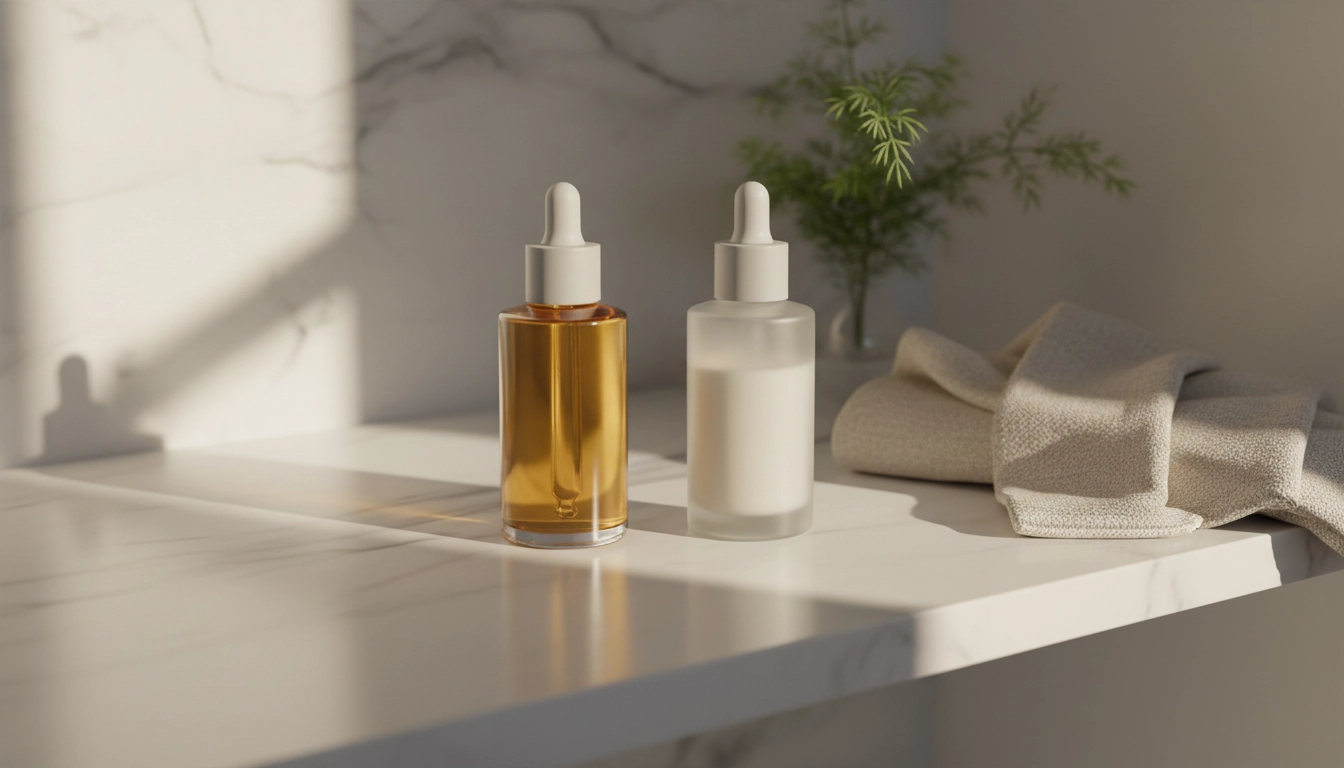
It’s Tuesday morning. You’re standing in front of the bathroom shelf, holding two small glass bottles. One promises radiance, the other calmness. The label of the first reads Vitamin C, the second Niacinamide, and somewhere between sips of coffee and the school run, you have to decide which one earns a spot in your routine. The question of niacinamide or vitamin C is one of the most common dilemmas in modern skincare, and the honest answer is more nuanced than any label suggests.
Both ingredients are dermatology favorites for a reason. They sit at the intersection of clinical evidence and everyday tolerability, which means they actually do something measurable on the skin. Still, they are not interchangeable. Choosing well means understanding what each one does and what your skin is asking for right now.

Always consult with a healthcare professional before starting new treatments.
What Vitamin C Actually Does for Your Skin
Vitamin C is, first and foremost, an antioxidant. It neutralizes free radicals generated by UV exposure, pollution, and blue light, which slows down the visible signs of environmental damage. That’s why dermatologists often pair it with sunscreen in a morning skincare routine.
It also plays a direct role in collagen synthesis. Vitamin C is a required cofactor for the enzymes prolyl and lysyl hydroxylase, which stabilize the collagen triple helix. Translation: without enough vitamin C, your skin literally cannot build firm, healthy collagen.
And then there’s the brightening effect. Vitamin C inhibits tyrosinase, the enzyme responsible for melanin production. Over weeks of consistent use, this gradually fades post-inflammatory marks, sun spots, and uneven tone. So when people ask is niacinamide or vitamin C better for dark spots, vitamin C tends to win on speed of visible brightening, especially in its pure form.
What Niacinamide Actually Does for Your Skin
Niacinamide, also known as vitamin B3, is the quiet multitasker. Its biggest strength is barrier repair. It boosts the production of ceramides, the lipids that hold your skin cells together and keep water in, which translates to less sensitivity, less redness, and a more resilient surface.
It also regulates sebum. Studies have shown that topical niacinamide at 2–5% can reduce excess oil production and visibly minimize the appearance of enlarged pores. This is why it’s a recurring answer to the question which is better for oily skin, niacinamide or vitamin C—niacinamide tends to be the more comfortable fit for shiny, congestion-prone skin.
On pigmentation, niacinamide works differently than vitamin C. Instead of blocking melanin creation, it interrupts the transfer of melanosomes from melanocytes to skin cells. The result is slower but steadier fading of discoloration, with very low irritation risk. So is niacinamide or vitamin C better for hyperpigmentation? Vitamin C is more aggressive; niacinamide is gentler and often better tolerated long-term.

Scientifically Backed Ingredients
The form of each active matters more than most marketing copy suggests.
Vitamin C: Forms That Work
- L-ascorbic acid: The most studied form. Effective between 10–20% at a pH below 3.5. Powerful, but unstable and can sting sensitive skin.
- Sodium ascorbyl phosphate (SAP) and magnesium ascorbyl phosphate (MAP): Gentler derivatives, more stable, better for reactive skin.
- Tetrahexyldecyl ascorbate (THD ascorbate): Oil-soluble, stable, and well-tolerated, though slower-acting.
Niacinamide: Simple and Stable
Pure niacinamide is remarkably stable across a wide pH range. Concentrations of 2–5% are clinically supported for barrier repair, sebum control, and pigmentation. Beyond 10%, some users report flushing or irritation without added benefit, so higher is not always better. When shopping for the best niacinamide serum, look for a clean 4–5% formulation with supporting humectants rather than a maximalist 20% bottle.
Hyaluronic Acid: The Quiet Supporter
Neither active hydrates the skin on its own. Hyaluronic acid, applied on damp skin before your serum, draws water into the upper layers and helps both vitamin C and niacinamide spread evenly and feel more comfortable. It’s a small step that makes a noticeable difference, especially if your serum doesn’t seem to be working.
Myth, Debunked: “You can’t use niacinamide and vitamin C together.”
This myth comes from a 1960s study using unstabilized raw forms at high temperatures. Modern formulations are perfectly compatible. You can layer them, or use them at different times of day. The worst that may happen with very sensitive skin is a brief, harmless flush.
What to Apply First: Niacinamide or Vitamin C
If you’re layering both in the same routine, the rule is thin to thick and acidic to neutral. Pure L-ascorbic acid needs a low pH to work, so it goes on clean, dry skin first. Niacinamide, which sits comfortably at a neutral pH, follows after.
So when people ask what to apply first, niacinamide or vitamin C, or simply niacinamide or vitamin C first—vitamin C goes first in the morning, niacinamide second, followed by moisturizer and SPF. If you prefer to separate them, vitamin C in the morning and niacinamide at night is a beautifully balanced approach.

How to Choose Based on Your Skin Type
There is no universal winner. The honest answer to which serum is best, niacinamide or vitamin C, depends entirely on what your skin needs this season.
- Dull, sun-exposed, or aging skin: Vitamin C. The brightening and collagen-supporting effects address exactly these concerns.
- Oily, acne-prone, or large-pore skin: Niacinamide. Sebum regulation and pore refinement are its strengths.
- Sensitive, reactive, or rosacea-prone skin: Niacinamide first. It calms inflammation and strengthens the barrier. Read more on managing sensitive skin before introducing vitamin C.
- Combination skin with uneven tone: Both. Morning vitamin C, evening niacinamide.
- Hyperpigmentation and dark spots: Vitamin C for faster results; niacinamide for steady, low-irritation fading. Many use both for niacinamide or vitamin C for dark spots protocols.
If you’re just getting started, slow is wise. Introduce one active at a time, give your skin two to three weeks to adjust, and pay attention. A simple, focused minimalist skincare routine almost always outperforms a cluttered one. For a fuller framework, this beginner’s guide to skincare routines is a grounded place to start.
A Final Word
Choosing between which is good, niacinamide or vitamin C, isn’t about finding a hero ingredient. It’s about listening to your skin and matching its current chapter with the right support. Vitamin C is the antioxidant that brightens and protects. Niacinamide is the gentle repairer that calms and balances. Used wisely, separately or together, they cover an enormous range of everyday skin concerns.
Skincare is rarely about doing more. It’s about doing the right things, consistently, with patience. Your skin will tell you, in its own quiet way, whether you’ve chosen well.
Frequently Asked Questions
1. Can I use niacinamide and vitamin C together every day?
Yes. Modern stabilized formulas are fully compatible. Apply vitamin C first on clean skin, then niacinamide, followed by moisturizer and SPF in the morning.
2. Which is better for dark spots: niacinamide or vitamin C?
Vitamin C usually fades dark spots faster by inhibiting melanin production, while niacinamide works more gently by blocking pigment transfer. Sensitive skin often benefits more from niacinamide.
3. Which serum is best for oily skin, niacinamide or vitamin C?
Niacinamide. It regulates sebum, refines pores, and calms breakout-related redness, making it the more comfortable choice for oily and acne-prone skin types.