

The Hidden Layer: Why Clean Ingredients Are Redefining the Luxury Lipstick
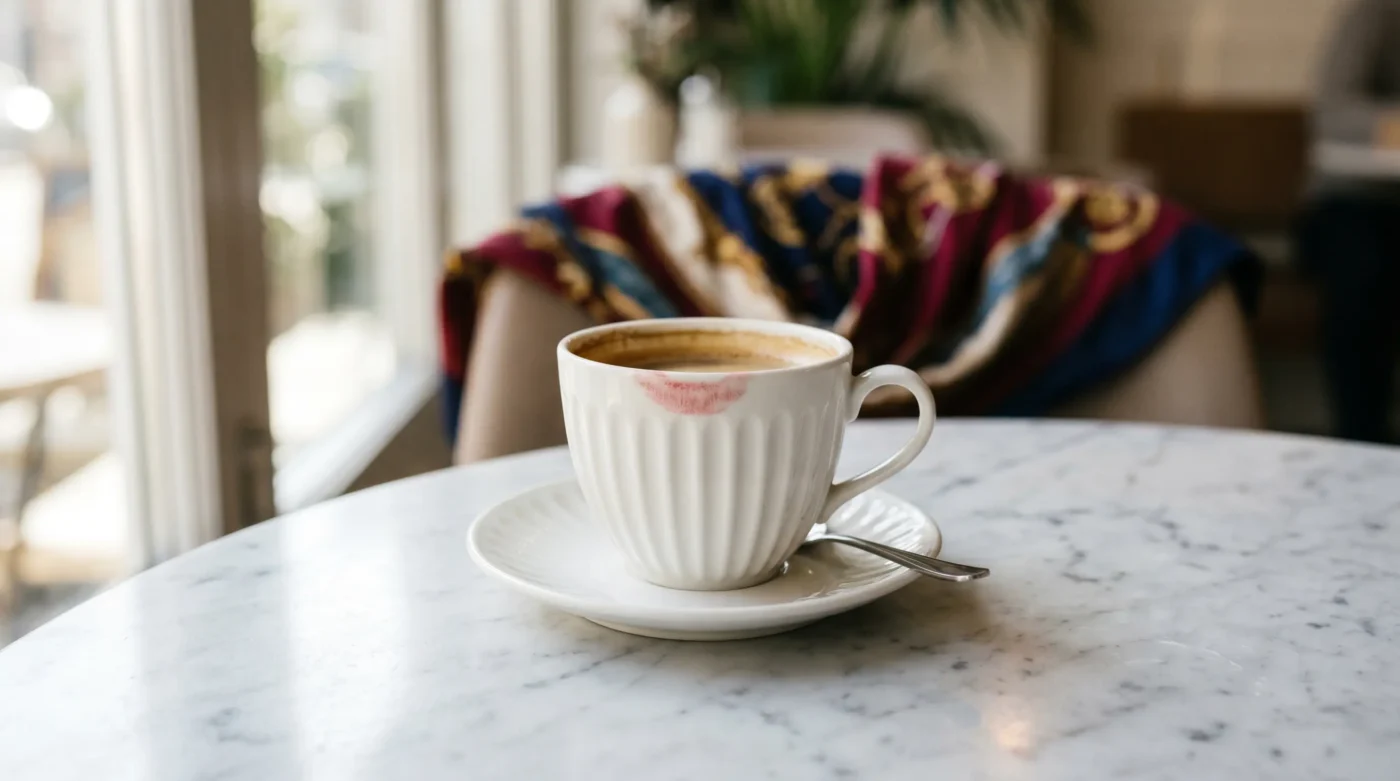
Consider the morning coffee cup. The ceramic rim, the faint imprint of colour left behind — a small, unremarkable detail that most people never think twice about. But that mark is not just pigment. It is a record of what was applied to the lips, and — given that the average person ingests between one and four milligrams of lipstick per day — a quiet reminder that what goes on the mouth does not always stay there. Clean ingredients in lip cosmetics are not a niche concern. They are a matter of daily, cumulative exposure.
This is not alarmism. It is arithmetic.
Transparency in Beauty: The New Measure of Luxury

There was a time when luxury in cosmetics was defined almost entirely by aesthetics — the weight of the bullet, the lacquer of the case, the depth of the colour. What the formula contained was considered proprietary, technical, and largely irrelevant to the consumer. That era is ending.
Transparency in beauty has become the defining quality marker of the most credible brands operating today. Not because consumers have become more demanding for its own sake, but because the information is now available — and once seen, it cannot be unseen. Full ingredient disclosure, third-party testing, and sourcing documentation are no longer exceptional. They are the baseline expectation of any brand that takes its audience seriously.
Luxury, in this context, has been quietly redefined. The most refined product is not the one with the most opulent packaging. It is the one with nothing to hide.
What Conventional Lipstick Actually Contains
The ingredient list of a conventional lipstick is, in many cases, a study in compromise. Formulas built for maximum pigment payoff and longevity have historically relied on a combination of synthetic waxes, petroleum derivatives, and — most significantly — synthetic dyes that carry their own set of concerns.
Certain synthetic dyes — particularly those derived from coal tar, such as D&C Red No. 6 or FD&C Yellow No. 5 — have been associated with allergic reactions and, in some studies, with broader systemic effects at sustained exposure levels. These are not obscure additives. They are among the most commonly used colourants in mass-market lip products.
Then there is the question of heavy metals. Independent testing conducted over the past decade — including studies by the Campaign for Safe Cosmetics and the FDA — has consistently found detectable levels of lead, cadmium, and chromium in commercially available lipsticks. These metals are not intentional ingredients; they arrive as contaminants in the raw pigment materials. But their presence is real, and their accumulation in the body over years of daily use is a legitimate area of scientific inquiry.
A lead-free lipstick is not a marketing claim. It is a formulation commitment — one that requires sourcing cleaner raw materials, accepting tighter manufacturing tolerances, and, often, a higher cost of production. Not every brand is willing to make that commitment. The ones that do are worth knowing.
The Ingredient Categories Worth Scrutinising
- Synthetic dyes (D&C and FD&C colourants): Coal tar-derived pigments with documented sensitisation potential. Look for these in the INCI list by their colour index numbers (e.g., CI 15850, CI 19140).
- Petroleum-derived waxes (paraffin, petrolatum, mineral oil): Occlusive agents that coat rather than nourish. Non-toxic in isolation, but a missed opportunity when plant-based alternatives exist.
- Synthetic fragrance: A single ingredient declaration that can represent dozens of undisclosed chemical compounds, some of which are known allergens.
- BHA and BHT: Synthetic antioxidants used as preservatives, with ongoing debate in the scientific literature regarding endocrine activity at repeated exposure.
- Heavy metal contaminants: Not listed on labels because they are not intentional — but present in many conventional pigments. Third-party testing is the only way to verify their absence.
Always consult with a healthcare professional before starting new treatments, particularly if you have known sensitivities, allergies, or concerns about specific ingredient exposures.
Scientifically Backed Ingredients: What Belongs on the Lips
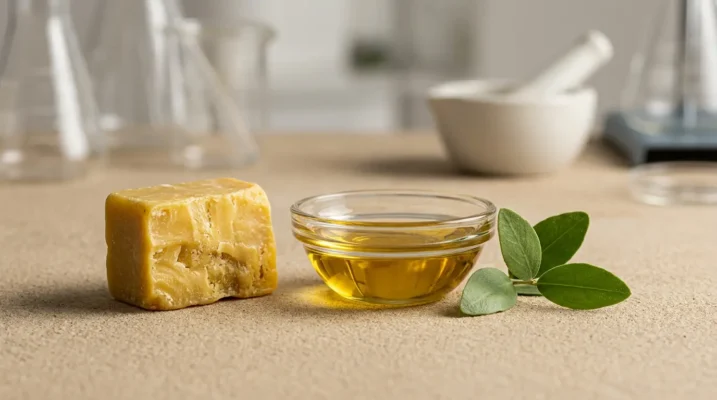
The case for clean ingredients in lip cosmetics is not simply about what to avoid. It is equally about what to include — and the dermatological science behind ingredients that actively support the lip’s delicate skin barrier.
Plant-Based Waxes (Candelilla, Carnauba, Rice Bran)
Plant-based waxes form the structural backbone of a clean lip formula. Unlike paraffin — a petroleum byproduct — botanical waxes are derived from renewable plant sources and carry a fundamentally different interaction profile with skin. Candelilla wax, sourced from a Mexican shrub, provides a firm, glossy texture without occlusion. Carnauba, from Brazilian palm leaves, offers exceptional durability. Both allow the lip’s surface to function normally while providing the slip and structure that a lipstick formula requires.
Vitamin E (Tocopherol)
Tocopherol is one of the most well-documented antioxidants in dermatological literature. Applied topically to the lips — which lack sebaceous glands and are therefore particularly vulnerable to oxidative stress and moisture loss — vitamin E performs two distinct functions: it neutralises free radicals generated by UV exposure and environmental pollution, and it supports the skin’s lipid barrier by integrating into the cell membrane structure. In a lip formula, it also acts as a natural preservative, extending the stability of plant-based oils without synthetic additives.
Natural Oils: Castor and Jojoba
Castor oil (Ricinus communis) has been used in lip cosmetics for over a century — not by accident. Its high ricinoleic acid content gives it an unusually thick, adhesive texture that helps pigment adhere to the lip surface, reducing feathering and improving longevity. It is also deeply emollient, drawing moisture to the lip’s surface. Jojoba (Simmondsia chinensis), technically a liquid wax rather than an oil, mirrors the skin’s own sebum in molecular structure — making it one of the most biocompatible ingredients available for lip care. It absorbs without residue and supports the lip barrier without disrupting its natural balance.
Plant Sterols
Less commonly discussed but dermatologically significant, plant sterols — found in shea butter, sunflower oil, and certain botanical extracts — have demonstrated measurable anti-inflammatory activity in topical applications. For the lips, which are frequently exposed to environmental stressors and prone to micro-inflammation, sterols offer a quieter but meaningful layer of protection. They support barrier repair and reduce the sensitivity that can develop with prolonged use of conventional, synthetic-heavy formulas.
Expert Tip: The Natural Pigment Longevity Myth
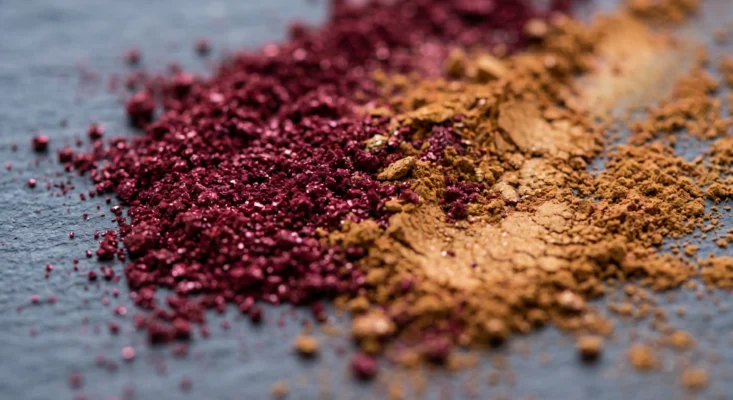
One of the most persistent assumptions in clean beauty is that natural or mineral pigments simply do not last as long as synthetic dyes. The logic seems intuitive: synthetic colourants are engineered for performance; natural ones are not. In practice, the picture is more nuanced.
The longevity of a lip colour is determined less by the pigment itself than by the formula surrounding it — specifically, the wax structure, the oil-to-wax ratio, and the adhesion agents used. A well-formulated lipstick built on castor oil and candelilla wax, with iron oxide or carmine pigments, can match the wear time of a synthetic-dye formula. The difference lies in the formulation investment, not the pigment category.
What natural pigments do not do is migrate as aggressively into fine lines around the mouth — a behaviour common in synthetic dye formulas due to their lower molecular weight and higher solubility in lip oils. In this respect, nourishing pigments derived from mineral or botanical sources often perform more elegantly over the course of a day, even if the initial payoff requires a slightly more deliberate application.
The myth, in short, is half-true. Natural pigments in a poorly constructed formula will fade quickly. In a well-constructed one, they hold — and they do so without the trade-offs.
Clean Ingredients and the Rise of Ethical Niche Brands
The most significant shift in the lip cosmetics market over the past decade has not come from the major houses. It has come from a quieter tier: small, independently owned ethical niche brands that built their formulas from the ingredient list outward, rather than from the marketing brief inward.
These brands share a set of common commitments: full INCI transparency, third-party heavy metal testing, the exclusion of synthetic dyes in favour of nourishing pigments, and sourcing practices that can be traced and verified. Many are certified by independent bodies — COSMOS, Ecocert, or the Environmental Working Group’s Verified programme — that require documentation rather than self-declaration.
What they have demonstrated, collectively, is that the trade-off between performance and integrity is largely a myth perpetuated by brands that have not invested in solving the formulation challenge. A lipstick can be deeply pigmented, long-wearing, and comfortable — and contain nothing that a thoughtful person would hesitate to ingest. These two things are not in tension. They never were.
Non-toxic cosmetics at the lip level represent one of the most straightforward areas in which to make a meaningful change to daily chemical exposure. The lips are a point of direct ingestion. The formula applied there matters more, not less, than what is applied elsewhere on the face.
FAQ: Clean Lipstick in Practice
Is lead-free lipstick genuinely safer — or is it just marketing?
The distinction is real, but it requires context. Lead is not an intentional ingredient in any lipstick formula — no brand lists it on the label. It arrives as a contaminant in the synthetic pigment raw materials, particularly in reds and pinks. The FDA has set a guidance level of 10 ppm (parts per million) for lead in lip products, but this is a guidance, not a legal limit. Brands that commit to lead-free lipstick formulations do so by sourcing higher-purity pigment materials and conducting independent testing to verify the absence of heavy metal contamination. This is a genuine formulation and sourcing commitment — not a label claim. When a brand publishes its third-party test results, that transparency is meaningful. When it simply states “lead-free” without documentation, the claim deserves scrutiny.
How do you identify toxic ingredients on a lipstick label?
The INCI (International Nomenclature of Cosmetic Ingredients) list is the starting point. A few practical markers to look for:
- Colour Index numbers beginning with CI 1xxxx or CI 4xxxx — these are typically synthetic dyes derived from coal tar or azo compounds.
- Paraffinum liquidum, petrolatum, or cera microcristallina — petroleum-derived waxes and oils.
- Parfum or fragrance — a single term that can represent an undisclosed blend of synthetic compounds.
- BHA (butylated hydroxyanisole) or BHT (butylated hydroxytoluene) — synthetic preservatives with contested safety profiles at repeated exposure.
- Propylparaben, butylparaben — longer-chain parabens with stronger evidence of endocrine activity than their shorter-chain counterparts.
Cross-referencing an ingredient list with the EWG Skin Deep database takes approximately two minutes and provides a reliable, evidence-based risk assessment for each component.
Can a clean-ingredient lipstick deliver the same colour intensity as a conventional one?
Yes — with the right formulation. The colour payoff of a lipstick is determined by pigment concentration, particle size, and the refractive properties of the base formula. Iron oxides and ultramarines — the mineral pigments most commonly used in clean formulas — are capable of producing rich, saturated colour across the full spectrum. Carmine, derived from cochineal, delivers some of the most intense reds available in any cosmetic category. The limitation is not the pigment. It is the formulator’s skill in suspending and distributing it within a plant-based wax matrix. The best ethical niche brands have solved this challenge. The result is a lipstick that performs with full intensity — and leaves nothing on the cup that one would prefer not to have consumed.
The lipstick ritual is one of the oldest in recorded human history. It deserves a formula worthy of that intimacy — one built on honesty about what it contains, and care for the person who wears it. Clean ingredients are not a restriction. They are a standard. And standards, once raised, rarely come back down.
Pingback: Clean Makeup vs Traditional Makeup: Is "Natural Beauty" Really Better for Your Skin? - Denyva
Pingback: Expired Makeup: When Is It Actually Unsafe to Keep Using? - Denyva