For years, the beauty industry has relied on unregulated buzzwords like “clean,” “eco-friendly,” and “chemical-free” to command premium prices while casting doubt on safe, synthetic ingredients. However, European regulators are shifting the rules of cosmetic marketing. Tackling greenwashing in skincare is no longer just a consumer activism issue; it is a legal requirement driven by strict EU cosmetic claims regulation. As enforcement tightens under new European directives, cosmetic brands are forced to move away from vague eco-narratives toward verifiable, scientific proof.
The Illusion of “Clean”: How Vague Claims Mislead Consumers
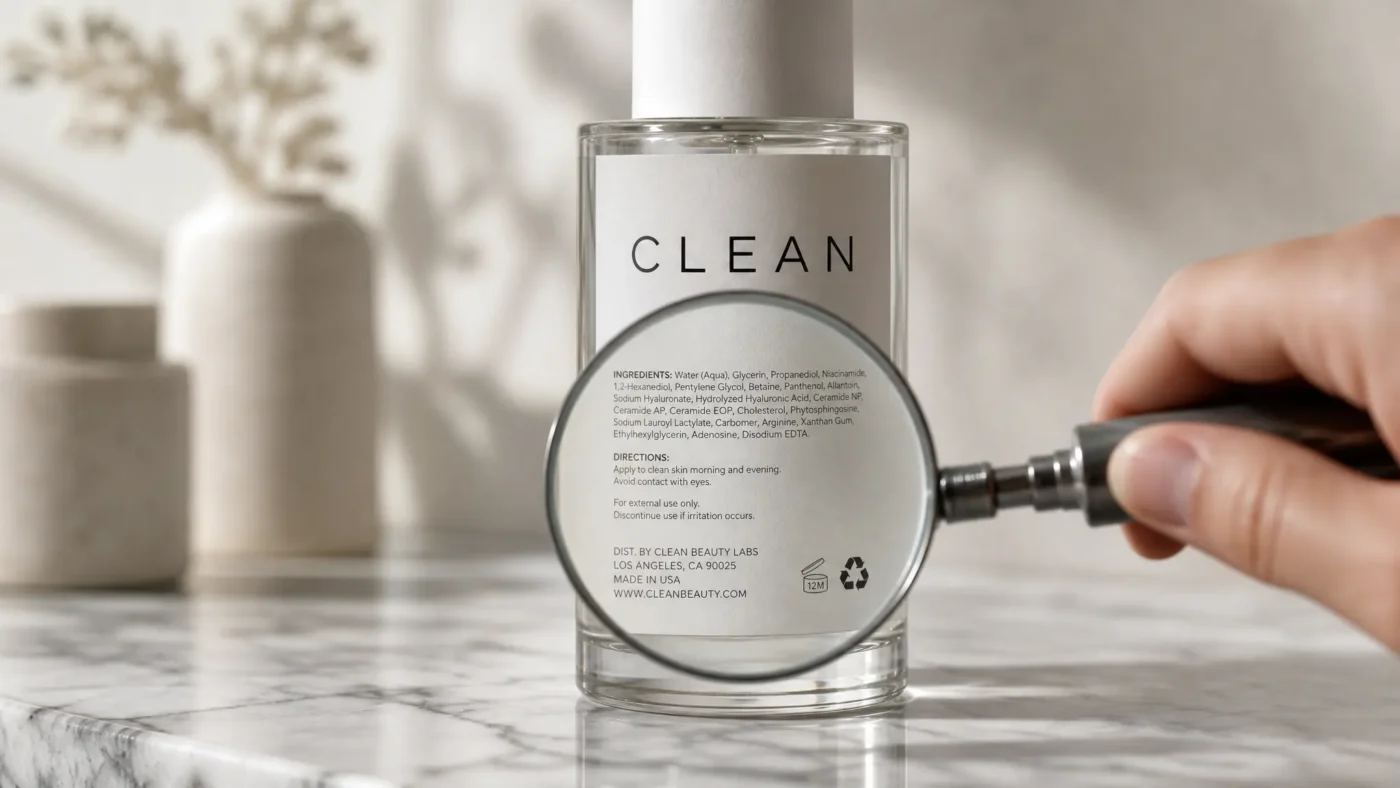
The word “clean” sounds reassuring, but it carries no standardized legal definition anywhere in EU cosmetic legislation. That absence of a fixed benchmark lets brands invent their own exclusion lists, deciding unilaterally which ingredients count as “toxic” or “pure” with no external audit required.
This vagueness exploits a well-documented cognitive shortcut. Research on consumer perception of natural versus synthetic cosmetic claims indicates that shoppers frequently equate “natural” with “safe” and “synthetic” with “harmful,” a heuristic that has little grounding in dermatological reality. Plenty of botanical extracts carry meaningfully higher allergen potential than their synthesized counterparts.
Fear-based “free-from” labeling compounds the problem. By spotlighting the absence of a legally approved ingredient, brands imply risk where regulatory science has found none. The result is a marketing category built less on formulation science and more on manufactured anxiety—clean beauty’s appeal rests on cognitive bias rather than objective safety data.
The Legal Framework: EU Regulation No 655/2013 and the Six Common Criteria
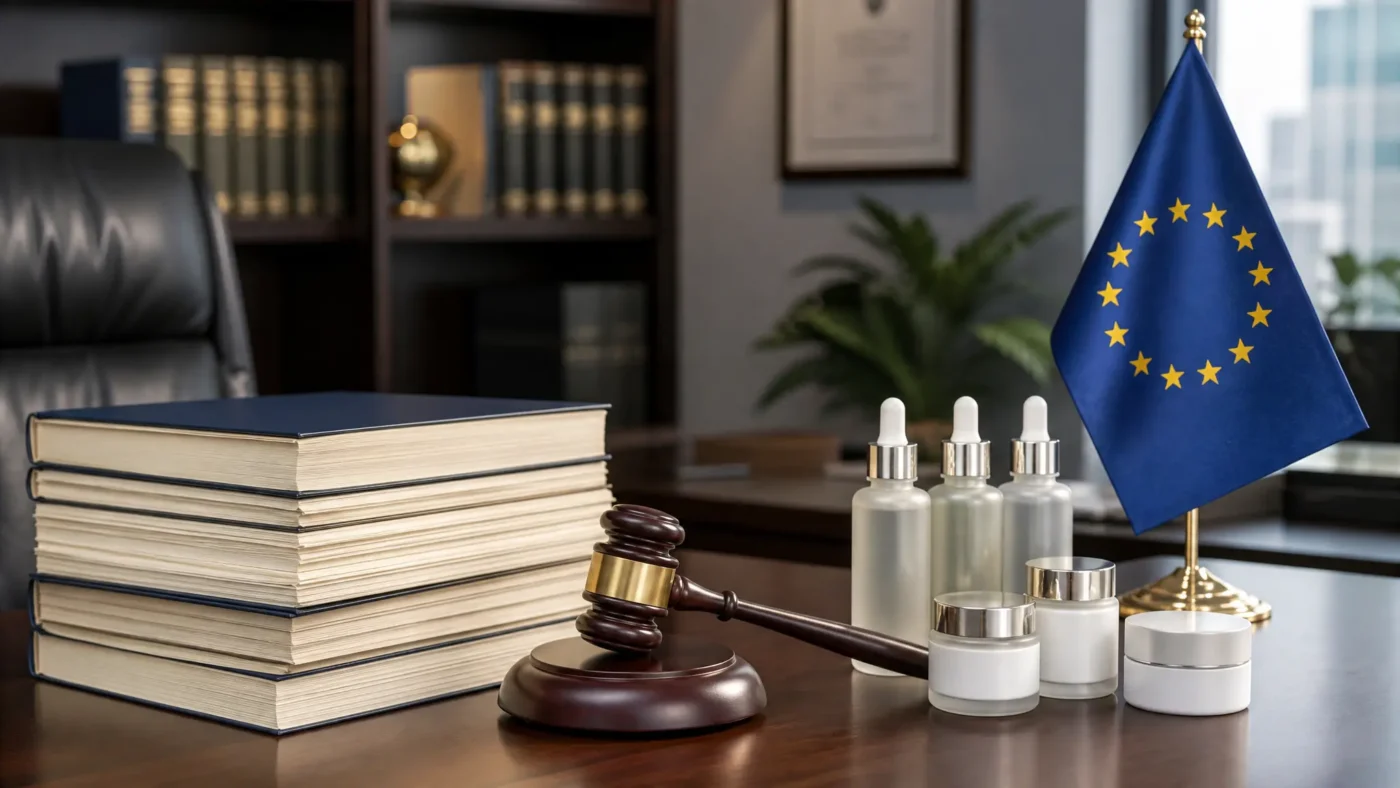
Commission Regulation (EU) No 655/2013 already lays the legal groundwork that “clean” marketing routinely skirts. It establishes six common criteria that every cosmetic claim across the EU must satisfy: legal compliance, truthfulness, evidential support, honesty, fairness, and enabling informed decision-making.
The fairness criterion is particularly relevant to greenwashing rhetoric. It explicitly prohibits denigrating legally authorized ingredients—parabens and other approved preservatives among them—purely to create a commercial advantage. A brand cannot imply a competitor’s product is dangerous simply because it contains something the regulation itself deems safe.
The evidential support criterion is arguably the sharpest tool regulators have. It mandates that any explicit or implicit claim, whether printed on packaging or implied through visual branding, must be backed by adequate and verifiable scientific evidence rather than subjective marketing speculation. Evaluating ingredient performance without relying on marketing hype is covered in Clean Makeup vs. Traditional Makeup, which unpacks how this evidentiary bar plays out in formulation choices.
The New Frontier: The EU Green Claims Directive
Where Regulation 655/2013 governs claims about safety and performance, the EU Green Claims Directive targets the environmental side of the greenwashing equation. According to a European Parliament briefing on the directive, explicit environmental claims—”biodegradable,” “climate neutral,” “eco-friendly”—must be independently verified and substantiated using life-cycle assessment methodology, not internal brand estimates.
Generic green claims made without accessible, third-party-verified evidence will be prohibited across all member states once the directive takes full effect. That closes a significant loophole: a leaf icon or a green label alone will no longer function as a de facto certification.
The directive also curtails a familiar accounting sleight of hand. Brands can no longer market a finished cosmetic product as “carbon neutral” on the strength of an unverified external offset scheme alone. Understanding ingredient safety standards, regulatory thresholds, and label claims is detailed in Clean Beauty Transparency, which explores how substantiation requirements extend into everyday labeling decisions.
The End of “Free-From” Fearmongering
Technical guidance on cosmetic claims takes direct aim at “free-from” labeling when it implies that an authorized, safe ingredient poses a health hazard. This is not a minor technicality—it strikes at the commercial logic underpinning much of clean beauty’s shelf presence.
Consider “free from preservatives” claims. Regulatory frameworks specify that this labeling is unlawful when the formula simply substitutes alternative multi-functional ingredients that perform the same antimicrobial preservation function under a different name. The product isn’t preservative-free; it is preserved differently, and the label obscures that distinction rather than clarifying it.
By restricting negative claims of this kind, regulators are steering manufacturers toward demonstrating genuine performance instead of manufacturing exclusion narratives. The practical effect is a market where brands increasingly have to prove what a product does rather than simply list what it lacks—shifting cosmetic marketing from fear-based exclusion toward objective efficacy.
How Consumers Can Navigate the New Era of Beauty Transparency
Even with tighter EU oversight, the burden of discernment still falls partly on the consumer. A few practical habits make that easier. Prioritize standardized third-party certifications such as COSMOS or the EU Ecolabel, both of which require audited supply chain verification rather than accepting a brand’s self-declared claims at face value.
Treat “free-from” lists with skepticism and instead look for evidence that a product’s actual performance claims are supported by transparent clinical testing data. A serum that documents its efficacy trial matters more than one that simply advertises what it excludes.
Reading the INCI list remains one of the more reliable habits a consumer can build. It allows a shopper to distinguish active functional components from trace botanical additions included largely for storytelling purposes. Regulatory oversight, not viral social media claims, should remain the primary reference point—evidence indicates that EU cosmetic safety standards remain among the strictest globally, which gives compliance-driven labeling far more credibility than an influencer’s endorsement.
FAQ
Is “clean beauty” officially defined under EU law?
No. The term “clean” has no official legal or regulatory definition under EU cosmetic legislation. Because it is an unstandardized marketing term, brands use it arbitrarily, which is why European regulators are cracking down on unsubstantiated “clean” and “toxin-free” claims.
Why are brands no longer allowed to put “preservative-free” on labels?
Under EU guidance, claiming “preservative-free” can be misleading if the formula uses non-traditional antimicrobial ingredients to achieve the same shelf-life effect. Furthermore, claiming a product is free from a safe, legally approved ingredient can unfairly imply that competitor products containing that ingredient are dangerous.
What is the EU Green Claims Directive?
The EU Green Claims Directive is a legislative proposal designed to eliminate greenwashing by requiring companies to back up environmental claims (like “eco-friendly” or “biodegradable”) with standardized, independently verified scientific data before presenting them to consumers.
How do EU cosmetic safety standards compare to other regions?
The EU maintains some of the strictest cosmetic safety regulations in the world. EU cosmetics law prohibits or restricts thousands of hazardous chemical substances under Regulation (EC) No 1223/2009, whereas other major markets regulate significantly fewer individual cosmetic compounds.