

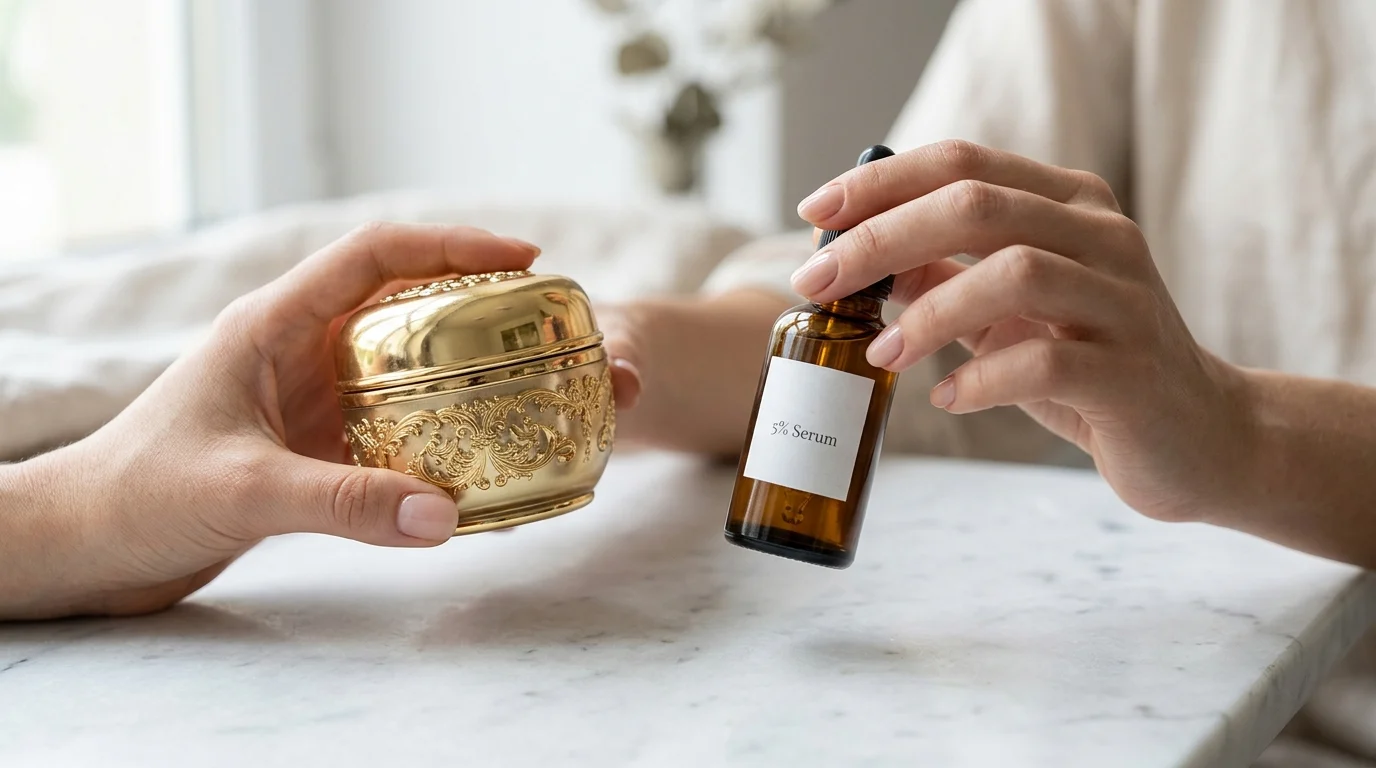
Pick up a beautifully heavy jar — gold-embossed, heritage logo, the kind that arrives in tissue paper inside a lacquered box — and turn it over. Read the first five ingredients: aqua, dimethicone, mineral oil, carbomer, parfum. Now set it down, and pick up a minimalist amber bottle from a studio you’ve never seen stocked at a department store. It lists its active load with quiet confidence: 2% bakuchiol, 4% polyglutamic acid, a precisely documented fermented lactobacillus fraction. Same price tier. Radically different intent. This is not a small distinction. Ingredient philosophy skincare — the deliberate, science-informed logic behind what goes into a formula and why — is the single most accurate predictor of whether a product will genuinely serve your skin or merely dress it for the moment. Brand scale, legacy, and advertising spend have no meaningful correlation with dermal efficacy. The formula does.
The Illusion of Scale: Why Luxury Giants Fill Jars with Fillers
Global prestige beauty operates on a specific economic logic. A brand producing millions of units annually must prioritize shelf stability over years, sensory uniformity across climate zones, and low cost-per-gram on raw materials. The result is a formulation architecture that leans heavily on silicones for slip, mineral oil for occlusion, and synthetic fragrance for brand signature — ingredients that are inexpensive at industrial scale and reliably inert in terms of reactivity.
None of this is inherently dangerous. But it is largely passive. These base formulas create a sensory illusion of nourishment without meaningful biochemical engagement with the skin. When a heritage conglomerate allocates 70–80% of a product’s retail price to packaging, celebrity contracts, and retail placement fees, the raw material budget per unit shrinks to a figure that makes high-concentration actives economically unviable.
This is where niche skincare vs luxury beauty diverges most sharply — not in aesthetics, but in financial architecture. A small independent studio with no celebrity ambassador and minimal retail overhead can redirect budget toward verified active concentrations, sustainable sourcing, and meaningful stability testing. Skincare routine minimalism is not just an aesthetic trend — it is the most honest response to a market flooded with performance theater dressed up as skincare.
The most principled formulation-led skincare brands tend to share a visible characteristic: shorter ingredient lists, percentage disclosures, and zero reliance on synthetic fragrance to build emotional recall. The product is expected to perform. That expectation is, in itself, a philosophy.
A Note on Sources: The scientific framework informing this article draws on cosmetic formulation science, dermatology research, skin barrier biology, microbiome research, cosmetic chemistry, and cosmetic preservation science. Where possible, claims reflect peer-reviewed findings published in journals such as the Journal of Cosmetic Dermatology and the International Journal of Cosmetic Science, alongside studies indexed through PubMed and NCBI. Commercial and advocacy sources are referenced where they provide accessible technical context and are used accordingly.
Sourcing, Stability, and the Science of Preservation
There is a persistent misconception in the “clean beauty” conversation: that effective skincare should be preservative-free, or that the presence of preservatives signals chemical recklessness. This is categorically false — and worth stating clearly. Any water-based formula without adequate preservation is a potential culture medium for bacteria, yeast, and mold. An unstabilized formula is not clean; it is incomplete.
The actual science of preservation is nuanced. According to a technical guide on cosmetic preservatives, the selection process involves matching preservative efficacy to formula pH, water activity, and intended use environment. Parabens, phenoxyethanol, ethylhexylglycerin, and gluconolactone all behave differently across formula types. Blanket vilification of any preservative class, without examining concentration and context, reflects marketing logic rather than cosmetic science.
Independently, safety considerations surrounding cosmetic preservatives remain a legitimate area of scrutiny — particularly for formulations targeting disrupted or sensitive skin barriers, where certain preservative combinations at elevated concentrations can exacerbate transepidermal water loss. This is where formulation literacy becomes critical: a brand that understands the interplay between preservative load and skin barrier repair will engineer a system that protects the product without taxing the skin.
Formal expertise matters enormously here. The technical foundations of cosmetic formulation span a demanding set of disciplines: stability modeling, active delivery optimization, and preservative challenge testing. These are not skills acquired through ingredient glossaries. An indie brand led by a trained cosmetic scientist is structurally different from one built on aesthetic vision alone.
These formulation principles are already being applied — with notable rigour — by several European niche studios. Nuori, for example, operates on a freshness-forward philosophy — producing in small batches with expiration windows that prioritize the potency of actives over the convenience of indefinite shelf life. Noble Panacea integrates time-release molecular architecture so that actives are delivered progressively rather than dumped onto the skin surface at full concentration in a single exposure. Both approaches reflect an acute awareness of active ingredient concentration as a variable to engineer, not simply declare.
Beyond the Hype: Restoring the Microbiome and the Skin Barrier
Skin is not a passive surface. It is a dynamic ecosystem, populated by microbial communities that help regulate immune response, maintain surface pH, and support the integrity of the skin barrier. When this balance is disrupted, skin can become reactive and sensitized — and paradoxically more vulnerable to the very actives marketed to treat it.

Microbiome skincare is one of the most scientifically grounded evolutions in modern formulation thinking. As explored in depth in the context of microbiome and bacterial skin balance, the goal is not to strip or sanitize the skin’s microbial community, but to support its diversity and resilience. Prebiotics like inulin and beta-glucan, postbiotics such as fermented lysates, and symbiotic blends — these are not marketing vocabulary. They are functional inputs with peer-reviewed mechanisms. Gallinée, a brand built entirely around this thesis, formulates each product around a lactic acid/prebiotic/probiotic complex designed to reinforce the skin’s acidic mantle and microbial balance simultaneously.
Equally, skin barrier repair has moved from marketing language to measurable clinical endpoint. Ceramides, fatty acids, and cholesterol — in physiologically relevant ratios — form the structural mortar of the stratum corneum. Niacinamide, panthenol, and certain plant-derived sphingolipids can further support this lamellar architecture, reinforcing how the epidermis manages moisture retention and resists irritant penetration. This is well-supported by barrier biology research indexed on PubMed. A brand genuinely committed to barrier health, as examined in detail through the lens of skin barrier repair and cosmetics, will include these materials at functional levels. Not as footnotes on an otherwise occlusive formula, but as the formula’s primary architecture.
This also reframes the conversation around aggressive actives. The cultural obsession with high-strength retinol, for instance, has produced a generation of chronically sensitized skin — barrier-depleted, microbiome-disrupted, and increasingly dependent on “barrier creams” to counteract the damage done by “treatment products” in the same routine. The exploration of alternatives to harsh actives is not a retreat from performance; it is a recalibration toward sustainable skin function. Bakuchiol, encapsulated retinaldehyde, azelaic acid, and polyhydroxy acids deliver meaningful cellular outcomes without the inflammatory cascade that high-dose retinoids provoke in compromised skin.
The Philosophy Spectrum: Comparing Intentional Execution
Not all philosophies are identical, and the differences between them are substantive. Understanding how distinct formulation frameworks operate reveals which approach is likely to serve a given skin profile — and why the concept of a single “best” skincare brand is inherently incoherent.
- Minimalism & Transparency — Typology publishes percentage concentrations for every active and restricts fragrance categorically. The formula is the message.
- Microbiome Focus — Gallinée anchors every product in a triple-action prebiotic-probiotic-postbiotic complex, treating the skin’s microbial community as the primary stakeholder of the formula.
- Biotech-Led Actives — Oio Lab integrates biotechnological plant-cell fractions and fermentation-derived peptides — a category that sits between classical botanical extraction and synthetic chemistry.
- Freshness-Based Stability — Nuori operates on a batch-fresh model, producing formulas in limited runs with explicit best-before windows to ensure active materials are administered at verified potency.
- Botanical Precision for Sensitive Skin — Twelve Beauty formulates exclusively for reactive skin, using cold-processed botanical fractions at carefully calibrated concentrations with zero synthetic fragrance.
- Marine Bioactives & Sustainability — Haeckels draws on sustainably sourced marine bioactives — seaweed-derived extracts and traceable coastal ingredients — anchored in a rigorous ecological formulation ethics.
- Raw Plant-Driven Essentialism — Rowse Beauty works with unrefined, minimally processed plant inputs — an approach that prioritizes bioavailability of native plant compounds over stabilized isolates.
- Artisanal Organic Performance — Evolve Organic Beauty bridges certified organic sourcing with performance-grade actives, demonstrating that organic compliance and meaningful efficacy are not mutually exclusive.
- Northern Baltic Botanicals — Mádara Cosmetics leverages the adaptive biochemistry of cold-climate plant species — where stress-activated secondary metabolites produce unusually potent antioxidant profiles.
- Peptide-Led Recovery — BioVelvet builds its formulation logic around advanced peptide science — targeting skin resilience and recovery through peptide-based signalling, rather than relying on broad-spectrum active layering.
The throughline across all of these is not size, heritage, or price point — it is indie beauty philosophy: the commitment to building around a clearly defined formulation thesis rather than market positioning. Cosmetic ingredient transparency is not just a consumer trend in this context; it is structural evidence of that commitment.
Is Big Beauty Ever Worth It? A Critical Assessment
Objectivity demands a candid answer: yes, sometimes. Certain heritage brands have invested genuinely in clinical research — particularly in the domains of photoprotection, retinoid delivery systems, and fragrance-free sensitive skin formulations. La Roche-Posay’s dermatologically validated sunscreen technology, for instance, reflects decades of UV filter research that most indie studios cannot replicate at equivalent depth. Cetaphil’s cleanser formula remains one of the most clinically validated barrier-supportive cleansers in existence — and it costs almost nothing.
The distinction worth drawing is between corporate scale as infrastructure versus corporate scale as substitution for formulation intent. Where large brands have invested real R&D budget — not just marketing budget — the results are often defensible. Augustinus Bader, though premium-priced, is built around a genuinely proprietary cellular renewal platform developed from Professor Bader’s clinical burn treatment research. The cost reflects the science.
But these are exceptions. The dominant pattern in mass prestige skincare is a heavily fragranced, silicone-forward formula retailing at luxury pricing on the strength of heritage narrative and aspirational campaign imagery. For the consumer managing hormonal skin fluctuations, supporting skin longevity and pro-aging goals, or simply trying to rebuild barrier function without further provocation — a small-batch, formulation-first studio often offers stronger value per active milligram.
The demand for clean label transparency is not anti-science populism. It is a rational market response to decades in which ingredient lists were deliberately obscured behind proprietary complex names, and where INCI nomenclature was treated as a technicality rather than a consumer right. Transparency is now a formulation differentiator — and the brands most reluctant to provide it tend to have the most to conceal.
⬛ Myth to Discard A higher price tag in skincare almost never reflects the cost of active raw materials. It reflects the cost of shelf space, celebrity contracts, luxury packaging, and decades of brand equity maintenance. A 50ml jar retailing at €200 from a global prestige house may contain fewer biologically active milligrams per gram than a €38 serum from a formulation-led studio with a two-paragraph website. Read the label. The formula doesn’t lie.
⚠️ Safety Note: Always patch test new skincare products regardless of brand tier, and consult a dermatologist if you have a diagnosed skin condition before introducing new active ingredients into your routine.
Frequently Asked Questions
Does brand size indicate better formulation quality?
No. Brand scale reflects production volume, distribution capability, and marketing infrastructure — none of which are proxies for active ingredient quality or concentration. Many large prestige brands allocate the majority of a product’s retail cost to non-formulation expenses. A smaller, independent brand with a formulation-first mandate routinely outperforms on active ingredient density simply because its economics allow it to.
How do I verify active ingredient concentrations in a skincare product?
Ingredients are listed in descending order of concentration on INCI labels, which gives a rough sequence — but not precise percentages. Brands with genuine transparency commitments will voluntarily disclose active percentages on packaging or product pages. If a brand lists a hyped active like niacinamide or bakuchiol in the final third of an ingredient list, sandwiched between preservatives, the concentration is likely cosmetically insignificant. Ask. A confident brand with a strong formulation philosophy will answer clearly.
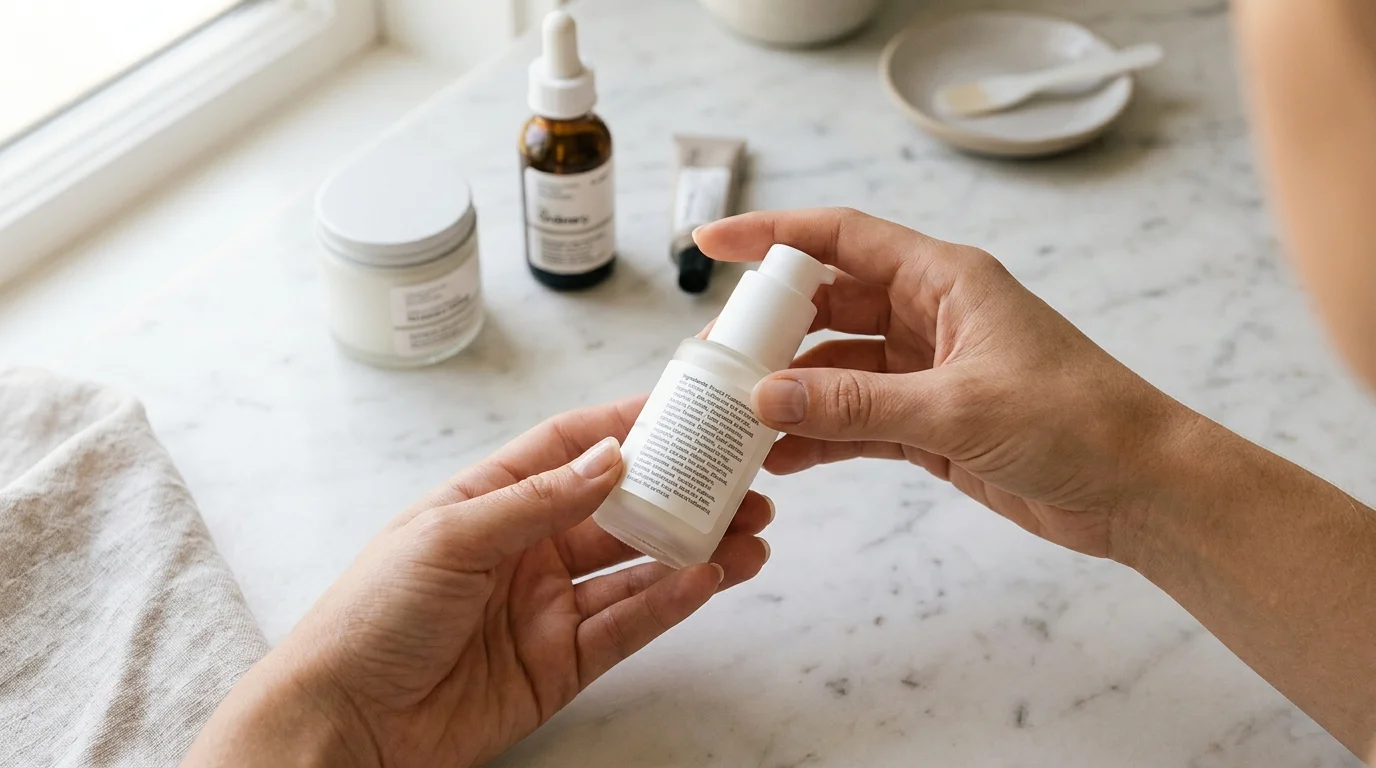
What is the most useful thing to look for when reading a skincare ingredient list critically?
First, note the position of water and primary emollients — these determine base formula architecture. Second, identify where the claimed hero actives appear relative to preservatives (typically in the lower 1–2% range of a formula). Third, note the presence of synthetic fragrance or “parfum.” Many people tolerate fragrance without any issue — but for sensitive or barrier-compromised skin, it may increase the risk of irritation or low-grade sensitization over time. Its inclusion is worth flagging regardless of brand tier. These three checks take under thirty seconds and will tell you more about a product’s actual intent than any campaign imagery.